Transcription of Dose Escalation Study Design Example Record
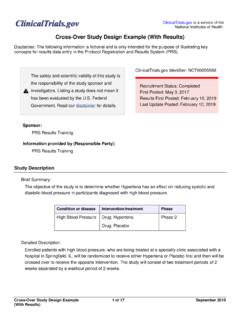
1 Is a service of the National Institutes of Health. dose Escalation Study Design Example 1 of 22 September 2019 (With Results) dose Escalation Study Design Example (With Results) Disclaimer: The following information is fictional and is only intended for the purpose of illustrating key concepts for results data entry in the Protocol Registration and Results System (PRS). The safety and scientific validity of this Study is the responsibility of the Study sponsor and investigators. Listing a Study does not mean it has been evaluated by the Federal Government. Read our disclaimer for details. ! Identifier: NCT00055581 Recruitment Status: Completed First Posted: January 2, 2018 Results First Posted: July 31, 2019 Last Update Posted: July 31, 2019 Sponsor: PRS Results Training Information provided by (Responsible Party): PRS Results Training Study Description Brief Summary: The primary aim of the Study is to establish the maximum-tolerated dose (MTD) of Ender-G in participants with cancer.
2 The secondary aims are to describe the pharmacokinetics of Ender-G and the toxic effects of Ender-G in participants with cancer. Condition or disease Intervention/treatment Phase Cancer Drug: Ender-G Phase 1 Detailed Description: This Study will enroll patients with various cancer types from a single academic medical center in the United States. All participants will be informed about the Study and potential risks and required to provide written informed consent prior to undergoing Study -related procedures. A traditional 3 + 3 dose Escalation Design will be implemented. Successive cohorts of patients (3 participants/cohort) will each be started on a fixed dose of Ender-G. The protocol specifies is a service of the National Institutes of Health. dose Escalation Study Design Example 2 of 22 September 2019 (With Results) 100 mg/m^2, via intravenous catheter (IV), twice a day for 4 weeks for the first cohort.
3 Successive cohorts will be given doses of 125 and 150 mg/m^2 twice a day. dose Escalation will continue until the maximum-tolerated dose (MTD), defined as one dose level below the dose in which dose -limiting toxicities (DLTs) are observed in >33% of the participants ( , in at least 2 participants in a cohort of 3 or in at least 3 participants in a cohort of 6). If no DLTs are observed for 4 weeks after administration of the last dose of Ender-G, a new cohort will be enrolled at the next planned dose level. If DLTs are observed in 2 of the three participants, the MTD will be determined to be the dose administered to the previous cohort. If DLTs are observed in one participant in the cohort, another three participants will be treated with the same dose level. In that case, 3 of the 6 participants would have to experience DLTs to determine the MTD.
4 Toxicities will be graded using the Common Terminology Criteria for Adverse Events Version (CTCAE ). If the CTCAE does not apply to an adverse event, it will be graded as mild, moderate, or severe. DLT is defined as any Ender-G-related CTCAE grade 3 or 4 adverse event. Health status assessments, including physical exams, complete blood chemistry, and urinalysis will be conducted at weeks 1, 2, 4, and 8. The protocol and informed consent documents have been reviewed and approved by the hospital human subjects review board and the Study will be performed in accordance with the Declaration of Helsinki. Study Design \ Study Type: Interventional Actual Enrollment: 15 participants Allocation: Non-Randomized Intervention Model: Sequential Assignment Masking: None (Open Label) Primary Purpose: Treatment Official Title: A Phase 1 Clinical Trial of Ender-G in Adults With Cancer Actual Study Start Date: January 2, 2018 Actual Primary Completion Date: August 29, 2018 Actual Study Completion Date: August 29, 2018 is a service of the National Institutes of Health.
5 dose Escalation Study Design Example 3 of 22 September 2019 (With Results) Arms and Interventions Arm Intervention/treatment Experimental: Ender-G 100 mg/m^2 Cohort 1: Participants were administered 100 mg/m^2 of Ender-G twice a day, via intravenous catheter (IV), for 4 weeks, with 4 weeks of follow-up after the last dose was administered. Drug: Ender-G 100 mg/m^2 intravenous solution Experimental: Ender-G 125 mg/m^2 Cohort 2: Participants were administered 125 mg/m^2 of Ender-G twice a day, via intravenous catheter (IV), for 4 weeks, with 4 weeks of follow-up after the last dose was administered. Drug: Ender-G 125 mg/m^2 intravenous solution Experimental: Ender-G 150 mg/m^2 Cohort 3: Participants were administered 150 mg/m^2 of Ender-G twice a day, via intravenous catheter (IV), for 4 weeks, with 4 weeks of follow-up after the last dose was administered.
6 Drug: Ender-G 150 mg/m^2 intravenous solution Outcome Measures Primary Outcome Measures: 1. Maximum Tolerated dose (MTD) of Ender-G [ Time Frame: Up to 8 weeks for each dosing cohort ] MTD was determined by testing increasing doses up to 150 mg/m^2 twice a day via IV on dose Escalation cohorts 1 to 3 with 3 to 6 participants each. MTD reflects the highest dose of drug that did not cause a dose -Limiting Toxicity (DLT) in > 33% of participants. DLTs were defined as any Ender-G-related Common Terminology Criteria for Adverse Events Version (CTCAE ) Grade 3 or 4 adverse events (reported in the subsequent Primary Outcome Measure). 2. Number of Participants Who Experienced dose -Limiting Toxicities (DLTs) [ Time Frame: Up to 8 weeks for each dosing cohort ] A DLT was any Grade 3 or 4 adverse event (AE) using the Common Terminology Criteria for Adverse Events Version (CTCAE ) that was possibly Ender-G-related.
7 CTCAE Grade 3 is a severe AE and Grade 4 is a life-threatening or disabling AE. ( , skin toxicity, diarrhea or antidiarrheal therapy, vomiting at same grade for >4 days despite aggressive antiemetic therapy, central nervous system, lung or renal toxicity or elevation of liver transaminases or bilirubin lasting more than 1 week) is a service of the National Institutes of Health. dose Escalation Study Design Example 4 of 22 September 2019 (With Results) DLTs were collected to determine the Maximum-Tolerated dose (MTD), which is defined as the dose level below the dose at which > 33% of participants experienced a DLT. Secondary Outcome Measures: 1. Maximum Observed Plasma Concentration of Ender-G (Cmax) [ Time Frame: prior to the initial dose on day 1 and , , , 1, 2, 3, 4, 5, 6, 7, 8, 16, 24, 36, 48 and 72 hours post- dose ] Blood samples were obtained and plasma concentrations were determined using a validated high-pressure liquid chromatography method.
8 2. Time to Maximum Observed Plasma Concentration of Ender-G (Tmax) [ Time Frame: prior to the initial dose on day 1 and , , , 1, 2, 3, 4, 5, 6, 7, 8, 16, 24, 36, 48 and 72 hours post- dose ] Blood samples were obtained and plasma concentrations were determined using a validated high-pressure liquid chromatography method. 3. Area Under the Concentration-Time Curve (AUC 0-72h) [ Time Frame: prior to the initial dose on day 1 and , , , 1, 2, 3, 4, 5, 6, 7, 8, 16, 24, 36, 48 and 72 hours post- dose ] Blood samples were obtained and plasma concentrations were determined using a validated high-pressure liquid chromatography method. 4. The Number of Participants Who Experienced Serious or Non-Serious Adverse Events [ Time Frame: Up to 8 weeks for each dosing cohort ] A non-serious adverse event is any untoward medical occurrence.
9 A serious adverse event is any adverse event that meets one or more of the following: results in death; is life-threatening; requires inpatient hospitalization or prolongation of existing hospitalization; results in persistent or significant disability/incapacity; is a congenital anomaly/birth defect; requires intervention to prevent permanent impairment or damage. Specific Adverse Event terms are provided in the Adverse Event module. Eligibility Criteria Ages Eligible for Study : 21 Years and older (Adult, Older Adult) Sexes Eligible for Study : Both Accepts Healthy Volunteers: No Criteria Inclusion Criteria: Clinically confirmed cancer is a service of the National Institutes of Health. dose Escalation Study Design Example 5 of 22 September 2019 (With Results) A World Health Organization (WHO) performance status < 3 Exclusion Criteria: Receiving enzyme-inducing anticonvulsants, steroids, or other experimental drugs History of migraines Clinically significant electrocardiogram (ECG) abnormalities White blood cell (WBC) count 2,000/mm^3 Contacts and Locations Locations United States, Maryland NIH Bethesda, Maryland, United States, 20892 Study Documents (Full-Text) Documents provided by PRS Results Training Study Protocol and Statistical Analysis Plan [PDF] August 30, 2017 More Information Responsible Party: PRS Results Training Identifier: NCT00055581 Other Study ID Numbers: TTTDoseEscalationR First Posted: January 2, 2018 Results First Posted.
10 July 31, 2019 Last Update Posted: July 31, 2019 Last Verified: July 2019 Human Subjects Protection Review Board Status: Approved Studies a FDA-regulated Drug Product: Yes Studies a FDA-regulated Device Product: No is a service of the National Institutes of Health. dose Escalation Study Design Example 6 of 22 September 2019 (With Results) Study Results Study Type Interventional Study Design Allocation: Non-Randomized; Intervention Model: Sequential Assignment; Masking: None (Open Label); Primary Purpose: Treatment Condition Cancer Interventions Drug: Ender-G Enrollment 15 Participant Flow Recruitment Details Pre-assignment Details Arm/Group Title Ender-G 100 mg/m^2 Ender-G 125 mg/m^2 Ender-G 150 mg/m^2 Arm/Group Description Cohort 1: Participants were administered 100 mg/m^2 of Ender-G twice a day, via intravenous catheter (IV), for 4 weeks, with 4 weeks of follow-up after the last dose was administered.