Transcription of Drama - Curriculum
1 arts EducationDramaPrimary SchoolCurriculumCuraclam naBunscoileD U B L I NPUBLISHED BY THE STAT I O N E RY OFFICETo be purc h ased dire c t ly from theG OVERNMENT PUBLICATIONS SALE OFFICESUN ALLIANCE HOUSEM O L E S WO RTH ST R E E TDUBLIN 2or by mail order fro mG OVERNMENT PUBLICAT I O N SP O STAL TRADE SECTION4-5 HARC O U RT ROA DDUBLIN 2( Tel: 01 - 6476834-5; Fax: 01 - 4752760 )or through any booksellerD esign Consulta n cy :B ra d l ey McGurk Pa rt n e rs h i pD esigned by :The Identity Busines sTy p es e tt i n g :Spectrum Print ManagementP r i n ted by :Mozzon Giuntina - Florence andOfficine Grafiche De Agostini - Nova ra 1999 Government of Ire l a n dDramaArts EducationCurriculumC o n te n tsIntroductionArts education2 The arts education curriculum2 Aims4 Drama5 Aims8 Broad objectives9 Infant classesOverview13 Content 14 First and second classesOverview19 Content 20 Drama CurriculumThird and fourth classesOverview25 Content 26 Fifth and sixth classesOverview33 Content 34 AssessmentAssessment42 AppendixGlossary50 Membership of the Curriculum Committee for arts Education 52 Membership of the PrimaryCo-ordinating Committee 53 IntroductionThe arts are organised expressions of ideas, feelings and experiences ini m a g es, in music, in language, in ges t u reand in movement.
2 They providefor sensory, emotional, intellectual and creative enrichment andcontribute to the child s holistic development. Much of what is finest insociety is developed through a variety of art forms which contribute tocultural ethos and to a sense of education enables the child to explore alternative ways of communi-cating with others. It encourages ideas that are personal and inventiveand makes a vital contribution to the d evelopment of a range ofi n te l l i g e n c es .A purposeful arts education at primary level is life-enhancing and is invaluable in stimulating creative thinking and inpromoting capability and adaptability. It emphasises the creative processand so ensures that the child s work is personal and has quality. Attemptsat a rtistic ex p ression are valued, self- es te e mis enhanced, sponta n e i ty andr i s k- ta k i n gareencouraged, and difference is celebrated. It is this affirmingaspect of the creative arts that makesp a rticipation such a positiveex p e r i e n c e.
3 arts education is integral to primary education in helping topromote thinking, imagination and sensitivity, and arts activities may be afocus for social and cultural development and enjoyment in education encompasses a range of activities in the visual arts , inmusic, in d rama, in dance and in lite ra t u re. Thes eactivities andexperiences help the child to make sense of the world; to question, tospeculate and to find solutions; to deal with feelings and to respond tocreative arts education curriculumThe arts education Curriculum prov i d esfor a balance between expressionand the child s need to experience and respond to the visual arts , tomusic and to Drama . Dance is outlined within the physical educationcurriculum, and the contribution that literature makes to the emotionaland imaginative development of the child is described within thelanguage visual arts Curriculum comprises interrelated activities in making artand in looking at and responding to art.
4 It presents a range of activities inperceiving, exploring, responding to and appreciating the visual involves looking with awareness and understanding of thevisual elements and their interplay in the environment and in art education2 This awareness is fundamental to the development of visual expressionand to the child s personal response toc re a t i ve experience. Making arti nvo lves two and three-dimensional work in a range of media. Appreciating promotes understanding of the qualities inherent in artworks and aesthetic enjoyment. In developing the pro g ramme, theex p res s i ve or makinga c t i v i t i es are balanced with opport u n i t i es to see and tomake a personal response to visual art forms of different styles, periodsand cultures. Regional craft traditions and their modern developments, aspart of the national heritage, are among those art music Curriculum compriseslistening and responding, performing andcomposing activities.
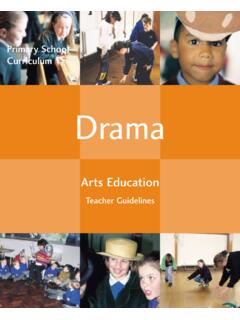
5 Focused listening is emphasised, both for its sheerenjoyment potential and for its essential role in composing andperforming. The child is encouraged to listen with attention to sounds inthe environment and to become gradually aware of how sound isorganised in music. Performance incorporates a balance of singing andinstrumental playing of his/her own work and the work of others. Ways ofusing sound are explored in composing, both with the voice and with awidening range of musical instruments. In the deve l o p m e n tof theprogramme, performance is balanced with opportunities to hear and tomake a personal response to music of different styles, periods andcultures, including the national repertoire in its varied national andregional forms. Interrelated activities for listening, performing andc o m p o s i n ga re sugges ted in the Curriculum conte n t .The Drama Curriculum comprises interrelated activities which explorefeelings, knowledge and ideas, leading to understanding.
6 It exploresthemes and issues, creates a safe context in which to do so, and providesfor opportunities to reflect on the insights gained in the process. It drawson the knowledge, interests and enthusiasm of the child. In Drama , thechild explores the motivations and the relationships between people thatexist in a real, imagined or historical context, to help him/her understandthe world. The child is encouraged tom a ke decisions and to ta keres p o n s i b i l i ty for those decisions within the safe contex tof the provides the child with opportunities to organise and develophis/her natural enjoyment of expressive movement in dance h rough dance, the child is encoura g e dto ex p l o re and experiment with ava r i e ty of body move m e n ts and to commu n i c a tea range of moods andfeelings. The dance programme comprises activities in the exploration,3 Drama Curriculumcreation and performance of dance and in deve l o p i n gunderstanding ofdance literature, the child is guided to explore the world of theimagination and to discover how language brings it to life.
7 Expressivelanguage, both oral and written, is foste red for its enjoyment value and tohelp develop aesthetic aims of arts education are to enable the child to explore, clarify and express ideas, feelings andexperiences through a range of arts activities to provide for aesthetic experiences and to develop aesthetic awarenessin the visual arts , in music, in Drama , in dance and in literature to develop the child s awareness of, sensitivity to and enjoyment ofvisual, aural, tactile and spatial environments to enable the child to develop natural abilities and potential to acquiretechniques, and to practise the skills necessary for creative ex p res s i o nand for joyful part i c i p a t i o nin different art forms to enable the child to see and to solve problems creatively throughi m a g i n a t i ve thinking and so encoura g eindividuality and enterprise to value the child s confidence and self-esteem through valuing self-expression to foster a sense of excellence in and appreciation of the arts in local,regional, national and global contex ts ,both past and present to foster a critical appreciation of the arts for personal fulfilment are strong elements of make-believe in all children s play.
8 Thismake-believe helps the child to test out his/her hypotheses about whatthe world is like and how it might feel to have certain experiences. It isfuelled by inquisitiveness and a desire to think about possibilities andc o n c e p ts thro u g hthe medium of action. The process by which this isdone is the same process as that by which Drama is made for all levelsand ages. The primary task of the teacher of Drama , there f o re, is top res e r veand encourage this desire to make-b e l i eve while at the same timeex te n d i n git to other areas of life and knowledge. In this way Drama canassist in the fulfilment of the child s current cognitiveand affective needsand in providing for his/her future personal, social, emotional andi n tellectual deve l o p m e n t .We meet Drama most frequently in the theatre, on television or in thecinema, and we as s o c i a te it with performance, costumes ,setting andstages. Similarly, in school we often associate Drama with script, rehearsal,voice production and the display of acting talent.
9 This type of Drama hascertain benefits in that it increases children s self-confidence, gives themthe opportunity to express themselves in public and allows them theopportunity of appearing on stage. However, it represents only a part ofthe rich learning and developmental experience that Drama has to Curriculum will not dwell on the d i s p l ay element of Drama but will,ra t h e r,emphasise the benefits to be gained f rom the pro c ess of ex p l o r i n glife thro u g hthe creation of plot, theme, fiction and make-believe. Dramaused in this way is called classroom Drama or process field that Drama can explore is as wide as life itself, and the areas ofthe exploration can be derived from the content of other curricula orfrom any other aspect of life that interests and concerns the children orthe teacher. Examining these topics through Drama will invo lve children insuch activities as the spontaneous making of Drama s c e n es (sometimes calledi m p rov i s a t i o n )
10 Entering into other lives and situations engaging with life issues, knowledge and themes through Drama honing and shaping Drama scenes for the purpose of communicatingthem to othersDrama5 Drama Curriculum living through a story, making it up as they go along, solving problemsin the real and fictional worlds, co-operating with others, and poolingideas thinking about and discussing the patterns in life so that the outcomeof encounters and plots will reflect their perception of how life is ormight of this can take place at a level suitable to the age of the complex the material may seem, the child, at any level, will findhis/her own understanding and ways of dealing with Drama is a holistic activity it is difficult to separa te the form fro mthe content, the affectivef rom the cognitive, the social deve l o p m e n tfromthe personal. Nevertheless, it can be said that its educational outcomesderive from two sources: the knowledge and insights gained from bringing the child s experienceto bear on the examination of a p a rticular aspect of life through dra m a the personal skills, social skills and Drama skills that must beencouraged if the class is to enter effectively into and create the worldof the skills are as natural to the younger child as playing and need onlycareful support and nurturing to extend them into continuing to serve thec h i l d s education.