Transcription of DRUG NAME: Paclitaxel
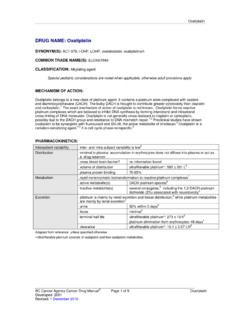
1 Paclitaxel DRUG NAME: Paclitaxel SYNONYM(S): benzenepropanoic acid1 COMMON TRADE NAME(S): TAXOL , ONXOL CLASSIFICATION: antimicrotubule agent Special pediatric considerations are noted when applicable, otherwise adult provisions apply. MECHANISM OF ACTION: Paclitaxel is a taxane. Paclitaxel binds to tubulin, the protein component of microtubules, simultaneously promoting their assembly and disassembly to form stable, nonfunctional ,2 Although some reports indicate a cross-reactivity rate of 90% between docetaxel and Paclitaxel , others suggest it does not occur ,3 Stabilization of microtubules blocks cells in the M phase of the cell cycle, inhibiting cell division and causing cell Paclitaxel acts as a radiosensitizing agent by blocking cells in the Paclitaxel is an ,6 PHARMACOKINETICS: Oral Absorption no information found Distribution biphasic: initial distribution to peripheral compartment, then slow efflux from the peripheral compartment; widely distributed into body fluids and tissues1,7; small changes in dose may lead to large changes in peak plasma concentrations and total drug exposure due to saturable, nonlinear pharmacokinetics2 cross blood brain barrier?
2 2,8 no volume of distribution1,2,5,6 67 L/m for 1-6 h infusion; varies with dose and infusion time; 198-688 L/m for 24 h infusion plasma protein binding1,2,5 88-98% Metabolism extensively metabolized in liver via CYP 2C8 (primarily) and CYP 3A4; activity of metabolites is unknown1,2,7 metabolite(s)2,4,9 67% as 6 -hydroxypaclitaxel via CYP 2C8; 37% as 3-p-hydroxypaclitaxel and 6 ,3-p-dihydroxypaclitaxel via CYP 3A4 Excretion primarily via bile1,2,5,7,8 urine 14% (1-13% as unchanged drug) feces 71% (5% as unchanged drug) terminal half life1,2,6,7 10 h; varies with dose and infusion time clearance1,2,7 12 L/h/m ; varies with dose and infusion time Children2 clearance: 19 to 260 L/m Adapted from standard reference7 unless specified otherwise. USES: Primary uses: Other uses: *Breast cancer Lung cancer, small cell2 *Lung cancer, non-small cell Esophageal cancer2 *Ovarian cancer Bladder cancer2 *Kaposi s Sarcoma Head and Neck cancer2 Cervical cancer2 Endometrial cancer2 *Health Canada approved indication BC Cancer Drug Manual Page 1 of 10 Paclitaxel Developed: 1 June 2012 Revised: 1 February 2018 Paclitaxel SPECIAL PRECAUTIONS: Caution: Preexisting liver impairment may impair elimination of paclitaxel1,7; dose reduction is suggested2,9; see Dosage Guidelines.
3 Special populations: Elderly patients may have more myelosuppression, neuropathy and cardiovascular toxicities2 Patients with AIDS-related Kaposi s sarcoma may have more hematologic toxicities, infections and febrile Carcinogenicity: no information found Mutagenicity: Not mutagenic in Ames test and mammalian in vitro mutation test. Paclitaxel is clastogenic in human lymphocytes in vitro but not in other mammalian in vivo chromosome ,2,7 Fertility: In animal studies, reduced fertility has been observed, with decreased pregnancy rates and increased embryo loss in females and testicular atrophy/degeneration in ,2 Pregnancy: FDA Pregnancy Category ,10 There is positive evidence of human fetal risk, but the benefits from use in pregnant women may be acceptable despite the risk ( , if the drug is needed in a life-threatening situation or for a serious disease for which safer drugs cannot be used or are ineffective). Paclitaxel has shown to be embryotoxic and fetotoxic in animal studies; soft tissue and skeletal malformations have been ,2,7 Breastfeeding is not recommended due to the potential secretion into breast ,2,7 SIDE EFFECTS: The table includes adverse events that presented during drug treatment but may not necessarily have a causal relationship with the drug.
4 Because clinical trials are conducted under very specific conditions, the adverse event rates observed may not reflect the rates observed in clinical practice. Adverse events are generally included if they were reported in more than 1% of patients in the product monograph or pivotal ORGAN SITE SIDE EFFECT Clinically important side effects are in bold, italics blood and lymphatic system/ febrile neutropenia anemia (62-78%, severe 6-16%)1,7 febrile neutropenia (2%)6 leukopenia (86-90%, severe 4-17%)1,7 neutropenia (87-90%, severe 27-52%)1,2,7; nadir 10-12 days, recovery 15-21 days; may require dose reduction thrombocytopenia (6-20%, severe 1-7%)1,2,7; nadir 8-9 days2 cardiac bradycardia (3-4 %); first 3 h of infusion1,7; see paragraph following Side Effects table cardiovascular events (severe 1-2 %)1,7; see paragraph following Side Effects table ear and labyrinth hearing loss, tinnitus, vertigo, ototoxicity (<1%) eye optic nerve and/or visual disturbances, photopsia, visual floaters (<1%); generally reversible, may be dose-related gastrointestinal emetogenic potential: low-moderate15 abdominal pain.
5 With intraperitoneal administration6 anorexia (25%)1 constipation (18%)1 BC Cancer Drug Manual Page 2 of 10 Paclitaxel Developed: 1 June 2012 Revised: 1 February 2018 Paclitaxel ORGAN SITE SIDE EFFECT Clinically important side effects are in bold, italics diarrhea (25-79%) intestinal obstruction (4%)1 mucositis (20-31%); more common with 24 h infusion1,7 nausea and vomiting (44-52%) taste changes2 general disorders and administration site conditions extravasation hazard: irritant,16,17 treat as vesicant18; see paragraph following Side Effects table edema (17-21%, severe 1%); localized under skin at no specific site fever (12%)7 injection site reactions (4-13%)1,7 immune system hypersensitivity reactions (5 -42%, severe 1-2%)1,7,19; see paragraph following Side Effects table infections and infestations infections (18-30%, severe 1%); primarily urinary tract and upper respiratory tract1,7 injury, poisoning, and procedural complications radiation recall dermatitis2 investigations ECG abnormalities (8-14%, severe <1%)1,2,7; see paragraph following Side Effects table alkaline phosphatase, elevated (18-22%, severe 1%)1,7 AST, elevated (18-19%, severe 1%)1,7 bilirubin, elevated (4-7%, severe 1%)1,7 musculoskeletal and connective tissue arthralgia/myalgia (54-60%, severe 8-12%)1,7; see paragraph following Side Effects table nervous system autonomic neuropathy, resulting in paralytic ileus and orthostatic hypotension (<1%) motor neuropathy, with resultant minor distal weakness (<1%) peripheral neuropathy (52-64% severe 2-4%)1,7; see paragraph following Side Effects table respiratory, thoracic and mediastinal dyspnea (2%)5,6 radiation recall pneumonitis2 skin and subcutaneous tissue alopecia (87-93%)1,7; usually complete, generally occurs 14-21 days after administration of Paclitaxel .
6 Onset sudden, often occurring in a single day2 nail discolouration (2%)7 rash (12-14%)1,7 vascular hypotension (11-24%); during first 3 h of infusion1,7 phlebitis1,7 Adapted from standard reference7 unless specified otherwise. Arthralgia/myalgia may be severe in some patients; however, there is no consistent correlation between cumulative dose and infusion duration of Paclitaxel and frequency or severity of the arthralgia/myalgia. Symptoms are usually transient, occurring within 2 or 3 days after Paclitaxel administration, and resolving within ,7 If arthralgia/myalgia is not relieved by adequate doses of ibuprofen, or short-term, low-dose dexamethasone or BC Cancer Drug Manual Page 3 of 10 Paclitaxel Developed: 1 June 2012 Revised: 1 February 2018 Paclitaxel prednisone20,21, gabapentin may be Dose reducing Paclitaxel may lessen the severity of arthralgias/myalgias; however, there is no data on efficacy of reduced doses in a curative setting. Dose reduction should be considered only if symptom severity precludes continuing ,12,23 Cardiovascular effects present as bradycardia, hypotension and ECG changes.
7 Bradycardia and hypotension typically occur during the first 3 hours of infusion; however, they are usually asymptomatic and do not require treatment. Paclitaxel administration may require interruption or discontinuation in some cases. Frequency of hypotension and bradycardia is not influenced by dose, schedule or prior anthracycline therapy. Common ECG changes are non-specific repolarization abnormalities, sinus bradycardia, sinus tachycardia, and premature beats. Among patients with normal ECG at baseline, prior therapy with anthracyclines did not influence the frequency of ECG abnormalities. Severe cardiovascular effects are rarely reported, including cases of atrial fibrillation, supraventricular tachycardia, myocardial infarction, congestive heart failure, and thromboembolic events. When reported, these patients had underlying disease or previous radiotherapy or chemotherapy which was thought to have contributed to the ,7 Paclitaxel extravasation may rarely cause local tissue necrosis, leading to the suggestion that Paclitaxel may have vesicant properties.
8 In some reports, patients have experienced recall reactions from previous Paclitaxel extravasations. No correlation has been made between concentration or volume of Paclitaxel extravasated and the risk of tissue necrosis. extravasation injuries due to Paclitaxel may be either immediate or delayed and thus patients may require an extended follow-up; patient complaints of pain, burning, or stinging at the injection site occurring several days after the infusion should be investigated. Specific treatment recommendations for Paclitaxel extravasation are still unclear as experience is ,16,17 For management of extravasation reactions, see BC Cancer Policy Number III-20 Prevention and management of extravasation of Chemotherapy. Hypersensitivity reactions typically occur within the first 10 minutes of the first two ,24 Reactions are caused by either a histamine release in response to polyoxyl 35 castor oil (Cremophor EL), or a non-IgE mediated reaction to the taxane moiety.
9 Frequent, minor hypersensitivity reactions include: flushing (28%), rash (12%), hypotension (4%), dyspnea (2%), tachycardia (2%), and hypertension (1%). Chills, abdominal pain, and back pain are more ,7 Severe hypersensitivity reactions include: dyspnea requiring bronchodilators, hypotension requiring treatment, flushing, chest pain, tachycardia, angioedema, and generalized urticaria. Severe reactions rarely occur after the third cycle of ,7 The incidence and severity of hypersensitivity reactions are reduced with premedication although rare, fatal reactions may occur despite A single IV dexamethasone dose with an antihistamine and an H2-antagonist reduces the incidence of hypersensitivity reactions from 40% to 2-3%.7,25 The frequency and severity of hypersensitivity reactions are not affected by the dose or duration of infusion of ,26 For management of hypersensitivity reactions, see BC Cancer Protocol Summary for management of Hypersensitivity Reactions to Chemotherapeutic Agents.
10 Rechallenge after a severe hypersensitivity reaction: The occurrence of hypersensitivity reactions does not preclude rechallenge with Paclitaxel . In the event of a hypersensitivity reaction, the patient may be rechallenged the same day after additional premedication, slowing the rate of infusion, and close ,25 Subsequent cycles may benefit from a regimen of oral dexamethasone given 12 and 6 hours before Paclitaxel , plus antihistamines and H2-antagonists given 30 minutes to 1 hour before ,26,27 Consider substituting Paclitaxel with docetaxel or implementing a desensitization protocol if a patient develops a reaction following a For management of hypersensitivity reactions, see BC Cancer Protocol Summary for management of Hypersensitivity Reactions to Chemotherapeutic Agents. Peripheral sensory neuropathy presents with numbness and tingling in a stocking-and-glove distribution, perioral numbness, and hyperesthesia. Onset of symptoms can be within days following infusion.