Transcription of E Writing Professional Letters - Cengage
1 8/12/09 1:10 PM Page 105. Writing UNIT. E. Written Communication Professional Letters g n in Files You business Letters are powerful ways to deliver formal or persuasive information, establish io rn Will Need: permanent records, or send significant, sensitive, or confidential messages. Although e-mail has become the most popular way to exchange written messages, business Letters ct ea are still a necessary communication tool. You usually write Letters to communicate with people outside of your organization, though you can also use Letters to send formal mes- du L. sages to colleagues. Besides the words you write on the page, your letter 's design and for- ro ge mat tell your reader about you, your attention to detail, and your level of professionalism. In this unit, you learn about the common guidelines to follow when you compose and for- ep ga mat your Letters . You also learn how to write business Letters that respond to requests, con- vince readers to take action, and express goodwill.
2 Ron Dawson, vice president of r R en marketing at Quest Specialty Travel, has received a few customer inquiries recently, and he asks you to write Letters responding to their requests. In addition, Ron wants you to work Fo f C. on a marketing letter to send to anyone who has enrolled on a Quest tour. ot o OBJECTIVES Understand Professional letter Writing N ty Write business Letters er Use salutations Close business Letters op Write routine Letters Pr Answer request Letters Write persuasive Letters Write for goodwill 8/12/09 1:10 PM Page 106. Understanding Professional UNIT. E. Written letter Writing Communication A business letter is a Professional communication tool for delivering messages outside of an organiza- tion. Although business Letters are used less frequently than other communication media such as electronic mail and faxes, when you need to communicate with suppliers, other businesses, and most importantly, customers, a business letter is the most appropriate choice.
3 Figure E-1 shows examples of typical business g Letters . Before you start working on the Letters Ron Dawson asked you to write, you want to n in review the guidelines for composing business Letters . DETAILS. io rn Use a business letter when you need to: ct ea Communicate with someone you don't know If you need to communicate with someone you haven't met or don't know personally, send a business let- QUICK TIP. du L. ter to establish a Professional relationship. Although an e-mail message is easier to write and faster to send, You usually send business Letters to its informal, spontaneous nature can make your message seem too personal or bold. ro ge people outside of Document your communication your organization. Send memos to If you need to maintain a written record of formal communication with someone outside your company, a people within your business letter is often the best choice.
4 business Letters produce a permanent record, especially when they ep ga company. accompany contracts, terms of agreement, or special offers. QUICK TIP Deliver bad news or discuss a sensitive matter You can send a letter r R en A business letter printed on company stationery conveys more formality and respect than channels such as using certified mail with a return receipt e-mail. Composing a written letter shows your reader that you take its subject seriously. In addition, busi- to document the ness Letters can be confidential and are more private than digital forms of communication. date your message Fo f C. was delivered. Develop goodwill A written letter is appropriate when you want to offer thanks, congratulations, sympathy, or apologies. In each case, a letter including the stationery, typeface, and signature expresses emotion more effectively ot o than an informal message.
5 Use a telephone call, personal visit, or e-mail message when you need to: N ty Deliver a message as quickly as possible er business Letters are typically sent via first-class mail, which can take several days to be delivered. Overnight express services are an option, though delivery costs are high. op Contact someone with whom you have a good working relationship For day-to-day communication with someone you know, a letter is generally too formal. Exceptions are when you are Writing to develop goodwill or need to produce a written record. Pr Write about a routine subject E-mail is popular because it's efficient, and phone calls and visits are more personal than written messages. For routine communication such as requests and responses that do not need to create permanent records, maintain confidentiality, express formality, or deliver persuasive arguments, use e-mail or phone calls.
6 Written Communication 106 Writing Professional Letters 8/12/09 1:10 PM Page 107. FIGURE E-1: Examples of business Letters Written Communication Document agreements Communicate with someone you don't know g n in io rn ct ea du L. Deliver bad ro ge news ep ga r R en Develop goodwill Fo f C. ot o N ty er op The world's most effective business letter ? Pr In 1975, Martin Conroy, an advertising executive, wrote a letter as a young men. The letter describes how the men return to their college subscription pitch for the Wall Street Journal. The letter was so for a reunion. They are still very much alike and even work for the effective, the Journal used it continuously for 28 years, making it the same company, except one is the manager of a small department and longest running direct response letter ever written. It's the Hamlet,' the other is the company president. The letter asks, What made the the Iliad,' the Divine Comedy' of direct-mail Letters , said James R.
7 Difference? implying that the answer involves reading the Wall Street Rosenfield, a direct-marketing consultant. What makes this simple, Journal. Millions of readers responded to the letter by buying subscrip- two-page letter so successful? In a nutshell, it uses plain language to tions, making it one of the most effective business Letters in the world. tell an engaging story. The letter begins with the lines, On a beautiful late spring afternoon, twenty-five years ago, two young men gradu- Sources: Fox, Margalit, Martin Conroy obituary, The New York Times, Decem- ated from the same college. They were very much alike, these two ber 22, 2006, and Brand Story, Wall Street Journal, December 26, 2006. Writing Professional Letters Written Communication 107. 8/12/09 1:10 PM Page 108. Writing business Letters UNIT. E. Written Communication Before you write a business letter , establish the goal or purpose of the communication.
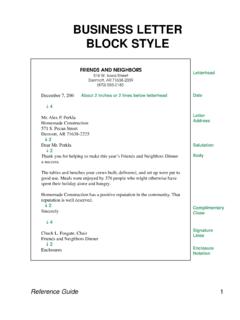
8 Are you making a request, responding to an inquiry, documenting a decision, or acknowledging an action? Next, consider your audience and anticipate the reaction to your message. When you start to write, follow the standard conventions for business Letters shown in Figure E-2. Using the correct form, or block style, shows your professionalism and simplifies your task as a writer. Ron gives you a letter from a customer inquir- ing about ecotours to the Caribbean and Central America. You begin a letter in response using the block ESSENTIAL style on Quest stationery. g ELEMENTS. n in 1. Letterhead io rn Most business Letters are written on letterhead stationery that includes the company name, street address, telephone and fax numbers, and Web site address. A logo usually identifies the organization. Figure E-3. ct ea shows the letterhead for Quest Specialty Travel.
9 2. Dateline Start with today's date. Spell the name of the month and use all four digits in the year. Always use the cur- du L. rent date for your Letters . Don't pre- or postdate business Letters . 3. Inside address ro ge The inside address includes basic information about the recipient: name, title, and the organization's name and mailing address. ep ga QUICK TIP 4. Salutation When you are writ- A business letter is considered formal communication and should always start with a salutation. This is usu- ing a business letter , ally the word Dear followed by the reader's name, as in Dear Ms. Alvarez. r R en use a colon (:) after the name. 5. Introduction Your first paragraph should directly express the purpose of your letter . Explain why you are Writing so that Fo f C. your reader can anticipate and better understand your message. Use a polite and conversational tone.
10 Avoid canned introductory statements. QUICK TIP. The closing statement 6. Body ot o can express good- The bulk of your letter should contain one or more paragraphs that provide your reader with information, will, make a polite comment, or ask an explanation, or other details related to your message. These paragraphs should all directly support the N ty your reader to take a main idea presented in your introduction. specific action. 7. Closing er QUICK TIP Include a closing paragraph that gracefully concludes the letter . Don't abruptly end a business letter . Sign your name in Instead, end with an expression of goodwill, a polite comment or observation, or a request to take a blue ink. This lets op your reader know specific action. that the letter is the 8. Complimentary close and signature original and not a End the letter with a complimentary close such as Sincerely, Respectfully, or Cordially.