Transcription of Effectively Clean Tanks and Reactors
1 Tanks , Reactors and other vessels can be cleaned in many ways. However, use of automated Clean -in-place sys-tems has increased rapidly. That s because automated devices Clean more thoroughly than other methods, dramatically reducing or eliminating risk of cross-contamination caused by product or cleaning -chemical cleaning provides other benefits as well: faster return to service of vessels downtime can be reduced by as much as 90%; decreased water and chemical use; lowered wastewater disposal costs; improved safety because workers no longer have to enter Tanks ; and better staff productivity because people can be de-ployed to other decision to automate is easy a plant usu-a lly can recoup the cost of an automated system in the f irst few months of operation through reduced chemi-ca l and water costs and increased production.
2 However, determining the best cleaning equipment can be hard. If vessels are large, have obstructions such as mixing paddles, and contain stick y, f lammable or toxic resi-dues, selection can get cha llenging. So, this article offers some guidelines to help you choose the most appropriate equipment for your STARTING POINTB efore you begin evaluating cleaning equipment, you must understand your cleaning First, assess the residue to determine what s required to remove it. Is the substance sticky or easily cleaned? Can a cleaning liquid dissolve it? If not, what level of impact is needed to break it up and wash it away?(If you re not sure how to remove the residue, a cleaning equipment vendor can use computational fluid dynamics modeling to determine the flow rate, operating pressure, cov-erage and the position of the spray head for complete Clean -ing of the vessel and any permanently installed equipment.)
3 cleaning agents. Once you understand the residue s characteristics, you can sort out which cleaning agents to use. Chemical additives typically are employed to remove contaminants, improve tank wetability and reduce foam. Heat can boost the cleaning action of many water-based detergent size. Interior surface area and distance between the walls substantially affect selection. Evaluate the spray distance, usually measured in terms of the vessel diameter, but also consider vessel length and height. For example, for a , vessel , use two vessel cleaners that each can handle up to 20 ft. or a single vessel cleaner that can handle up to 40 ft. You many need multiple nozzles if the spray can t reach a part of the vessel due to internal obstructions such as an agitator (Figure 1).
4 Impact. The level of impact needed to thoroughly Clean vessels depends on the residue, cleaning chemicals and water temperature. Hard-to- Clean residues require greater impact. The theoretical spray impact, I, equals K Q P where K is a constant, Q is flow rate and P is liquid you re not certain how much impact is needed, a Clean -ing equipment vendor should be able to provide guidance and impact data. Some manufacturers will conduct tests in their spray labs with your specific residue to optimize Effectively CleanTanks and ReactorsChoose the right equipment to avoid costly contamination problemsBy Anthony Wood, Spraying Systems performance. Another option is a short-term lease on a pumping system and vessel cleaner, so you can evaluate the equipment in your production environment.
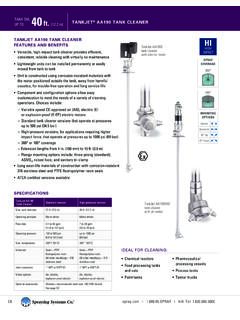
5 Some vendors also offer no-obligation equipment Is the residue, cleaning solvent or environment toxic or flammable? The answer will significantly influence the type of equipment you you understand your cleaning requirements, the next step is to evaluate the cleaning equipment. So, let s look at what s available and the pros and cons of each TYPE OF POWERThe first decision is whether to use a machine powered by fluid or a motor. Fluid-driven cleaning machines use fluid to spin a turbine that powers a gear set (Figure 2). The nozzle assembly rotates as the hub revolves around its central axis. The higher the liquid pressure and flow, the faster the rotation. Motor-driven cleaning machines rely on an external elec-tric or air motor to drive the nozzle assembly (Figure 3).
6 The nozzles revolve around the central axis of the nozzle machines operate at high pressures, provide 360 cleaning coverage and suit large vessels (up to 100 ft. dia.). They often offer comparable cleaning performance. However, there are several operational A fluid-driven machine is more prone to clogging. As fluid passes through the device, debris can accumulate in the internal flow passages or get caught in the gears. When this hap-pens, the machine stops working because the gears no longer can rotate. Verifying operation is crucial but can be challenging it s difficult to visually observe the inside of a large motor-driven machine will continue to operate even with debris in the nozzles.
7 The external motor ensures continued rota-tion and cleaning . Plus, you easily can hear the sound from the motor and verify operation without having to inspect the you re using less than pristine water and it s difficult to see inside your vessel , a motor-driven machine is a better choice. cleaning cycle time. If short cleaning cycles are a priority, con-sider a motor-driven unit. Using an electric motor, cycle times remain constant regardless of operating pressure and flow rate. With an air motor, you can increase air pressure to make the nozzle hub rotate more quickly. Figure 1. The size of a vessel or internal obstructions may require use of multiple nozzles for effective CLEANINGSix steps may provide significant benefits:1.
8 Reduce use of heated water. Hot water is costly but frequently is viewed as a necessary evil to remove some resi-dues. However, increasing impact often can often get the job done and cut or eliminate the need for hot Minimize striping. vessel cleaners provide 360 coverage. However, the solid stream sprays don t overlap as they rotate, so there s a small distance between the sprays and thus a so-called striping effect. The greater the distance the nozzles are from the vessel walls, the greater the distance between the sprays. The best way to minimize striping is to use a four-nozzle hub rather than the standard two-nozzle hub. This will cut striping in Change spray head position. Use an adjustable ball fitting to Clean vessels in sections.
9 Clean the top half of the vessel , then lower the device and Clean the bottom half of the vessel or change the angle to Clean difficult Decrease the number of cleaning cycles. Simple adjustments to pressure and flow may enable a reduction in the number of cycles needed for thorough cleaning . To increase impact and cleaning efficiency it s far more ef-fective to increase flow than pressure. Doubling flow rate boosts impact as much as 100%; doubling pressure only provides 40% more Recirculate. Do you spray and drain? Check into re-cycling your cleaning solution if you aren t using hazardous materials and your water is debris Activate cleaning with the flip of a switch. Hard piping your vessel cleaner in place can save time and reduce labor costs.
10 Consider permanently installing the device if the mate-rial or its temperature won t damage the cleaning NozzlesFluid-driven machines can achieve comparable cycle times to motor-driven machines by raising pressure. However, operating at higher pressures increases wear of internal parts and results in more frequent or explosion risks. Explosion-proof electric motors are available or you can use an air motor. Or you may be able to change cleaning solvents to eliminate the explosion hazard without negatively impacting cleaning . Other options include increasing humidity in the vessel to minimize the risk of static electricity, prevent complete drying of the residue and ease residue CONSIDERATIONSF luid-driven machines generally cost less than motor-driven ones, although the cost depends upon the size of the machine.