Transcription of TECHNICAL OPTIMIZING TANK CLEANING …
1 CLEANING POWER GUIDELINES Choosing a tank cleaner is based primarily on tank size and level of CLEANING required. Understanding the definitions that follow will help ensure you select the right tank cleaner for your TANK CLEANER OVERVIEW BY TANK DIAMETERThe chart on the next page shows our tank CLEANING products and the maximum and minimum tank diameter each unit can clean. The maximum tank diameter is defined as the total distance the spray can travel to tank walls assuming the unit is positioned in the center of the tank. The closer the nozzle is to the tank wall, the greater the impact. It is possible to use some tank cleaners in smaller tanks than recommended, but be sure to keep clearance, tank material and drainage capacity in mind. High-impact CLEANING is required to remove stubborn residues such as layers of a dried substance. Tank cleaners in this category generally use high pressure and/or high flow and spin at slow rotational speeds to maintain high impact. Solid stream nozzles are used to maximize CLEANING is required when good impingement is needed to remove residues.
2 Tank cleaners that provide medium impact generally use solid stream nozzles at medium flows and pressures. Rotational speed is slightly faster than high impact tank cleaners but much slower than free-spinning nozzles to ensure adequate impact on target is used when distributing CLEANING solution throughout the tank without impact provides sufficient CLEANING . Rinsing nozzles are typically free-spinning or stationary spray balls. | | Intl. Tel: TANK CLEANING OPERATIONSSPRAY DISTANCETank Diameter 360100 TankJet AA290100 TankJet 18080 TankJet 8050 TankJet 78 & 78D45 TankJet 65 & 65HT40 TankJet AA190 40 TankJet YMD330 TankJet 7530 TankJet 2750025 TankJet 16 24 TankJet 27500 & 27500-R20 TankJet 28500 & 28500-R18 TankJet 1290018 TankJet AA09016 TankJet D26984 16 TankJet D4015916 TankJet D41800E16 TankJet D4199016 TankJet 9-C16 TankJet 63225 & 63225-3A 13 TankJet 9-B12 TankJet 14 & 1912 TankJet 6353 & 6353-MFP10 TankJet 18250A8 TankJet 9-A6 TankJet M605 TankJet D265645 TankJet 21400A5 TankJet VSM5 TankJet 304733 TankJet 23240-2, | | Intl.
3 Tel: TANK CLEANING OPERATIONSOPTIMIZING YOUR TANK CLEANING OPERATIONSTank CLEANING equipment is designed to yield specific performance under specific conditions. A variety of factors can affect results. Even when tank CLEANING equipment appears to be working as expected, there may be room for improvement. Adjustments are often possible to achieve more consistent results, improve efficiency, reduce the length of time tanks are out of service and lower operating costs. Here are seven optimization tips to consider as you evaluate the current performance of your tank CLEANING HEATED WATER VS. IMPACT Hot water is costly but may be needed to remove some residues. However, in some cases, hot water may be eliminated by increasing CLEANING impact. This can result in a dramatic reduction in energy costs and savings of thousands of dollars annually. Ask your local sales engineers for assistance in determining if increasing impact can eliminate hot water use in your application. This may involve a proof-of-concept test to compare the CLEANING performance of high impact vs.
4 Hot water. Don t try to evaluate impact without expert advice. Impact, or the amount of force the CLEANING liquid applies to the tank surface, is difficult to measure. There is no industry standard for reporting impact data. Even though nozzles produce the same type of pattern, such as a solid stream, performance will vary based on how the nozzles were designed and machined. 2. OPERATIONAL CONSIDERATIONS Two tanks that are the same size with the same residue may require completely different tank cleaners and CLEANING times. For example, a 12 ft. ( m) diameter tank used for paint mixing may be cleaned using a medium-impact tank cleaner with cycle times averaging 10 minutes if the paint residue is still wet. The same size tank may require a high-impact tank cleaner and take longer to clean if the paint has dried in the tank. 3. LOOK FOR ISSUES ASSOCIATED WITH STRIPING High-impact tank cleaners that provide 360 CLEANING coverage use solid stream sprays. These sprays don t overlap as they rotate, so there s a small distance between each path and striping occurs.
5 The greater the distance the nozzles are from the vessel walls, the greater the distance between paths. In some operations , striping can be a contamination risk. Switching to a three- or four-nozzle configuration, rather than the standard two-nozzle configuration, is one way to reduce striping and minimize effect with two-nozzle hub configurationStriping effect with four-nozzle hub | | Intl. Tel: CLEANING OPTIMIZATION CHECKLIST4. SHORTEN CLEANING TIME BY INCREASING IMPACT Simple adjustments to liquid pressure and flow may enable a reduction in the number of cycles needed for thorough CLEANING . Faster CLEANING saves time and reduces water and chemical use. To increase impact and CLEANING efficiency, it s far more effective to increase flow than liquid pressure since increasing flow rate intensifies impact at a greater rate than increasing pressure. In fact, doubling flow rate boosts impact as much as 100% while doubling liquid pressure provides only 40% more impact.
6 In addition, there are other drawbacks to increasing pressure. Higher liquid pressures can introduce turbulence to the jet stream, reducing throw and CLEANING efficiency. 5. CLEANING HARD-TO-REACH AREASI nternal obstructions, like agitator shafts/blades, coils, etc., block the spray from hitting the tank wall. Certain areas, such as skim lines, require more CLEANING than others. Having the flexibility to reposition tank CLEANING equipment can help you achieve complete CLEANING in less time and reduce operating costs. An adjustable ball fitting can be used to clean vessels in sections: Clean the top half of the vessel , then lower the device and clean the bottom half of the vessel , or change the angle to clean difficult locations. Lances and adjustable flanges can also be used to help position nozzles properly. For example, if the tank only has a single entry opening, special lances and flanges can be used so the nozzle turret can be easily moved to multiple locations in the tank. Special lances and flanges can also be used to position nozzles so the spray impacts directly on heavily soiled areas or skim REVIEW SYSTEM COMPONENTS In addition to the tank cleaner, other equipment can affect CLEANING Pumps: Check that you have the correct pump for your system.
7 The efficiency of the pump will have a direct impact on flow and the performance of the tank CLEANING Piping and Valves: Be sure pipes and valves are properly sized. Incorrect sizing can lead to inadequate flow, pressure and fluid Filtration: Confirm that required filtration products are installed. Filters or strainers should be properly sized and installed to prevent clogging. P Monitoring: Ensure gauges or flow meters are placed in critical locations. System monitoring will enable quick detection and resolution of PERFORM REGULAR MAINTENANCEA fter installing the tank cleaner, be sure to document performance to establish a baseline for later comparison. Also, be sure to inspect equipment on a regular basis. Verifying operation can be challenging since it is difficult to visually observe tank CLEANING equipment while operating. Problems with tank CLEANING equipment often become evident when trace amounts of residue are detected after for debris build-up. Debris can clog nozzles, become embedded in bushings and gears and cause the unit to stop working or reduce service life.
8 Even if you are just CLEANING with water, rust or scale from piping may accumulate in the unit. Make sure to put your tank cleaners on a routine maintenance program to check bushings, seals, bearings and nozzles and make sure they are not worn or sure to document when service is done and how frequently components are replaced. Relative ImpactFlow RateLiquid Inlet PressureRelative Impact13 gpm ( lpm)45 psi ( bar) gpm ( lpm)90 psi ( bar) gpm ( lpm)45 psi ( bar) | | Intl. Tel: CLEANING OPTIMIZATION CHECKLISTFERMENTER CLEANING TIME REDUCED FROM 45 MINUTES TO 20 MINUTESB efore: Tank CLEANING nozzle operating at 40 psi ( bar) required two CLEANING cycles, extending CLEANING time and increasing use of water and : Two fluid-driven TankJet 360 tank cleaners, each with a two-nozzle hub, operating at 90 psi ( bar) provide thorough CLEANING of the fermenter in less than half the time. High-impact, high-efficiency inch ( mm) nozzles rotate 360 in horizontal and vertical planes, creating a criss-crossing pattern that thoroughly removes residue.
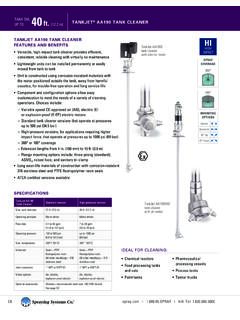
9 CONSULT WITH EXPERTS If you would like help OPTIMIZING your tank CLEANING operations , our local sales engineers are always available for assistance and workshops at your facility. After evaluating your current operations and equipment, we ll offer optimization suggestions designed to achieve your specific CLEANING objectives. More information on local sales services are available at MANUFACTURER REDUCES CLEANING TIME BY 80%Before: spray balls were used to clean two ft dia. x 9 ft tall (1900 mm diameter x 2790 mm tall) processing tanks . After: A TankJet AA190, equipped with a 1 ft. (317 mm) shaft, operates at pressures up to 500 psi (34 bar) to provide high-impact, 360 CLEANING . Even with stubborn residue, CLEANING time has been reduced from 1 hour to 12 CLEANING TIME REDUCED FROM 45 MINUTES TO 10 MINUTESB efore: Turbine-driven rotating nozzle spraying hot water at 10 gpm ( lpm) at 100 psi ( bar). Wash cycle was often repeated a second time for complete removal of : A TankJet AA190 now cleans the totes at 500 psi (34 bar) and a flow rate of 20 gpm ( lpm).
10 Operating at greater flow rates and higher pressures increases CLEANING impact and results in cycle times of just 10 360 Tank CleanerTankJet AA190 Tank CleanerTankJet AA190 Tank CleanerOPTIMIZING TANK CLEANING WILL PAY FOR ITSELF QUICKLY. HERE ARE A FEW | | Intl. Tel: CLEANING CASE STUDIES