Transcription of Emerging Infectious Diseases
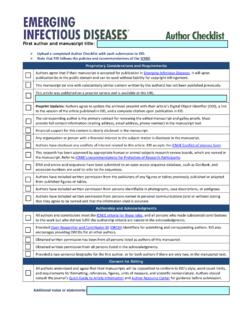
1 Summary of authors InstructionsAuthor s instructions . For a complete list of EID s manuscript guidelines, see the author resource page: Manuscript Submission. To submit a manuscript, access Manuscript Central from the Emerging Infectious Diseases web page ( ). Include a cover letter indicating the proposed category of the article ( , Research, Dispatch), verifying the word and reference counts, and confirming that the final manuscript has been seen and approved by all authors . Complete provided authors Checklist. Manuscript Preparation. For word processing, use MS Word. Set the document to show continuous line numbers. List the following information in this order: title page, article summary line, keywords, abstract, text, acknowledgments, biographical sketch, references, tables, and figure legends. Appendix materials and figures should be in separate files. Title Page. Give complete information about each author ( , full name, graduate degree(s), affiliation, and the name of the institution in which the work was done).
2 Clearly identify the corresponding author and provide that author s mailing address (include phone number, fax number, and email address). Include separate word counts for abstract and text. Keywords. Use terms as listed in the National Library of Medicine Medical Subject Headings index ( ).Text. Double-space everything, including the title page, abstract, references, tables, and figure legends. Indent paragraphs; leave no extra space between paragraphs. After a period, leave only one space before beginning the next sentence. Use 12-point Times New Roman font and format with ragged right margins (left align). Italicize (rather than underline) scientific names when needed. Biographical Sketch. Include a short biographical sketch of the first author both authors if only two. Include affiliations and the author s primary research interests. References. Follow Uniform Requirements ( ). Do not use endnotes for references.
3 Place reference numbers in parentheses, not super-scripts. Number citations in order of appearance (including in text, figures, and tables). Cite personal communications, unpublished data, and manuscripts in preparation or submitted for publication in parentheses in text. Consult List of Journals Indexed in Index Medicus for accepted journal abbreviations; if a journal is not listed, spell out the journal title. List the first six authors followed by et al. Do not cite references in the Provide tables within the manuscript file, not as separate files. Use the MS Word table tool, no columns, tabs, spaces, or other programs. Footnote any use of bold-face. Tables should be no wider than 17 cm. Condense or divide larger tables. Extensive tables may be made available online only. Figures. Submit editable figures as separate files ( , Microsoft Excel, PowerPoint). Photographs should be submitted as high-resolution (600 dpi) .tif or.
4 Jpeg files. Do not em-bed figures in the manuscript file. Use Arial 10 pt. or 12 pt. font for lettering so that figures, symbols, lettering, and numbering can remain legible when reduced to print size. Place fig-ure keys within the figure. Figure legends should be placed at the end of the manuscript Submit as AVI, MOV, MPG, MPEG, or WMV. Videos should not exceed 5 minutes and should include an audio description and complete captioning. If audio is not available, provide a description of the action in the video as a separate Word file. Published or copyrighted material ( , music) is discouraged and must be accompanied by written release. If video is part of a manuscript, files must be uploaded with manu-script submission. When uploading, choose Video file. Include a brief video legend in the manuscript of ArticlesPerspectives. Articles should not exceed 3,500 words and 50 references. Use of sub-headings in the main body of the text is recommended.
5 Photographs and illustrations are encouraged. Provide a short abstract (150 words), 1-sentence summary, and biographical sketch. Articles should provide insightful analysis and commentary about new and reemerg-ing Infectious Diseases and related issues. Perspectives may address factors known to influence the emergence of Diseases , including microbial adaptation and change, human demographics and behavior, technology and industry, economic development and land use, international travel and commerce, and the breakdown of public health measures. Synopses. Articles should not exceed 3,500 words in the main body of the text or include more than 50 references. Use of subheadings in the main body of the text is recommended. Photographs and illustrations are encouraged. Provide a short abstract (not to exceed 150 words), a 1-line summary of the conclusions, and a brief biographical sketch of first author or of both authors if only 2 authors .
6 This section comprises case series papers and concise reviews of Infectious Diseases or closely related topics. Preference is given to reviews of new and Emerging Diseases ; how-ever, timely updates of other Diseases or topics are also welcome. If detailed methods are included, a separate section on experimental procedures should immediately fol-low the body of the Articles should not exceed 3,500 words and 50 references. Use of sub-headings in the main body of the text is recommended. Photographs and illustrations are encouraged. Provide a short abstract (150 words), 1-sentence summary, and biographical sketch. Report laboratory and epidemiologic results within a public health perspective. Explain the value of the research in public health terms and place the findings in a larger perspective ( , Here is what we found, and here is what the findings mean ).Policy and Historical Reviews. Articles should not exceed 3,500 words and 50 refer-ences.
7 Use of subheadings in the main body of the text is recommended. Photographs and illustrations are encouraged. Provide a short abstract (150 words), 1-sentence sum-mary, and biographical sketch. Articles in this section include public health policy or his-torical reports that are based on research and analysis of Emerging disease Articles should be no more than 1,200 words and need not be divided into sections. If subheadings are used, they should be general, , The Study and Conclusions. Provide a brief abstract (50 words); references (not to exceed 15); figures or illustrations (not to exceed 2); tables (not to exceed 2); and biographical sketch. Dis-patches are updates on Infectious disease trends and research that include descriptions of new methods for detecting, characterizing, or subtyping new or reemerging pathogens. Developments in antimicrobial drugs, vaccines, or Infectious disease prevention or elimi-nation programs are appropriate.
8 Case reports are also Dimension. Thoughtful essays, short stories, or poems on philosophical is-sues related to science, medical practice, and human health. Topics may include science and the human condition, the unanticipated side of epidemic investigations, or how people perceive and cope with infection and illness. This section is intended to evoke compassion for human suffering and to expand the science reader s literary scope. Manuscripts are selected for publication as much for their content (the experiences they describe) as for their literary merit. Include biographical Letters Reporting Cases, Outbreaks, or Original Research. Starting with the January 2017 volume, EID will publish letters that report cases, outbreaks, or original research as Research Letters. authors should provide a short abstract (50-word maximum), references (not to exceed 10), and a short biographical sketch. These letters should contain no more than 850 words (including the abstract) and may include either 1 figure or 1 table.
9 Do not divide Research Letters into Commenting on Articles. Letters commenting on articles should contain a maximum of 300 words and 5 references; they are more likely to be published if submitted within 4 weeks of the original article s Thoughtful discussions (500 1,000 words) of current topics. Commentaries may contain references (not to exceed 15) but no abstract, figures, or tables. Include biographical , Other Media. Reviews (250 500 words) of new books or other media on Emerging disease issues are welcome. Title, author(s), publisher, number of pages, and other pertinent details should be Summaries. Summaries of Emerging Infectious disease conference ac-tivities (500 1,000 words) are published online only. They should be submitted no later than 6 months after the conference and focus on content rather than process. Provide illustrations, references, and links to full reports of conference Reports.
10 Reports on consensus group meetings, workshops, and other ac-tivities in which suggestions for diagnostic, treatment, or reporting methods related to Infectious disease topics are formulated may be published online only. These should not exceed 3,500 words and should be authored by the group. We do not publish official guidelines or policy Quiz. The photo quiz (1,200 words) highlights a person who made notable contributions to public health and medicine. Provide a photo of the subject, a brief clue to the person s identity, and five possible answers, followed by an essay describing the person s life and his or her significance to public health, science, and Infectious disease. Etymologia. Etymologia (100 words, 5 references). We welcome thoroughly researched derivations of Emerging disease terms. Historical and other context could be included. Announcements. We welcome brief announcements of timely events of interest to our readers.