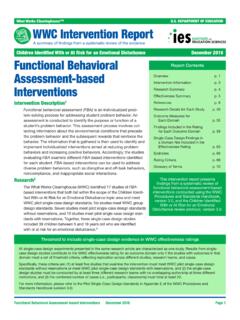
Transcription of Emotional/Behavioral Disorder Fact Sheet
1 West Virginia State Department of Education Office of Special Education * 1-800-642-8541 * Emotional/Behavioral Disorder Fact Sheet DEFINITION emotional disturbance means a condition exhibiting one or more of the following characteristics over a long period of time and to a marked degree that adversely affects a child s educational performance: (A) An inability to learn that cannot be explained by intellectual, sensory, or health factors. (B) An inability to build or maintain satisfactory interpersonal relationships with peers and teachers. (C) Inappropriate types of behavior or feelings under normal circumstances. (D) A general pervasive mood of unhappiness or depression. (E) A tendency to develop physical symptoms or fears associated with personal or school problems. TYPES Anxiety disorders Bipolar Disorder Conduct disorders Obsessive-compulsive Disorder Psychotic disorders Depressive disorders POSSIBLE CAUSES Heredity Brain Disorder Diet Stress Family functioning However, researchers have not found that any of these factors are the direct cause of behavioral or emotional problems.
2 According to the National Alliance on Mental Illness (NAMI), mental illnesses can affect persons of any age, race, religion, or income. Mental illnesses are not the result of personal weakness, lack of character, or poor upbringing. Mental illnesses are treatable. Most people diagnosed with a serious mental illness can experience relief from their symptoms by actively participating in an individual treatment plan. INCIDENCE According to the CDC (Centers for Disease Control and Prevention), of all children ages 4-17 years were reported by parents as having serious emotional or behavioral difficulties. In comparison to WV s State s Determination under IDEA approximately 1,363 children (.49%) ages 3-21 years of age have been identified as having emotional or behavioral difficulties. According to the National Institute of Mental Health (NIMH), emotional and behavioral disorders affect 10-15% of children globally.
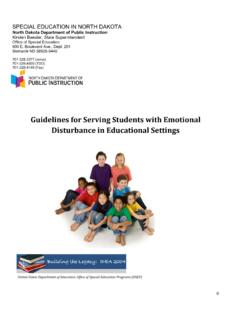
3 POSSIBLE SIGNS AND CHARACTERISTICS Some of the characteristics and behaviors seen in children who have an emotional disturbance include: Hyperactivity (short attention span, impulsiveness); Aggression or self-injurious behavior (acting out fighting); Withdrawal (not interacting socially with others, excessive fear or anxiety); Immaturity (inappropriate crying, temper tantrums, poor coping skills); and Learning difficulties (academically performing below grade level). Children with the most serious emotional disturbances may exhibit: Distorted thinking Excessive anxiety Bizarre motor acts Abnormal mood swings. TEACHING TIPS/INSTRUCTIONAL STRATEGIES Educational programs for children with an emotional disturbance need to include attention to both emotional and behavioral support, as well as helping them to master: Academics Develop social skills Increase self-awareness Increase self-control Increase self-esteem West Virginia State Department of Education Office of Special Education * 1-800-642-8541 * Emotional/Behavioral Disorder Fact Sheet STUDENTS WITH THE MOST SERIOUS emotional disturbances MAY EXHIBIT: Rules and routines that are predictable; Consistent rewards for appropriate behavior; Behavior management techniques such as: Positive reinforcement, token economy, contracts, and a cool-down area.
4 Systematic teaching of social skills through modeling, discussion, and rehearsal are provided to help students increase control over their behavior and improve their relations with others; Supportive therapies involving music, art, exercise, and relaxation techniques; and Individual and group counseling to improve self-understanding, self-esteem, and self-control. HELPFUL RESOURCES WV Early Childhood Positive Behavior Support National Association of Special Education Teachers (NASET) Kids Mental Health National Institute of Mental Health (NIMH) Technical Assistance Center on Social emotional Intervention for Young Children (TACSEI) The Council for Children with Behavioral Disorders (CCBD) NAMI National Alliance on Mental Illness SAMHSA s National Mental Health Information Center