Transcription of en - Ilex Medical Ltd.
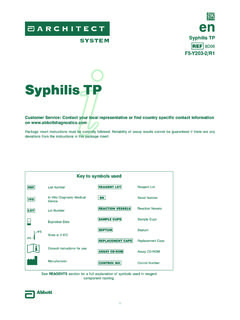
1 1systemenTSH 7K6249-3481/R3B7K620 Read Highlighted ChangesRevised June, 2010 TSHC ustomer Service: Contact your local representative or find country specific contact information on insert instructions must be carefully followed. Reliability of assay results cannot be guaranteed if there are any deviations from the instructions in this package to symbols usedList NumberIn Vitro Diagnostic Medical DeviceSerial NumberLot NumberExpiration DateStore at 2-8 CConsult instructions for useManufacturerReagent LotCalibrator (1, 2)Control Low, Medium, High (L, M, H)Assay CD-ROMR eaction VesselsSample CupsSeptumReplacement CapsWarning: Severe IrritantSee REAGENTS section for a full explanation of symbols used in reagent component TSHINTENDED USEThe ARCHITECT TSH assay is a Chemiluminescent Microparticle Immunoassay (CMIA) for the quantitative determination of human thyroid stimulating hormone (TSH) in human serum and AND EXPLANATION OF TEST Human Thyroid Stimulating Hormone (TSH) or thyrotropin is a glycoprotein with a molecular weight of approximately 28,000 daltons, synthesized by the basophilic cells (thyrotropes) of the anterior TSH is composed of two non-covalently linked subunits designated alpha and beta.
2 Although the alpha subunit of TSH is common to the luteinizing hormone (LH), follicle stimulating hormone (FSH) and human chorionic gonadotropin (hCG), the beta subunits of these glycoproteins are hormone specific and confer biological as well as immunological specificity. Both alpha and beta subunits are required for biological TSH stimulates the production and secretion of the metabolically active thyroid hormones, thyroxine (T4) and triiodothyronine (T3), by interacting with a specific receptor on the thyroid cell T3 and T4 are responsible for regulating diverse biochemical processes throughout the body which are essential for normal development and metabolic and neural synthesis and secretion of TSH is stimulated by thyrotropin releasing hormone (TRH), the hypothalamic tripeptide, in response to low levels of circulating thyroid ,4 Elevated levels of T3 and T4 suppress the production of TSH via a classic negative feedback mechanism.
3 Other evidence also indicates that somatostatin and dopamine exert inhibitory control over TSH release, suggesting that the hypothalamus may provide both inhibitory and stimulatory influence on pituitary TSH Failure at any level of regulation of the hypothalamic-pituitary-thyroid axis will result in either underproduction (hypothyroidism) or overproduction (hyperthyroidism) of T4 and/or cases of primary hypothyroidism, T3 and T4 levels are low and TSH levels are significantly In the case of pituitary dysfunction, either due to intrinsic hypothalamic or pituitary disease; , central hypothyroidism, normal or marginally elevated basal TSH levels are often seen despite significant reduction in T4 and/or T3 levels.
4 These inappropriate TSH values are due to a reduction in TSH bioactivity which is frequently observed in such cases. Routine TRH stimulation is advised to confirm the diagnosis in such cases. Secondary hypothyroidism typically results in an impaired TSH response to TRH, while in tertiary hypothyroidism the TSH response to TRH may be normal, prolonged or Primary hyperthyroidism ( , Grave s Disease, nodular goiter) is associated with high levels of thyroid hormones and depressed or undetectable levels of The TRH stimulation test has been used in diagnosis of hyperthyroidism. Hyperthyroid patients show a subnormal response to the TRH In addition, large doses of glucocorticoids, somatostatin, dopamine and replacement doses of thyroid hormones reduce or totally blunt the TSH response to ,12 Earlier assays for serum TSH lacked the sensitivity to be used as a primary test of thyroid Sensitive TSH assays now available, with increased ability to clearly distinguish between euthyroid and hyperthyroid populations, are changing thyroid function testing.
5 Analytical sensitivity, as a means of assessing low concentration accuracy, is being replaced by functional The American Thyroid Association has formally recommended the use of functional sensitivity as the means to quantify the sensitivity of TSH assays,15 although analytical sensitivity is still widely used. Third generation TSH assays exhibit 20% interassay CVs at < IU/mL and are useful in the discrimination of patients with true hyperthyroidism from those with TSH suppression seen in subclinical hyperthyroidism and some non-thyroidal Other thyroid tests (Free T4 estimate, Total T4, T-Uptake, and Total T3) combined with the ability to accurately measure low levels of TSH, improve the efficiency of thyroid ARCHITECT TSH assay is used as an aid in the assessment of thyroid status, diagnosis of thyroid disease, and treatment of thyroid PRINCIPLES OF THE PROCEDUREThe ARCHITECT TSH assay is a two-step immunoassay to determine the presence of thyroid stimulating hormone (TSH)
6 In human serum and plasma using Chemiluminescent Microparticle Immunoassay (CMIA) technology with flexible assay protocols, referred to as the first step, sample, anti- TSH antibody coated paramagnetic microparticles and TSH Assay Diluent are combined. TSH present in the sample binds to the anti-TSH antibody coated microparticles. After washing, anti- TSH acridinium labeled conjugate is added in the second step. Pre-Trigger and Trigger Solutions are then added to the reaction mixture; the resulting chemiluminescent reaction is measured as relative light units (RLUs). A direct relationship exists between the amount of TSH in the sample and the RLUs detected by the ARCHITECT i optical additional information on system and assay technology, refer to the ARCHITECT System Operations Manual, Section Kit, 100 Tests/500 TestsNOTE: Some kit sizes are not available in all countries or for use on all ARCHITECT i Systems.
7 Please contact your local TSH Reagent Kit (7K62) 1 or 4 Bottle(s) ( mL) Anti- TSH (mouse, monoclonal) coated Microparticles in TRIS buffer with protein (bovine) stabilizers. Preservative: antimicrobial agents. 1 or 4 Bottle(s) ( mL) Anti- TSH (mouse, monoclonal) acridinium-labeled Conjugate in MES buffer with protein (bovine) stabilizers. Minimum concentration: 60 ng/mL. Preservative: antimicrobial agent. 1 or 4 Bottle(s) ( mL) TSH Assay Diluent in TRIS buffer. Preservative: antimicrobial DiluentARCHITECT i Multi-Assay Manual Diluent (7D82-50) 1 Bottle (100 mL) ARCHITECT i Multi-Assay Manual Diluent containing phosphate buffered saline solution.
8 Preservative: antimicrobial ReagentsARCHITECT i Pre-Trigger Solution Pre-Trigger Solution containing (w/v) hydrogen peroxide. ARCHITECT i Trigger Solution Trigger Solution containing sodium hydroxide. ARCHITECT i Wash BufferNOTE: Bottle and volume varies based on order. Wash Buffer containing phosphate buffered saline solution. Preservatives: antimicrobial AND PRECAUTIONS For In Vitro Diagnostic UsePackage insert instructions must be carefully followed. Reliability of assay results cannot be guaranteed if there are any deviations from the instructions in this package PrecautionsCAUTION: This product may require the handling of human specimens. It is recommended that all human sourced materials be considered potentially infectious and handled in accordance with the OSHA Standard on Bloodborne Pathogens18.
9 Biosafety Level 219 or other appropriate biosafety practices20,21 should be used for materials that contain or are suspected of containing infectious following warnings and precautions apply to this component:Assay Diluent WARNING:Contains Tris Hydroxymethyl Aminomethane and Tromethamine skin serious eye cause respiratory hands thoroughly after handlingP280 Wear protective gloves / protective clothing / eye breathing mist / vapours / only outdoors or in a well-ventilated +P351 + P338IF IN EYES: Rinse cautiously with water for several minutes. Remove contact lenses, if present and easy to do. Continue +P313If eye irritation persists: Get Medical advice / +P352IF ON SKIN: Wash with plenty of soap and +P313If skin irritation occurs: Get Medical advice / off contaminated clothing and wash before +340IF INHALED: Remove victim to fresh air and keep at rest in a position comfortable for a POISON CENTER or doctor/physician if you feel + P233 Store in a well-ventilated place.
10 Keep container tightly locked material and its container must be disposed of in a safe a detailed discussion of safety precautions during system operation, refer to the ARCHITECT System Operations Manual, Section PrecautionsDo not use reagent kits beyond the expiration date. Do not mix reagents from different reagent kits. Prior to loading the ARCHITECT TSH Reagent Kit on the system for the first time, the microparticle bottle requires mixing to resuspend microparticles that have settled during shipment. For microparticle mixing instructions, refer to the PROCEDURE, Assay Procedure section of this package MUST be used to prevent reagent evaporation and contamination and to ensure reagent integrity.