Transcription of en - Ilex Medical Ltd.
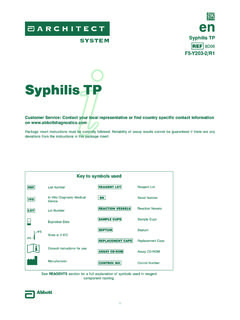
1 System1enHCV Ag 6L47F5-Y206-2/R1 HCV AgCustomer ServiceInternational: Call your Abbott representativeThis package insert must be read carefully prior to use. Package insert instructions must be carefully followed. Reliability of assay results cannot be guaranteed if there are any deviations from the instructions in this package to symbols usedList NumberIn Vitro Diagnostic Medical DeviceLot NumberExpiration DateStore at 2-8 CConsult instructions for useManufacturerAssay CD-ROMR eaction VesselsSample CupsSeptumReplacement CapsSerial NumberControl NumberCalibrator A-FNegative ControlPositive Control 1 Positive Control 2 Reagent LotSee REAGENTS section for a full explanation of symbols used in reagentcomponent Diagnostics Division2 NAMEARCHITECT HCV AgINTENDED USEThe ARCHITECT HCV Ag assay is a Chemiluminescent Microparticle Immunoassay (CMIA) for the quantitative determination of core antigen to Hepatitis C virus in human serum and AND EXPLANATION OF TEST ARCHITECT HCV Ag is a Chemiluminescent Microparticle Immunoassay (CMIA)
2 Using microparticles coated with monoclonal anti-HCV for the detection of HCV Ag assays are used as an aid in the diagnosis of suspected Hepatitis C viral (HCV) infection and to monitor the status of infected individuals, , whether the patient s infection has resolved or the patient has become a chronic carrier of the virus. For the diagnosis of acute or chronic hepatitis, HCV Ag reactivity should be correlated with patient history and the presence of other Hepatitis C serological ,2 BIOLOGICAL PRINCIPLES OF THE PROCEDUREThe ARCHITECT HCV Ag assay is a two-step immunoassay, using Chemiluminescent Microparticle Immunoassay (CMIA) technology, with flexible assay protocols referred to as Chemiflex, for the quantitative determination of core antigen of Hepatitis C virus. In the Pre-Treatment step, sample, Pre-Treatment Reagent 1 and Pre-Treatment Reagent 2 are combined. An aliquot of the pre-treated sample is aspirated and dispensed into a new reaction vessel.
3 The pre-treated sample, Assay Specific Diluent and anti-HCV coated microparticles are Ag present in the pre-treated sample binds to the anti-HCV coated microparticles in the first step. After washing, acridinium-labeled anti-HCV conjugate is added in the second another wash cycle, Pre-Trigger and Trigger Solutions are added to the reaction mixture. The resulting chemiluminescent reaction is measured as relative light units (RLUs). A direct relationship exists between the amount of HCV Ag in the sample and the RLUs detected by the ARCHITECT i optical concentration of Hepatitis C core antigen in the specimen is determined using a previously generated ARCHITECT HCV Ag calibration curve. If the concentration of the specimen is greater than or equal to fmol/L, the specimen is considered reactive for HCV additional information on system and assay technology, refer to the ARCHITECT System Operations Manual, Section Kit, 100 TestsARCHITECT HCV Ag Reagent Kit (6L47) 1 Bottle ( mL) Microparticles: murine anti-HCV antibody coated microparticles in 400 mM Bicine, 50 mM TRIS buffer with protein (bovine) stabilizer.
4 Minimum concentration: solids. Preservatives: sodium azide and antimicrobial agents. 1 Bottle ( mL) Conjugate: murine anti-HCV antibody acridinium-labeled conjugate in 80 mM BIS-TRIS with protein (bovine) stabilizer. Minimum concentration: g/mL. Preservatives: sodium azide and antimicrobial agents. 1 Bottle ( mL) HCV Ag Assay Specific Diluent containing N NaOH. 1 Bottle ( mL) HCV Ag Pre-Treatment Reagent 1 containing N HCl. 1 Bottle ( mL) HCV Ag Pre-Treatment Reagent 2 containing N HCl. 1 Bottle ( mL) HCV Ag Specimen Diluent containing phosphate buffer with protein (horse serum) stabilizer. Preservatives: sodium azide and antimicrobial agents. Other ReagentsARCHITECT i Pre-Trigger Solution Pre-Trigger Solution containing (w/v) hydrogen peroxide. ARCHITECT i Trigger Solution Trigger Solution containing N sodium hydroxide. ARCHITECT i Wash BufferNOTE: Bottle and volume vary based on order.
5 Wash Buffer containing phosphate buffered saline solution. Preservative: antimicrobial AND PRECAUTIONS Safety PrecautionsCAUTION: This product requires the handling of human specimens. It is recommended that all human sourced materials be considered potentially infectious and handled in accordance with the OSHA Standard on Bloodborne Biosafety Level 2 4 or other appropriate biosafety practices5,6 should be used for materials that contain or are suspected of containing infectious ARCHITECT HCV Ag Assay Specific Diluent (6L47J) contains sodium hydroxide and is classified per applicable European Community (EC) Directives as: Corrosive (C). The following are the appropriate Risk (R) and Safety (S) severe case of contact with eyes, rinse immediately with plenty of water and seek Medical material and its container must be disposed of in a safe Wear suitable protective clothing, gloves and eye/face case of accident or if you feel unwell, seek Medical advice immediately (show the label where possible).
6 The ARCHITECT HCV Ag Pre-Treatment Reagents 1 and 2 (6L47U and 6L47Y) contain hydrochloric acid and are classified per applicable European Community (EC) Directives as: Corrosive (C). The following are the appropriate Risk (R) and Safety (S) case of contact with eyes, rinse immediately with plenty of water and seek Medical material and its container must be disposed of in a safe Wear suitable protective clothing, gloves and eye/face case of accident or if you feel unwell, seek Medical advice immediately (show the label where possible).The ARCHITECT HCV Ag Conjugate (6L47H) contains sodium fluoride and is classified per applicable European Community (EC) Directives with the following Risk (R) and Safety (S) with acids liberates very toxic material and its container must be disposed of in a safe swallowed, seek Medical advice immediately and show its container or product contains sodium azide; for a specific listing, refer to the REAGENTS section.
7 Contact with acids liberates very toxic gas. This material and its container must be disposed of in a safe information on the safe disposal of sodium azide and a detailed discussion of safety precautions during system operation, refer to the ARCHITECT System Operations Manual, Section product not classified as dangerous per European Directive 1999/45/EC as amended - Safety data sheet available for professional user on PrecautionsDo not use reagent kits beyond the expiration date. Do not open the ASSAY SPECIFIC DILUENT plastic bag until ready to leaking is observed with the Assay Specific Diluent bottle, the reagent kit cannot be used due to a lack of homogeneity which may impact results. The Assay Specific Diluent contains sodium hydroxide, and can cause severe skin and eye burns. Leaking bottles should be handled with appropriate safety not pool reagents within a reagent kit or between reagent kits.
8 Prior to loading the ARCHITECT HCV Ag Reagent Kit on the system for the first time, the reagents shipped on dry ice must be completely thawed and mixed thoroughly. For mixing instructions, refer to the PROCEDURE, Assay Procedure section of this package septum MUST be used to prevent reagent evaporation and contamination, and to ensure reagent integrity. Reliability of assay results cannot be guaranteed if a septum is not used according to the instructions in this package avoid contamination, wear clean gloves when placing a septum on an uncapped reagent a septum has been placed on an open reagent bottle, do not invert the bottle as this will result in reagent leakage and may compromise assay time, residual liquids may dry on the septum surface. These are typically dried salts and have no effect on assay a detailed discussion of handling precautions during system operation, refer to the ARCHITECT System Operations Manual, Section Instructions The ARCHITECT HCV Ag Reagent Kit is shipped on dry ice and must be stored at 2-8 C in an upright position after stored and handled as directed, reagents are stable until the expiration ARCHITECT HCV Ag Reagent Kit may be stored on board the ARCHITECT i System for a maximum of 15 days.
9 After 15 days, the reagent kit must be discarded. For information on tracking onboard time, refer to the ARCHITECT System Operations Manual, Section may be stored on or off the ARCHITECT i System. If reagents are removed from the system, store them at 2-8 C (with septums and replacement caps) in an upright position. For reagents stored off the system, it is recommended that they be stored in their original trays and boxes to ensure they remain upright. If the microparticle bottle does not remain upright (with a septum installed) while in refrigerated storage off the system, the reagent kit must be discarded. After reagents are removed from the system, a scan must be initiated to update the onboard stability of Reagent DeteriorationWhen a control value is out of the specified range, it may indicate deterioration of the reagents or errors in technique. Associated test results may be invalid and may require retesting.
10 Assay recalibration may be necessary. For troubleshooting information, refer to the ARCHITECT System Operations Manual, Section PROCEDUREThe ARCHITECT HCV Ag assay file ( or higher) must be installed on the ARCHITECT i System from the ARCHITECT i Assay CD-ROM (Addition C) prior to performing the assay. For detailed instructions on assay file installation and on viewing and editing assay parameters, refer to the ARCHITECT System Operations Manual, Section ARCHITECT HCV Ag assay requires ARCHITECT System Software Version or higher and ARCHITECT i Assay CD-ROM (Addition C) Version (LN 8K30-06) or the ARCHITECT Anti-HCV assay and the ARCHITECT HCV Ag assay are run on the same ARCHITECT i System, the Anti-HCV assay file ( or higher) must be installed from ARCHITECT i Assay CD-ROM -WW (excluding US)- Version (LN 6E59-27) or higher, prior to the installation of the HCV Ag assay information on printing assay parameters, refer to the ARCHITECT System Operations Manual, Section a detailed description of system procedures, refer to the ARCHITECT System Operations default result unit for the ARCHITECT HCV Ag assay is fmol/L.

![T I S S E E L [Fibrin Sealant] - Baxter Healthcare](/cache/preview/5/e/c/8/3/b/b/2/thumb-5ec83bb2d349410260af6c556ae67fe3.jpg)


