Transcription of Endep - Medicines
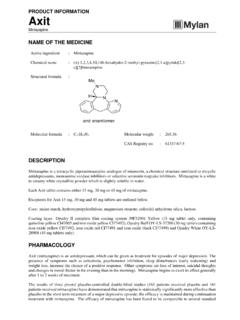
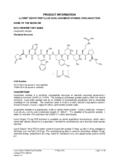
1 Endep Amitriptyline hydrochloride PRODUCT INFORMATION NAME OF THE medicine The active ingredient of Endep tablets is amitriptyline hydrochloride. The chemical name for amitriptyline hydrochloride is 3-(10,11-dihydro-5H-dibenzo[a,d]cyclohep ten-5-ylidene)-N,N-dimethylpropylamine hydrochloride. Its structural formula is: Empirical formula: Molecular weight: CAS Registry No.: 549-18-8 DESCRIPTION Amitriptyline hydrochloride occurs as colourless crystals or a white or almost white powder; odourless or almost odourless; taste, bitter and burning, followed by a sensation of numbness. It is soluble in 1 part of water, in parts of ethanol (96%), in parts of chloroform and in 1 part of methanol. It is practically insoluble in ether. Endep 10 tablets contain the following inactive excipients: lactose, microcrystalline cellulose, disodium edetate, sodium starch glycollate, pregelatinised maize starch, colloidal anhydrous silica, purified talc, magnesium stearate and Opadry Blue OY-B-30904.
2 Endep 25 tablets contain the following inactive excipients: lactose, microcrystalline cellulose, disodium edetate, sodium starch glycollate, pregelatinised maize starch, colloidal anhydrous silica, magnesium stearate and Opadry Yellow OY-LS-32814. Endep 50 tablets contain the following inactive excipients: lactose, microcrystalline cellulose, disodium edetate, sodium starch glycollate, pregelatinised maize starch, colloidal anhydrous silica, purified talc, magnesium stearate and Opadry Buff OY-LS-37200. PHARMACOLOGY Amitriptyline is a tricyclic antidepressant with sedative properties. Mechanism of action. The mechanism of action of amitriptyline in man is not known. It is not a monoamine oxidase inhibitor and it does not act primarily by stimulation of the central nervous system. In broad clinical use, amitriptyline has been found to be well tolerated. NCH3CH3,HClEndep Product Information 2 Amitriptyline inhibits the membrane pump mechanism responsible for uptake of noradrenaline and serotonin in adrenergic and serotonergic neurons.
3 Pharmacologically, this action may potentiate or prolong neuronal activity since reuptake of these biogenic amines is important physiologically in terminating its transmitting activity. This interference with the uptake of noradrenaline and/or serotonin is believed by some to underlie the antidepressant activity of amitriptyline. Amitriptyline has also been found to be effective in the treatment of enuresis in some cases where organic pathology has been excluded. The mode of action of amitriptyline in enuresis is not known. However, amitriptyline does have anticholinergic properties and Medicines of this group, such as belladonna, have been used in the treatment of enuresis. Pharmacokinetics. Amitriptyline is readily absorbed from the gastrointestinal tract, with peak plasma concentrations occurring within approximately 6 hours of oral administration. The mean apparent elimination half-life for amitriptyline was reported by one source to be hours; the mean half-life of its active metabolite, nortriptyline was 26 hours.
4 Amitriptyline is approximately 96% bound to plasma proteins. Amitriptyline undergoes extensive metabolism in the liver, primarily through N-demethylation, to nortriptyline. Paths of metabolism of both amitriptyline and nortriptyline include hydroxylation and N-oxidation. Amitriptyline is excreted in the urine, mainly in the form of metabolites, either free or as glucuronide and sulfate conjugates. Very little unchanged medicine is excreted in the urine. From one-third to one-half of an oral radioactive dose is excreted in the urine within 24 hours of administration. INDICATIONS For the treatment of major depression. Endep 50 mg tablets are indicated only for the maintenance treatment of major depression (see Precautions). Nocturnal enuresis where organic pathology has been excluded. CONTRAINDICATIONS Amitriptyline is contraindicated in patients who have shown prior hypersensitivity to it. Monoamine Oxidase Inhibitors (MAOIs) Endep should not be given concurrently with monoamine oxidase inhibitors, including selegiline.
5 The combination of amitriptyline with a monoamine oxidase inhibitor has caused severe convulsions, hyperpyretic crises and death. When it is desired to substitute amitriptyline for a monoamine oxidase inhibitor, a minimum of 14 days should be allowed to elapse after the latter is discontinued. Amitriptyline should then be initiated cautiously with gradual increase in dosage until optimum response is achieved. Endep Product Information 3 Cisapride Amitriptyline is contraindicated in patients taking cisapride due to the possibility of adverse cardiac interactions including prolongation of the QT interval, cardiac arrhythmias and conduction system disturbances. Myocardial Infarction Amitriptyline is not recommended for use during the acute recovery phase following myocardial infarction. See Precautions, Use in Pregnancy and Use in Lactation. PRECAUTIONS Clinical Worsening and Suicide Risk associated with Psychiatric Disorders. The risk of suicide attempt is inherent in depression and may persist until significant remission occurs.
6 This risk must be considered in all depressed patients. Patients with depression, both adult and paediatric, may experience worsening of their depressive symptoms and/or the emergence of suicidal ideation and behaviour (suicidality), whether or not they are taking antidepressant medications, and this risk may persist until significant remission occurs. As improvement may not occur during the first few weeks or more of treatment, patients should be closely monitored for clinical worsening and suicidality, especially at the beginning of a course of treatment, or at the time of dose changes, either increases or decreases. Consideration should be given to changing the therapeutic regimen, including possibly discontinuing the medication, in patients whose depression is persistently worse or whose emergent suicidality is severe, abrupt in onset, or was not part of the patient s presenting symptoms. Patients (and caregivers of patients) should be alerted about the need to monitor for any worsening of their condition and/or the emergence of suicidal ideation/behaviour or thoughts of harming themselves and to seek medical advice immediately if these symptoms present.
7 Patients with co-morbid depression associated with other psychiatric disorders being treated with antidepressants should be similarly observed for clinical worsening and suicidality. Pooled analyses of short-term placebo-controlled trials of antidepressant drugs (SSRIs and others) showed that these drugs increase the risk of suicidal thinking and behaviour (suicidality) in children, adolescents and young adults (ages 18-24) with major depressive disorder and other psychiatric disorders. Short term-studies did not show an increase in risk of suicidality with antidepressants compared to placebo in adults beyond age 24; there was a reduction with antidepressants compared to placebo in adults aged 65 and older. Pooled analyses of 24 short-term (4 to 16 weeks), placebo-controlled trials of nine antidepressant Medicines (SSRIs and others) in 4400 children and adolescents with major depressive disorder (16 trials), obsessive compulsive disorder (4 trials), or other psychiatric disorders (4 trials) have revealed a greater risk of adverse events representing suicidal behaviour or thinking (suicidality) during the first few months of treatment in those receiving antidepressants.
8 The average risk of such events in patients treated with an antidepressant was 4%, compared with 2% of patients given placebo. There was considerable variation in risk among the antidepressants, but there was a tendency towards an increase for almost all antidepressants studied. The risk of suicidality was most consistently observed in the major depressive disorder trials, but there were signals of risk arising from trials in other psychiatric indications (obsessive Endep Product Information 4 compulsive disorder and social anxiety disorder) as well. No suicides occurred in these trials. It is unknown whether the suicidality risk in children and adolescent patients extends to use beyond several months. The nine antidepressant Medicines in the pooled analyses included five SSRIs (citalopram, fluoxetine, fluvoxamine, paroxetine, sertraline) and four non-SSRIs (bupropion, mirtazapine, nefazodone, venlafaxine). The pooled analyses of placebo-controlled trials in adults with major depressive disorder or other psychiatric disorders included a total of 295 short-term trials (average duration of 2 months) of 11 antidepressant drugs in over 77,000 patients.
9 There was considerable variation in risk of suicidality among drugs, but a tendency toward an increase in the younger patients for almost all drugs studied. Absolute risk of suicidality varied across the different indications, with the highest incidence in major depressive disorder. The risk differences (drug vs. placebo), however, were relatively stable within age strata and across indications. These risk differences (drug-placebo difference in the number of cases of suicidality per 1000 patients treated) are provided in Table 1. Table 1 Age Range Drug-Placebo Difference in Number of Cases of Suicidality per 1000 Patients Treated Drug-Related Increases <18 14 additional cases 18-24 5 additional cases Drug-Related Decreases 25-64 1 fewer case 65 6 fewer cases There were suicides in the adult trials, but the number was not sufficient to reach any conclusion about drug effect on suicide. It is unknown whether the suicidality risk extends to longer-term use, beyond several months.
10 However, there is substantial evidence from placebo-controlled maintenance trials in adults with depression that the use of antidepressants can delay the recurrence of depression. Symptoms of anxiety, agitation, panic attacks, insomnia, irritability, hostility (aggressiveness), impulsivity, akathisia (psychomotor restlessness), hypomania, and mania, have been reported in adults, adolescents and children being treated with antidepressants for major depressive disorder as well as for other indications, both psychiatric and non-psychiatric. Although a causal link between the emergence of such symptoms and either worsening of depression and/or emergence of suicidal impulses has not been established, there is concern that such symptoms may be precursors of emerging suicidality. Families and caregivers of children, adolescents and young adults (ages 18-24) being treated with antidepressants for major depressive disorder or for any other condition (psychiatric or non-psychiatric) should be informed about the need to monitor these patients for the emergence of agitation, irritability, unusual changes in behaviour, and other symptoms described above, as well as the emergence of suicidality, and to report such symptoms immediately to health care providers.