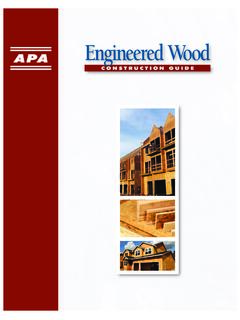
Transcription of Engineered Wood Construction Guide, Guide to Engineered ...
1 Engineered WoodCONSTRUCTION GUIDEE ngineered wood products are a good choice for the environment. They are manufactured for years of trouble-free, dependable use. They help reduce waste by decreasing disposal costs and product damage. Wood is a renewable, recyclable, biodegradable resource that is easily manufactured into a variety of viable few facts about wood. We re growing more wood every day. Forests fully cover one-third of the United States and one-half of Canada s land mass. American landowners plant more than two billion trees every year. In addition, millions of trees seed naturally. The forest products industry, which comprises about 15 percent of forestland ownership, is responsible for 41 percent of replanted forest acreage. That works out to more than one billion trees a year, or about three million trees planted every day. This high rate of replanting accounts for the fact that each year, 27 percent more timber is grown than is harvested.
2 Canada s replanting record shows a fourfold increase in the number of trees planted between 1975 and 1990. Life Cycle Assessment shows wood is the greenest building product. A 2004 Consortium for Research on Renewable Industrial Materials (CORRIM) study gave scientific validation to the strength of wood as a green building product. In examining building products life cycles from extraction of the raw material to demolition of the building at the end of its long lifespan CORRIM found that wood was better for the environment than steel or concrete in terms of embodied energy, global warming potential, air emissions, water emissions and solid waste production. For the complete details of the report, visit Manufacturing wood is energy efficient. Wood products made up 47 percent of all industrial raw materials manufactured in the United States, yet consumed only 4 percent of the energy needed to manufacture all industrial raw materials, according to a 1987 study.
3 Good news for a healthy planet. For every ton of wood grown, a young forest produces tons of oxygen and absorbs tons of carbon : It s the natural choice for the environment, for design and for strong, lasting Natural ChoiceNOTICE: The recommendations in this Guide apply only to products that bear the APA trademark. Only products bearing the APA trademark are subject to the Association s quality auditing SHEATHINGEXPOSURE 1 SIZED FOR SPACING32/16 15/32 INCH000PS 1-07 C-D PRP-108 THE ENGINEEREDWOOD ASSOCIATIONAPA Percent of Percent ofMaterial Production Energy UseWood 47 4 Steel 23 48 Aluminum 2 8 Engineered Wood Construction GuideForm No. E30U 2007 APA The Engineered Wood Association Engineered wood products are used in a wide range of Construction applications. Time-tested panel products are used in traditional wood-frame Construction and in combination with other Engineered wood products and systems.
4 For low in-place cost, versatility, and superior performance, Engineered wood systems are simply hard to Guide from APA is designed as a reference manual for both residential and commercial Construction . It contains up-to-date information on APA Performance Rated Panels, glulam, I-joists, structural composite lumber, specification practices, floor, wall and roof systems, diaphragms and shear walls, fire-rated systems and methods of what you want to know about Engineered wood Construction systems isn t fully explained here, chances are it is in one of our many other publications. Titles cited throughout this publication can be downloaded or ordered from the APA web site, at Or, for individual assistance with specific application questions or problems, contact the APA Product Support Help Desk at (253) Wood Construction GuideForm No. E30U 2007 APA The Engineered Wood Association TO Engineered WOOD PRODUCTS.
5 5 Panel Selection and Specification .. 5 Manufacturing and Performance Standards ..5 Grade Designations ..6 Sanded, Unsanded and Touch-Sanded Panels ..6 Bond Classification ..6 Moisture Exposure Recommendations ..7 Group Number ..7 Span Ratings .. 12 How To Order APA Panels .. 12 Grade Availability ..13 Nail Sizes ..13 Metric Conversions ..14 Panel Storage and Handling ..14 Panel Specification Guide ..15 Glulam Selection and Specification .. 19 Balanced and Unbalanced Beams ..19 Allowable Design Properties ..19 Sizes ..19 Appearance Classification ..20 Section Properties and Capacities ..21 Camber ..21 Trademarks and Acceptances ..22 Glulam Beam Storage and Handling ..22 Glulam Specification Guide ..23I-Joist Selection and Specification .. 24 APA PRI-400 ..24 Residential Floor Spans ..24I-Joist Storage and Handling ..25 APA Performance Rated I-Joist Specification Guide ..27 SCL Selection and Specification .. 26 Laminated Veneer Lumber (LVL) ..26 Parallel Strand Lumber (PSL).
6 26 Laminated Strand Lumber (LSL) ..26 Oriented Strand Lumber (OSL) ..26 Allowable Strength Properties ..26 Structural Composite Lumber (SCL) Specification Guide ..27 FLOOR Construction .. 28 APA Rated Sturd-I-Floor ..28 Sturd-I-Floor 32 oc and 48 oc ..31 APA Performance Rated Rim Board ..32 The APA Glued Floor System ..32 APA Panel Subflooring ..34 Lightweight Concrete Over APA Panels ..35 APA Plywood Underlayment ..35 Hardwood Flooring Over APA Panel Subfloors ..37 Ceramic Tile Over APA Plywood Floors ..38 APA Panel Stair Treads and Risers ..40 Heavy Duty Plywood Floors ..40 WALL Construction .. 42 APA Sturd-I-Wall ..42 Siding Fasteners ..45 APA Panel and Lap Siding Over Nailable Sheathing ..45 APA Panel Wall Sheathing ..48 APA Sheathing Under Stucco ..49 Siding Joint Details ..49 APA Rated Siding Patterns and Grades ..51 Finishing Plywood for Exterior Exposure ..51 Interior Paneling ..53 Panel Backing ..54 Wood Structural Panel Wall Bracing and Shear Walls..54 Wall Bracing.
7 54 Shear Walls ..56 ROOF Construction .. 57 APA Panel Roof Sheathing ..57 Preframed Roof Panels ..59 Long Span Systems .. 61 Plywood Under Special Coatings..62 APA Panel Soffits ..62 APA Panel Roof Diaphragms ..64 BUILDING REQUIREMENTS AND RELATED PANEL SYSTEMS .. 66 Fire-resistant Construction ..66 Wind-resistive Roofs ..71 Noise Transmission Control ..72 Energy Conservation ..73 Condensation: Its Cause and Control .. 74 Thermal Resistance of Wood Structural Panels ..75 The Permanent Wood Foundation .. 76 Plywood for Outdoor Decks .. 76 Plywood for Concrete Forming .. 76 Structural Insulated Panels ..77 APA Panels Over Metal Framing ..77 APA Panel Systems Over Concrete Slabs ..78 Special Floor Surfacing ..78 ADDITIONAL INFORMATION .. 79 About APA The Engineered Wood Association and Engineered Wood Systems ..79 Engineered Wood Construction GuideForm No. E30U 2007 APA The Engineered Wood Association TO Engineered WOOD PRODUCTSThe evolution of Engineered wood products has greatly expanded building options and methods in all forms of residential and commercial Construction .
8 The next 23 pages of this APA Guide provide product information and specification recom-mendations for several of the most common Engineered wood products plywood, oriented strand board, glulam, and I-joists. Other Engineered wood products that are often used in the Construction systems described in this Guide include Rim Board and structural composite lumber (SCL). Engineered wood describes wood products that are Engineered for structural applications. Having been used since the 1940s, ply wood is considered by many to be the original Engineered wood product. All glued Engineered wood products are made by combining wood strands, veneers, lumber or other wood fiber with glue to form a larger composite struc-tural unit. They are designed and manufactured to maximize the natural strength and stiffness characteristics of wood by optimally orienting the wood veneers, strands or laminations and by combining wood with durable adhesives. PANEL SELECTION AND SPECIFICATIONM anufacturing and Performance StandardsPanels for Construction and industrial applications can be manufac-tured in a variety of ways as plywood (cross-laminated wood veneer), oriented strand board (OSB) or other wood-based panel plywood panels are manufac tured under the detailed manufac-turing specifications or under the performance testing provisions of Voluntary Product Standard PS 1-07 for Structural Plywood, developed coopera tively by the plywood industry and the Department of Commerce.
9 Other plywood panels, however, as well as composite and OSB panels, are manu fac tured under the provisions of APA PRP-108, Perfor mance Standards and Qualification Policy for Struc tural-Use Panels, or under Voluntary Product Standard PS 2-04, Performance Standard for Wood-Based Structural-Use Panels, that establish perfor-mance criteria for specific designated Construction APA Performance Rated Panels are easy to use and specify because the recommended end use and maximum support spacings are clearly indicated in the APA trademark located on the panel. By broadening the range of panel configurations and compo sitions, APA Performance Rated Panels allow more efficient use of raw materials. APA PRP-108 Performance Standards are recognized through NER-108 by the International Code Council Evaluation TABLE 1 VENEER GRADESA Smooth, paintable. Not more than 18 neatly made repairs, boat, sled, or router type, and parallel to grain, permitted.
10 Wood or synthetic repairs permitted. May be used for natural finish in less demand-ing Solid surface. Shims, sled or router repairs, and tight knots to 1 inch across grain permitted. Wood or synthetic repairs permitted. Some minor splits Improved C veneer with splits limited to 1/8-inch width and knotholes or other open defects limited to 1/4 x 1/2 inch. Wood or synthetic repairs permitted. Admits some broken Tight knots to 1-1/2 inch. Knotholes to 1 inch across grain and some to 1-1/2 inch if total width of knots and knotholes is within specified limits. Synthetic or wood repairs. Discol oration and sanding defects that do not impair strength permitted. Limited splits allowed. Stitching Knots and knotholes to 2-1/2-inch width across grain and 1/2 inch larger within specified limits. Limited splits are per-mitted. Stitching permitted. Limited to Exposure Wood Construction Guide Panel Selection and Specification5 Form No. E30U 2007 APA The Engineered Wood Association Wood Construction Guide Panel Selection and SpecificationForm No.