Transcription of ENGINEERING
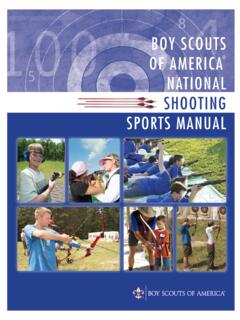
1 ENGINEERING . STEM-Based BOY SCOUTS OF AMERICA. MERIT BADGE SERIES. ENGINEERING . Enhancing our youths' competitive edge through merit badges . Requirements 1. Select a manufactured item in your home (such as a toy or an appliance) and, under adult supervision and with the approval of your counselor, investigate how and why it works as it does. Find out what sort of ENGINEERING activities were needed to create it. Discuss with your counselor what you learned and how you got the information. 2. Select an ENGINEERING achievement that has had a major impact on society. Using resources such as the Internet (with your parent's permission), books, and magazines, find out about the engineers who made this ENGINEERING feat possible, the special obstacles they had to overcome, and how this achievement has influenced the world today.
2 Tell your counselor what you learned. 3. Explain the work of six types of engineers. Pick two of the six and explain how their work is related. 4. Visit with an engineer (who may be your counselor or parent) and do the following: a. Discuss the work this engineer does and the tools the engineer uses. b. Discuss with the engineer a current project and the engineer's particular role in it. c. Find out how the engineer's work is done and how results are achieved. d. Ask to see the reports that the engineer writes concerning the project. e. Discuss with your counselor what you learned about ENGINEERING from this visit. ENGINEERING 3.
3 5. Do ONE of the following: a. Use the systems ENGINEERING approach to make step-by-step plans for your next campout. List alternative ideas for such items as program schedule, campsites, transportation, and costs. Tell why you made the choices you did and what improvements were made. b. Make an original design for a piece of patrol equipment. Use the systems ENGINEERING approach to help you decide how it should work and look. Draw plans for it. Show the plans to your counselor, explain why you designed it the way you did, and explain how you would make it. 6. Do TWO of the following: a. Transforming motion. Using common materials or a con- struction set, make a simple model that will demonstrate motion.
4 Explain how the model uses basic mechanical elements like levers and inclined planes to demonstrate motion. Describe an example where this mechanism is used in a real product. b. Using electricity. Make a list of 10 electrical appliances in your home. Find out approximately how much elec- tricity each uses in one month. Learn how to find out the amount and cost of electricity used in your home during periods of light and heavy use. List five ways to conserve electricity. c. Understanding electronics. Using an electronic device such as a mobile telephone or portable digital media player, find out how sound travels from one location to another.
5 Explain how the device was designed for ease of use, function, and durability. d. Using materials. Do experiments to show the differences in strength and heat conduc- tivity in wood, metal, and plastic. Discuss with your counselor what you have learned. 4 ENGINEERING . e. Converting energy. Do an experiment to show how mechanical, heat, chemical, solar, and/or electrical energy may be converted from one or more types of energy to another. Explain your results. Describe to your counselor what energy is and how energy is converted and used in your surroundings. f. Moving people. Find out the different ways people in your community get to work.
6 Make a study of traffic flow (number of vehicles and relative speed) in both heavy and light traffic periods. Discuss with your counselor what might be improved to make it easier for people in your community to get where they need to go. g. Building an ENGINEERING project. Enter a project in a science or ENGINEERING fair or similar competition. (This requirement may be met by participation on an ENGINEERING competition project team.) Discuss with your counselor what your project demonstrates, the kinds of questions visitors to the fair asked, and how well you were able to answer their questions. 7. Explain what it means to be a registered Professional Engineer ( ).
7 Name the types of ENGINEERING work for which registration is most important. 8. Study the Engineer's Code of Ethics. Explain how it is like the Scout Oath and Scout Law. 9. Find out about three career opportunities in ENGINEERING . Pick one and research the education, training, and experience required for this profession. Discuss this with your counselor, and explain why this profession might interest you. ENGINEERING 5. ENGINEERING Resources. ENGINEERING Resources Scouting Literature Garner, Geraldine O. Careers in Architecture, Automotive Maintenance, ENGINEERING , 2nd ed. McGraw- Chemistry, Composite Materials, Digital Hill, 2002.
8 Technology, Drafting, Electricity, Electronics, Green, Constance McLaughlin. Energy, Inventing, Model Design and Eli Whitney and the Birth of Building, Nuclear Science, Programming, American Technology. Addison Robotics, Space Exploration, Surveying, Wesley Longman, 1997. and Welding merit badge pamphlets Hickam Jr., Homer H. Rocket Boys For more information about or to (October Sky). Delacorte, 1998. order Scouting-related resources, Kent, Steven. The Ultimate History see of Video Games: From Pong to (with your parent's permission). Pokemon. Prima Lifestyles, 2001. Kuprenas, John, and Matthew Frederick. Books 101 Things I Learned in ENGINEERING Anderson, Margaret Jean.
9 Isaac Newton: School. Grand Central Publishing, 2013. The Greatest Scientist of All Time. Middleton, William. Landmarks on the Enslow, 2001. Iron Road: Two Centuries of North Baine, Celeste. Is There an Engineer American Railroad ENGINEERING Inside You? A Comprehensive (Railroads Past and Present). Indiana Guide to Career Decisions in University Press, 1999. ENGINEERING , 3rd ed. Professional Molotch, Harvey. Where Stuff Comes Publications, 2004. From: How Toasters, Toilets, Cars, Berlow, Lawrence H. Reference Guide Computers, and Many Other to Famous ENGINEERING Landmarks Things Come to Be as They Are. of the World: Bridges, Tunnels, Routledge, 2005.
10 Dams, Roads, and Other Structures. Pletsch, William. Integrated Circuits: Oryx, 1998. Making the Miracle Chip. Pletsch &. Brown, Henry T. 507 Mechanical Associates, 2000. Movements: Mechanisms and Reid, The Chip. Random Devices. Dover Publications, 2005. House, 2001. Dupre, Judith. Bridges: A History of the Roberts, Dustyn. Making Things World's Most Famous and Important Move: DIY Mechanisms for Spans. Black Dog & Leventhal, 1997. Inventors, Hobbyists, and Artists.. Skyscrapers: A History of the McGraw-Hill, 2010. World's Most Extraordinary Buildings. Black Dog & Organizations and Websites Leventhal, 2013. American Indian Science and Freedman, Russell.