Transcription of Enhancing Coping Skills for Adolescents
1 Distress Tolerance Enhancing Coping Skills for AdolescentsAndrea Hanley, Bianco, Objectives At the end of this workshop, participants will be able the DBT rationale for clients learning distress tolerance clients to apply at least 1 self-soothing and 1 distraction skill to rapidly reduceextreme knowledge of traditional DBT Skills to Adolescents using illicit substancesto diminish emotional behavior therapy dialectical behavior therapy (DBT) is a type of therapy to help peoplewho have a hard time managing strong and intense emotions. DBT teaches Skills to Regulate emotions Reduce worry about the past and future Form more positive, healthy relationships Tolerate distressing feelings and situationsDBT and Distress Tolerance DBT Skills fall into 4 main categories: Emotion Regulation Mindfulness Interpersonal Effectiveness Distress Tolerance Distress Tolerance Skills should be used when an individual needs to toleratedistressing situations and emotional pain, especially when the problem cannotbe solved right Tolerance Skills Distract with ACCEPTS Self-Soothe Pros & Cons Radical Acceptance Half Smile Urge Surfing (ride the wave) Alternate Rebellion Bridge Burning IMPROVE the Moment Everyday Acceptance Willingness Problem-Solving Grounding Yourself Using SOLVED TIPPSelf-Soothe With The Six SensesCreate relaxation with a mindful connection to the senses When in distress, strong emotions can get in the way of thinking of asolution to the problem or implementing a solution.
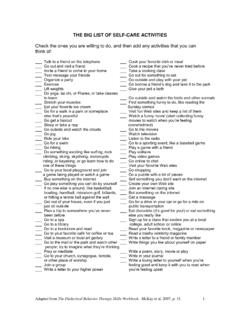
2 Soothing our emotions through the five main senses (taste, smell, touchsight, sound) and the sixth sense of movement sets the stage for beingeffective in the Self-Soothe With The Six Senses Have a self-soothe kit of your own as an example Ask youth to name the 5 senses and name a calming experience associated with eachof the senses. Also, mention movement as a sixth sense Create mini kits to give out Hard candy Scented wax melt or candle Soft fabric or squeeze ball Photo or picture of calm scene List of websites with nice sounds ( , , ) or list of sounds to listenfor ( , wind in leaves, hum of electronics, own heartbeat) Info graphics of stretches, yoga poses, standing exercisesHalf SmileUsing the mind body (and body mind) connection When you feel angry, you scowl. When you feel sad, you look down. When you feelhappy, you smile.
3 Our emotions show on our face and similarly our facial expressionsinform our emotions. In the middle of stress or a difficult situation, creating a comfortable posture and arelaxed facial expression can be one step toward acceptance and communicating toyour brain greater physical calm and emotional Half Smile When youth is already facing a difficult situation, validate first. Ask about theiremotions and let them know it is okay to feel the way they do. I would feel angry in that situation too. I can understand why you would feel thatway. Ask about a time they couldn t handle the situation they are currently dealingwith and remind them they ve come a long way. Was there ever a time you weren t able to handle a situation like this? I think it sreally great that you re handling it now. You re doing a great job.
4 Ask youth about something they are grateful for or a time they felt calm What is one thing that makes you grateful or happy? When do you feel mostcalm? Teaching Half Smile (continued) Help youth imagine a happier or calmer state and ask about how their face times with friends, listening to music, doing something Have youth practice first relaxing facial muscles then creating a small curl to their them hold this facial expression for about 1 minute. Ask if they ve noticed anychange in their AcceptanceAcceptance decreases suffering There are times in life that we must experience suffering,whether due to a trauma, difficult life circumstances, or are five ways we might respond to suffering: Change the situation that is causing us pain Change the way you see or what you think about the situation Radically accept the situation Stay stuck in suffering Make the situation worseTeaching Radical AcceptanceSteps to accepting if this is a situation that simply cannot be changed or solved ( , youth s familyis moving, a friend or family member has died) that there are many ways to respond to a difficult situation and that sometimesthe best way is to just not respond at allbut rather to accept the situation.
5 You don t haveto like or approve of the situation, but trying to change something that can t be changed ortrying to feel differently about a bad situation will only make things worse and prolong thepain youth make the choiceto accept reality as it is. There are some things in life that wedon t have control over, like other people and the environment. What we do have controlover is ourselves, and the choice is ours as to how we control our thinking, feelings,impulses, and behaviors. Teaching Radical Acceptance (continued)Steps to accepting the youth see that after making the choice to accept reality for what it is, theycan focus on being who they need to be and acting how they need to act to be aseffective as possible. Now you can focus less on Why me? and more on This ishow it is. Now that you ve accepted the situation as it is, what is being called forfrom you?
6 Youth practice ways of accepting reality in the future:a)Use mindful breathing to be in the moment and self-sootheb)Use half-smile to accept reality with your facec)Rehearse thoughts about what you would do if you just accept reality as it isd)Make the choice to accept reality and figure out what the situation calls forUsing dialectical behavior therapy for Substance Use DisordersWhy DBT for SUD? DBT is on SAMHSA s National Registry of Evidence-Based Programs andPractices (2014) as a treatment option for: Suicide Attempts Nonsuicidalself-injury (NSSI) Psychosocial Adjustment Treatment Retention Drug Use Symptoms of Easting DisordersWhy DBT for SUD? Studies show significant overlap of BPD and SUD (Linehan, 2010) BPD and SUD = troublesome combination Severe psychopathology upon hospital admissions predicts poorer outcomead early relapse among drug abusers (Saxon and Calsyn, 1995; McLellan et al.
7 , 1992,1983; Woody et al., 1985) Substance abuse is a risk factor for suicide attempts and death by suicide(Rossowand Lauritzen, 1999) In a 6-year study of almost 300 BPD clients, the co-occurrence of SUDs wasmost closely associated with poorer outcome (Zanariniet al., 2004)Research on DBT/SUD4 Randomized Controlled Trials DBT vs. Treatment as Usual (Linehan, Schmidt, Dimeff, Craft, Kanter, & Comtois, 1999) DBT vs. Comprehensive Validation therapy (CVT) with 12-Step (Linehan,Dimeff, Reynolds, Comtois, Welch, Heagerty, & Kivlahan, 2002) DBT vs. Treatment as Usual (Verheul, Van Den Bosch, Koeter, De Ridder, Stijnen, & VanDen Brink, 2003) DBT vs. Treatment as Usual (McMain, 2004)DBT for BPD with SUD Essentially same treatment with slightly different emphasis on: Picking targets Skills modifications and development of new Skills for SUD patients Targets adapted for BPD with SUD.
8 Substance use (Goal is Abstinence + Functionality) Lying Teaching dialectic of emotional vulnerability and self-invalidation Building a life worth living (overarching goal of DBT)DBT Skills for SUDs Distress Tolerance Burning Bridges Urge Surfing Alternate Rebellion TIPP Pros and ConsDBT Skills for SUDs Burning Bridges DBT Skills for SUDs Burning Bridges DBT Skills for SUDs Urge SurfingDBT Skills for SUDs Alternate RebellionDBT Skills for SUDs TIPP Tip your temperature Intensely exercise Pace your breathing Progressively relax your musclesDBT Skills for SUDs Pros and ConsCase to Illustrate Application of DBT for BPD with SUD 25-year-old, single, Caucasian female Diagnosed with MDD, recurrent, in full remission, BPD, Alcohol and Cocaine abuse Frequency of cocaine use typically 3x/week Alcohol use on average: 5x/week, 1-5 glasses of #1: Party Crisis Options for Bridges Leaving the party immediately!
9 Surfing acknowledged the desire for a shot of vodka and reminded self it s awave and it will Rebellion double dip on food, leave the toilet seat up, .. about the pros and cons of drinking Go dance intensely to the musicIs DBT Okay for SUD without BPD?Pending clinical efficacy trials, consider the following: Be guided by empirical literature Consider the extent to which emotional dysregulation plays a role in continueddrug use A reasonable approach for non-BPD multi-diagnostic individuals who have notsucceeded in other evidence-based therapies for SUD A reasonable first-line approach for those with substance dependence who arechronically suicidal but do not meet criteria for BPDR eferences Pederson, L. (2012). The expanded dialectical behavior therapy skillstraining manual: Practical DBT for self-help, and individual & grouptreatment settings.
10 Eau Claire, WI: Premier Publishing & Media Rathus, J. H. & Miller, A. L. (2015). DBT Skills manual for York, NY: The Guilford Press