Transcription of EPIDIOLEX (cannabidiol) oral solution
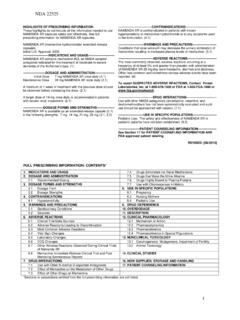
1 HIGHLIGHTS OF PRESCRIBING INFORMATION These highlights do not include all the information needed to use EPIDIOLEX
2 Safely and effectively. See full prescribing information for EPIDIOLEX . EPIDIOLEX (cannabidi ol) oral solution , CX [pending DEA scheduling action] Initial Approval: XXXX [pending controlled substance scheduling] ------------ -- --- -- -- -- --- --INDICATIONS AND USAGE-------------------------- EPIDIOLEX is indicated for the treatment of seizures associated with Lennox-Gastaut syndrome or Dravet syndrome in patients 2 years of age and older (1) ------------ -- --- -- -- -DOSAGE AND ADMINIS TRATION---------------------- Obtain serum transaminases (ALT and AST) and total bilirubin levels in all patients prior to starting treatment.
3 ( , ) EPIDIOLEX is to be administered orally. ( ) The recommended starting dosage is mg/kg taken twice daily (5 mg/kg/day). After one week, the dosage can be increased to a maintenance dosage of 5 mg/kg twice daily (10 mg/kg/day). ( ) Based on individual clinical response and tolerability, EPIDIOLEX can be increasedup to a maximu m recommended maintenance dosage of 10 mg/kg twice daily (20 mg/kg/day). See Full Prescribing Information for titration. ( ) Dosage adjustment is recommended for patients with moderate or severe hepatic impairment.
4 ( , ) ------------ -- --- -- --DOSAGE FORMS AND STRENGTHS --------------------- Oral solution : 100 mg/mL (3) ------------ -- --- -- -- -- --- -- -- -CONTRAINDICATIONS ----------------------------- Hypersensitivity to cannabidiol or any of the ingredients in EPIDIOLEX (4) ------------ -- --- -- -- --W ARNINGS AND PRECAUTIONS ----------------------- Hepatocellular Injury: EPIDIOLEX can cause transaminase elevations. Concomitant use of valproate and higher doses of EPIDIOLEX increase the risk of transaminase elevations.
5 See Full Prescribing Information for serum transaminase and bilirubin monitoring recommendations . ( ) Somnolence and Sedation: Monitor for somnolence and sedation and advise patients not to drive or operate machinery until they have gained sufficient experience on EPIDIOLEX . ( ) Suicidal Behavior and Ideation: Monitor patients for suicidal behavior and thoughts. ( ) Hypersenstivity Reactions: Advise patients to seek immediate medical care. Discontinue and do not restart EPIDIOLEX if hypersensitivity occurs.
6 ( ) Withdrawal of Antiepileptic Drugs: EPIDIOLEX should be gradually withdrawn to minimize the risk of increased seizure frequency and status epilepticus . ( ) ------------ -- --- -- -- -- --- -- --ADVERS E REACTIONS ------------------------------ The most common adverse reactions (10% or more for EPIDIOLEX and greater than placebo) are: somnolence; decreased appetite; diarrhea; transaminase elevations ; fatigue, malaise, and asthenia; rash; insomnia, sleep disorder, and poor quality sleep; and infections.
7 ( ). To report SUSPECTED ADVERS E REACTIONS, contact Greenwich Biosciences at 1-833-424-6724 (1-833-GBIOSCI) or FDA at 1-800-FDA 1088 or me dwatch. -------------------------------DRUG INTERACTIONS ----------------------------- Moderate or strong inhibitors of CYP3A4 or CYP2C19: Consider dose reduction of EPIDIOLEX . ( ) Strong inducer of CYP3A4 or CYP2C19: Consider dose increase of EPIDIOLEX . ( ) Consider a dose reduction of substrates of UGT1A9, UGT2B7, CYP2C8, CYP2C9, and CYP2C19 ( , clobazam).
8 ( ) Substrates of CYP1A2 and CYP2B6 may also require dose adjustment . ( ) ------------ -- --- -- -- --US E IN SPECIFIC POPULATIONS ----------------------- Pregnancy: Based on animal data, may cause fetal harm. ( ) See 17 for PATIENT COUNSELING INFORMATION and Medication Guide Revised: 6/2018 FULL PRESCRIBING INFORMATION: CONTENTS* 1 INDICATIONS AND USAGE 2 DOSAGE AND ADMINISTRATION Assessments Prior to Initiating EPIDIOLEX Dosage Information Administration Instructions Discontinuation of EPIDIOLEX Patients with Hepatic Impairment 3 DOSAGE FORMS AND STRENGTHS 4 CONTRAINDICATIONS 5 WARNINGS AND PRECAUTIONS Hepatocellular Injury Somnolence and Sedation Suicidal Behavior and Ideation Hypersensitivity Reactions Withdrawal of Antiepileptic Drugs 6 ADVERS E REACTIONS
9 Clinical Trials Experience 7 DRUG INTERACTIONS Effect of Other Drugs on EPIDIOLEX Effect of EPIDIOLEX on Other Drugs Concomitant Use of EPIDIOLEX and Valproate CNS Depressants and Alcohol 8 USE IN SPECIFIC POPULATIONS Pregnancy Lactation Pediatric Use Geriatric Use Hepatic Impairment 9 DRUG ABUSE AND DEPENDENCE Controlled Subs tance Abuse Dependence 11 DESCRIPTION 12 CLINICAL PHARMACOLOGY Mechanism of Action Pharmacodynamics Pharmacokinetics 13 NONCLINICAL TOXICOLOGY Carcinogenesis and Mutagenesis 14 CLINICAL STUDIES Lennox-Gastaut Syndrome Dravet Syndrome 16 HOW SUPPLIED/STORAGE AND HANDLING How Supplied Storage and Handling 17 PATIENT COUNSELING INFORMATION * Sections or subsections omitted from the full prescribing information are not listed.
10 Reference ID: 4282447 FULL PRESCRIBING INFORMATION 1 INDICATIONS AND USAGE EPIDIOLEX is indicated for the treatment of seizures associated with Lennox-Gastaut syndrome (LGS) or Dravet syndrome (DS) in patients 2 years of age and older.