Transcription of EVIDENCE BASED MEDICINE (EBM) Overview: Notes Validity ...
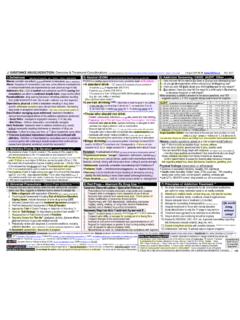
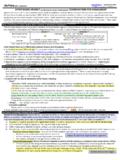
1 EVIDENCE - BASED MEDICINE (EBM) overview : Notes on Validity , Precision & Contextualization of Results1,2,3,4,5 L Regier BSP BA Nov 2019 For references/updates/extra info see.
2 Critical Appraisal of Drug Studies 6,7 A) Is the study valid? 1. Were patients randomized to treatment (tx) groups & was allocation concealed (AC)? {Without concealment, 37% bias in favor of tx. Sealed, opaque envelopes or central registry used to attain AC} 8,9 2. Was everyone (patients, physicians, investigators, assessors) blinded to tx? {Especially important for assessors of subjective outcomes eg. Pain.} 3. Was the study controlled? ( inclusion of placebo or active control group/arm; in an N of 1 trial, patient is own control.) 4. Were treatment & control groups similar in prognostic factors for outcome of interest at beginning of study?
3 If not, were adjustments made? 5. Were all patients accounted for at end? {Missing patients addressed?} 6. Was data analyzed BASED on groups patients were initially randomized to? {Intent to treat or ITT; protects integrity of prognostic randomization; per protocol (PP) analysis may also be of interest ( non-inferiority trials} 7. Were patient groups treated similarly except for study intervention? 8. How was the study funded (role of funder)? Was study stopped early? 9. Was active comparator drug & dose a good choice? B) What are the study results? 1. What was the primary (1 ) endpoint?
4 What were the secondary (2 ) endpoints? Were endpoints & subgroups pre-specified?10 Avoid data mining! 2. What was the difference between treatments? (Benefits & Harms) 3. Were the differences statistically significant? Clinically significant? {What were the 95% confidence intervals (CIs) or p values? Does the CI cross line of no effect?} 4. What are the absolute and relative risk reductions or increases? 5. What is the number needed to treat (NNT) or harm (NNH)? C) Does this study matter to my patients? 1. How clinically relevant/important are the outcomes? 2. Were the patients similar to those in my practice?
5 {Consider inclusion & exclusion criteria; very sick, old, young, drug interactions & complicated/co-morbid patients often excluded.} 3. Do treatment benefits outweigh the risks, costs & impact on life? Types of Studies (from low to high level of EVIDENCE ) 11 Case-control study: a retrospective observational study which selects patients with the outcome of interest (cases) & patients without that outcome (controls); attempts to find exposures linked to the outcome. Cohort study: an observational study in which two groups (cohorts) are observed over time for an outcome of interest.
6 One cohort has exposure to a condition or treatment that the other does not. {Observational studies: association does not prove causation! Strength of association: RR: weak; moderate; >3 } Crossover study: a design in which each patient receives both treatments in two phases separated by a washout period. Each patient serves as own control, thus less variability in outcomes, & smaller sample size required; period effects may limit findings. Randomized controlled trial (RCT): a prospective study in which patients are randomized to treatment or control groups (equal chance at being assigned to any group).
7 Groups are followed for outcome of interest. Systematic Review (SR): a systematic collection, review & presentation of available studies addressing a clinical question using specific criteria may include meta-analysis. Cochrane13/Campbell14 Reviews {Meta-analysis: the combining of studies meeting prespecified criteria & addressing a clinical question. Results are calculated from the data of each study. Data is then pooled. sample size & statistical power useful if individual trials underpowered or subgroup analysis.} [Level of EVIDENCE : SR > RCT > observational study > expert Caution: Lots of low quality RCTs may not be better than 1 good quality RCT!]
8 A low quality SR, or a SR of low quality trials does not constitute high-level EVIDENCE .] Terms: Related To Validity Bias: design flaws leading to over/underestimation of treatment effect recall bias, selection bias, publication bias; confounding factors esp observational studies Blinding: if investigators, patient etc are unaware of who receives tx vs control, they are less likely to inappropriately report better results with tx. Study Results: Size Of The Treatment Effect 16,17,18,19 Event rate (ER): the number of people experiencing the event as a proportion of total number of people in the population or group -Experimental ER (EER): {# events in experimental group / total in exp.}
9 Group} -Control group ER (CER): {# events in control group / total in control group} Relative risk (RR) or risk ratio: {EER/CER} Relative risk reduction (RRR): the RR subtracted from 1 {RRR=1 RR} [Whereas ARR varies with type of population treated, RRR is often more constant.] Absolute risk reduction (ARR): the arithmetic difference between the 2 event rates {CER EER} [If risk: ARI= absolute risk increase] Number needed to treat (NNT): the number of patients who would have to be treated with the studied intervention for the studied time period for 1 of them to benefit.
10 {NNT= 100 / ARR%} Number needed to harm (NNH): number of patients who would have to be treated with the studied intervention per studied time period for 1 extra person to experience the adverse event. {NNH = 100 / ARI%} Odds ratio (OR): = experimental event odds / control event odds; especially used in case-control studies where baseline risk is not known; also used in meta-analysis. When events are rare, the OR is similar to the RR; however, OR rate exaggerated relative to RR when events more common. {Link : tool for converting OR to NNT20} Point estimate: the trial result used as best estimate of the true effect Hazard ratio (HR): like RR but more accurate; accounts for the time each participant was in the study before having event or withdrawing.