Transcription of Excavation Safety - ClickSafety
1 Introduction Excavation Safety Welcome! This module will cover: The Federal OSHA Excavation standard CFR 1926 Subpart P, excavations Course length: 30-40 minutes Refer to your local state laws for more information. Introduction Course Objectives Upon completion of this course, you should be familiar with the hazards of trenching and related OSHA Safety standards, including those regarding: Classification of soils Air monitoring Trench and Excavation access Spoils piles Shoring and sloping Learn how to identify and mitigate Excavation hazards Introduction Learning Objectives Upon completion of this training session, the student will be able to: 1: Identify major Excavation hazards 2: Describe types of Excavation hazards 3.
2 Protect him/herself from Excavation hazards 4: Recognize employer requirements to protect workers from Excavation hazards Introduction TIP: Disclaimer: This Compliance Assistance product is not a standard or regulation, and it creates no new legal obligations. The Compliance Assistance product is advisory in nature, informational in content, and is intended to assist employers in providing a safe and healthful workplace. Pursuant to the Occupational Safety and Health Act, employers must comply with Safety and health standards promulgated by OSHA or by a State with an OSHA-approved State Plan.
3 In addition, pursuant to Section 5(a)(1), the General Duty Clause of the Act, employers must provide their employees with a workplace free from recognized hazards likely to cause death or serious physical harm. Employers can be cited for violating the General Duty Clause if there is a recognized hazard and they do not take reasonable steps to prevent or to abate the hazard. However, failure to implement these recommendations is not, in itself, a violation of the General Duty Clause. Citations can only be based on standards, regulations, and the General Duty Clause.
4 Introduction Topic 1 Overview What is a Excavation Hazard? Definitions Statistics Examples ALL Excavation related deaths are 100% PREVENTABLE! Introduction Topic 2 Overview What are the Major Types of Excavation Hazards in Construction? A. Unprotected edges B. Fall hazards C. Improper sloping or benching D. Spoils mismanagement E. Not properly classifying soils F. Improper shoring systems Introduction Topic 3 Overview How can I protect myself from Excavation Hazards? Training Requirements Requirements for excavations systems and Sloping soils Introduction Topic 4 Overview What is my employer required to do to protect workers from excavations ?
5 Provide Excavation Protection Training & Equipment Proper Excavation Techniques Excavation Inspections and Use Competent Person Introduction OSHA s Excavation Safety Standards In place since 1989 37% of all trenching incidents occur at depths less than 5 feet! Most fatalities occur in trenches 5-15 feet deep Employers & Employees are responsible to ensure excavations are safe before entering Safety Standards are designed to save your life! Introduction Trench or Excavation ? Trench: a cut in the earth that is deeper and longer than it is wide, but not wider than 15 feet Excavation : any man-made cut, cavity, trench, or depression in an earth surface, formed by earth removal Trenches and excavations : Similar characteristics Equally dangerous Require worker protection What is an Excavation Hazard?
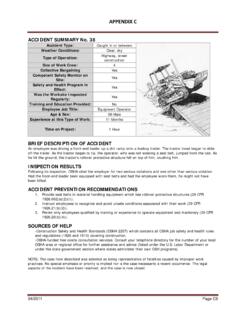
6 Review the Facts: Excavation Fatality #1 Victim: 37-year-old laborer, 3 years of experience Task: installing a small diameter pipe in a trench Trench: 3 feet wide, 12 15 feet deep, 90 feet long Not shored or sloped No box or shield Evidence of a previous cave-in Results: Victim killed in a second cave-in How was this preventable? What is an Excavation Hazard? Excavation Fatality Root Cause OSHA citations to management included failure to provide: Sloping or shoring Adequate PPE Ladder, ramp, or runway access Proper training This death was 100% Preventable!
7 What is an Excavation Hazard? Review the Facts: Excavation Fatality 2 Victims/task: employees replacing a concrete filter tank at a carwash Trench: 9 feet deep, 14 feet long, 6 feet wide No shoring or sloping provided Tragedy: a vertical face gave way, killing one employee, seriously injuring the other. What is an Excavation Hazard? Excavation Fatality 2 (cont.) OSHA citations to management included failure to: Shore unstable soils. Train employees. Provide PPE. Enforce the use of PPE. Protect against impalement. 15 Find and Fix Recognize Any Hazard(s)?
8 16 Find and Fix What is an Excavation Hazard? Myths of Excavation If the trench is not deeper than 5 feet, I don t have to shore or protect the Excavation . Air monitoring is only for confined spaces, not excavat i o n s . I can dig myself out if I am buried. Hitting utilities is simply part of the business! If the soil looks pretty good, it must be type A. What is an Excavation Hazard? Myth 1: Under Five feet, Shoring Is Not Required The OSHA regulation actually says: Each employee shall be protected .. Except when excavations are less than 5 feet and examination of the ground by a competent person provides no indication of a potential cave-in.
9 Therefore, based on the competent person s examination, shoring may still be required. What is an Excavation Hazard? Myth 2: Air Monitoring Is Not Required in Trenches OSHA requires air monitoring in confined spaces. Includes trenches deeper than 4 feet, which present hazards such as: Methane gas (landfills) Flammable vapors (old gas stations) Carbon monoxide (your own equipment) Various chemicals (welding tasks, etc.) Safety Tip: Most of us don t think of trenches as confined spaces, so the thought of air monitoring is not a primary issue when excavating.
10 What is an Excavation Hazard? Myth 3: I Can Dig Myself Out Reality of a cave-in: A cubic yard of soil can weigh as much as a small pickup truck. soil pressing on the chest can make it impossible to breathe. Fine particles of dirt can clog your nose, mouth, and lungs. Safety Tip: The first order of business is protecting workers in the trench, not planning on an impossible self rescue. What is an Excavation Hazard? Myth 4: Hitting Utilities Is Part of the Business Live electrical lines in the ground can kill workers and cause significant property damage.