Transcription of Exemplars Science Alignments
1 Page 1 What Is Exemplars ? ..3 Science Exemplars ..4 How Do People Use Exemplars ? ..5 A Guide for Exemplars Science Inquiry Tasks ..6 About Student Self-Assessment ..10 Exemplars Science Rubrics ..13 Science Education and Developmental Stages of Children Ages 5 11 ..19 Getting Started With Science Portfolios ..21 Effective Classroom Assessment Practices and Guidelines ..22 Analytic and Holistic Scoring Rubrics: What is the Difference? ..26 The Process of Inquiry ..30 Guiding Students to Design and Conduct Investigations ..36 Implementing Exemplars in the Classroom ..38 Learning and Teaching Activities ..41 Table of ContentsExemplars Science AlignmentsIn an effort to assist teachers and administrators on the local level, Exemplars has aligned its Science material to NGSS, state and national STEM standards.
2 To access our current product Alignments please visit: The Alignments database can be searched by both standard and product. This service is FREE! We hope this feature will make implementation in your classrooms Hess, Editor, Science Exemplars ConsultantTracy Lavallee, Science Exemplars ConsultantDeborah Armitage, Exemplars ConsultantExemplars 271 Poker Hill Road, Underhill, VT 2017 What Is Exemplars ?Increasingly, schools, districts and states are adopting new standards and revising their Science curriculums. Teachers, curriculum coordinators and administrators are grappling with how to incorporate them, along with new authentic assessments and instructional strategies into an already challenging classroom started Exemplars to respond to the many teachers we have worked with who have told us how badly they want to implement standards-based assessment and instruction in their classrooms and how challenging it goal of Exemplars is to provide performance assessment inquiry tasks, scoring rubrics, anchor papers and tips to make it more manageable for educators to implement new standards and this approach to began in 1993 with authentic assessment in mathematics for grades K 8 to help teachers, schools and districts implement the NCTM standards.
3 It was created with the help of classroom teachers, drawn nationwide from model practitioners teachers who have been through the process of setting standards, designing authentic inquiry tasks and using rubrics to assess student performance. It has helped schools and districts in 50 states and 30 foreign countries to meet the challenges of national, state and local standards. Response to this teacher-developed, classroom-tested model has been enthusiastic. It is viewed as so user friendly and non-threatening that teachers enjoy working with 1993, Exemplars added Mathematics 9 12, and in 1995 we added Science , K 8. RWR (Reading, Writing and Research in the Content Areas) was published for grades 5 8 in 1999. Our newest products include Developing Writers and Spanish ToolkitPage 3 Exemplars has helped schools and districts in 50 states and 30 foreign countries to meet the challenges of national, state and local ExemplarsScience Exemplars is based on guidelines put forth by Benchmarks for Science Literacy (Project 2061 of the American Association for the Advancement of Science ) and National Science Education Standards (National Research Council).
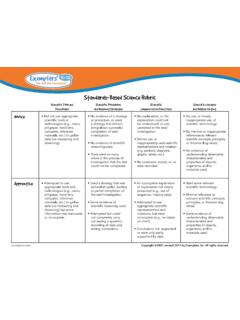
4 Alignments to NGSS, state and national STEM standards can be viewed online at Exemplars is focused on the big ideas of Science beginning at the K 2 level and is concerned with content as well as process. (See the description of Exemplars Inquiry Tasks and Rubric on pages 6 18.) Science Exemplars is a vehicle for improving assessment and instruction. It improves assessment by providing: Inquiry-based assessment tasks Rubrics that are aligned to state and national standards in Science Anchor papers exemplifying four levels of Science performance; Novice, Apprentice, Practitioner and ExpertIt improves instruction by: Making standards clear to students Encouraging students to self-assess Giving students the opportunity to work as scientists on interesting investigations and inquiry tasks Providing teachers with support by relating each task to the big ideas of Science ; the context for the problem; interdisciplinary links; and possible solutionsScience Exemplars has been reviewed and approved by Science ToolkitPage 4 Alignments to NGSS, state and national STEM standards can be viewed online at alignmentsHow Do People Use Exemplars ?
5 People use Exemplars in many different ways. Teachers use Exemplars for both assessment and instruction, depending on the circumstances. The tasks in Exemplars are inquiry-based performance assessments. They can be used to help teach students skills and concepts and to assess students understanding of skills and concepts. Exemplars include: Preassessments given at the beginning of a unit to assess what students already know Formative assessments given to inform instruction and assess how students are progressing Culminating or Summative assessments given at the end of the unit to assess student understanding Exemplars engaging inquiry tasks, rubrics and anchor papers make it an ideal vehicle for professional development. Administrators have found Exemplars to be a powerful way of reporting student performance based on national and state standards to their communities. Students use Exemplars to learn the practice of Science and the process of self-assessment.
6 Principals, curriculum coordinators, content area supervisors and staff developers have found Exemplars to be an effective way of helping teachers begin to understand standards and performance ToolkitPage 5 Teachers use Exemplars for both assessment and instruction. The tasks in Exemplars are inquiry-based perfor-mance assessments. They can be used to help teach students skills and concepts and to assess stu-dents understanding of skills and concepts. A Guide for Exemplars Science Inquiry TasksExemplars tasks are designed for different developmental levels, and they have been grouped by grades K 2, 3 5 and 6 8. Each task is written with one of these developmental levels in mind. Often, for many tasks, adaptations (in materials, data collection procedures and tools, representations used, data analysis, etc.) can be made for students with more or less sophisticated levels of skills and understanding. Student work samples are benchmarked for the identified grade levels and the tasks as task includes the following: Inquiry Task and Essential Question to be Answered Describes what Science concepts this investigation explores and which Science process skills are reinforced during the task.
7 The Essential Question provides the lesson focus or the question students are trying to answer. Big Ideas and Unifying Concepts While no single lesson can address the big ideas of Science , we have included some unifying concepts toward which particular tasks can help build an understanding in relation to other Science lessons. Many teachers will find this a useful way to connect one lesson or unit to others throughout the year. Unifying concepts, identified by the national Science standards, include: Change-Constancy Cause-Effect Order and Organization Models Systems Interdependence Evolution and Equilibrium Form and Function Design Patterns ScaleScience ToolkitPage 6 Many teachers will find unifying concepts a useful way to con-nect one lesson or unit to others throughout the year. Science Content Science content areas that are addressed and assessed through Exemplars Science Inquiry Tasks are identified under five broad headings: Physical Science Concepts properties of matter, motion and forces, transfer and transformation of energy Life Science Concepts structure and function, reproduction and heredity, regulation and behavior, population and ecosystems, evolution, diversity and adaptations Design Technology use of tools, invention, design constraints and advantages, impact on human and other resources Science in Personal and Societal Perspectives personal health; populations, resources and environments; natural hazards; risks and benefits; and Science , technology and society Earth Science earth systems; earth s history; solar system; and natural resource management Time Required for the Task Time is estimated and is based upon the teacher s field test.
8 Context Describes what the students have already been doing in Science to lay the groundwork for this activity and what prior knowledge and skills they might draw upon to accomplish the task. What the Task Accomplishes Describes how this investigation task will teach, reinforce, and assess the skills and knowledge identified in the corresponding Science standards. How the Student Will Investigate Describes how students will be engaged during the task. Includes how the teacher might guide exploration, ask questions, and model skills needed for successful completion of the task. Interdisciplinary Links and Extensions Includes suggested topics and activities that can extend the learning from this activity to other content areasScience ToolkitPage 7 Children are natural inquirers, they still need to be taught the specific skills of inqui-ry so that they can begin to think and act as scientists do. Teaching Tips and Guiding Questions Includes ideas to guide the inquiry process during the lesson (s).
9 While the children engage in exploration, suggested questions are provided to guide their thinking and lead them to the big ideas. Good questions ensure that students build understanding while they manipulate materials and record information. Questions should move from the specific (How different ) to the general (Can you state a rule Do all in the same way?) Concepts to be Assessed Identifies unifying concepts (big ideas) and Science concepts to be assessed using the Science Exemplars Rubric criterion: Science Concepts and Related Content. This brief overview calls attention to what conceptual knowledge and scientific terminology students will demonstrate an understanding and use of in their work samples. For example: Observing and explaining reactions of bending and not bending (cause-effect); Observing and comparing physical properties of matter (comparing the weight, size, and flexibility of solids); Classifying materials according to properties, etc.
10 Skills to be Developed Identifies specific Science process skills to be assessed using the Science Exemplars Rubric (under the criteria: Scientific Procedures and Reasoning Strategies and Scientific Communication/Using Data). This brief overview calls attention to scientific skills students will demonstrate an understanding and use of in their work samples. For example: Observing, Predicting, Classifying, Recording, Communicating, Measuring, etc. needed to complete the task. Links to Science (and other) Standards Identifies connections to Science (and mathematics) standards. For example: Scientific Method: Students describe, predict, investigate and explain phenomena. Scientific Theory: Students look for evidence that explains why things happen, and modify explanations when new observations are made. Physical Science Properties of Matter: Students describe and sort objects and materials according to observations of similarities, and differences of their physical properties (size, weight, color, shape, texture and flexibility).