Example: barber
Exploration One: Our Community
activities in the Explorations begin with routines and learning about the classroom and progress to more abstract ideas throughout the year. Explorations are grounded in research on developmental expectations as described in the Head Start Early Learning Outcomes Framework: Ages Birth to Five (ELOF), which outlines the
Tags:
Information
Domain:
Source:
Link to this page:
Documents from same domain
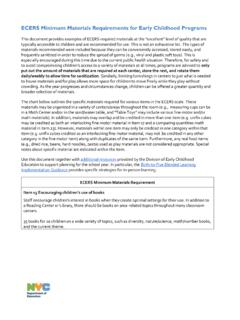
ECERS Minimum Materials Requirements for Early Childhood ...
infohub.nyced.orgshapes, lines, space and colors while making a unique product only they could have created. All materials must be accompanied by paper as needed or another surface for use such as drawing paper or an easel. In addition, all of the necessary materials must be present (e.g., collage materials must have some adhesive or paint must have brushes).
Connections - Infant and Toddler Curriculum for …
infohub.nyced.orgResponsive Caregiving, 24-36 Months The enclosed instructional guidance may be used for educational, non profit purposes only. If you are not an Early Learn or NYC DOE Head Start provider, send an email to deceinstruction@schools.nyc.gov to request permission to use this document or any portion thereof.
Using IEP Goals in the Pre-K Classroom
infohub.nyced.orgUsing IEP Goals in the Pre-K Classroom If a child is found eligible to receive preschool special education services, an Individualized Education Program (IEP) is developed. An IEP is about an individual child and how to meet his or her unique needs within the context of …
Unit 6 Light - infohub.nyced.org
infohub.nyced.orgChildhood Education Early Childhood Framework for Quality (EFQ). See Section IX: Supporting Resources for more information about Family Engagement Practices. Culminating Celebration This is an opportunity to reflect on the unit with the children, as well as to note and celebrate the growth and learning that has occurred.
The Early Childhood Environment Rating Scale - Revised ...
infohub.nyced.orgThe DOE uses the ECERS -R tool as a way to look consistently at pre-K learning environments across the city • Developed by the University of North Carolina as a way to measure
Unit Seven: Water Unit Seven: Table of Contents Water I ...
infohub.nyced.org7 UNIT FRAMEWORK III. Unit Framework Essential Question This is a child-friendly question that connects the knowledge and skills that children should develop
Procurement Policy and Procedures - infohub.nyced.org
infohub.nyced.orgDOE Procurement Policy and Procedures Section 3-02 COMPETITIVE SEALED BIDDING (a) Application.....40 (b) Request for Bids.....
Pre-K Scope and Sequence - infohub.nyced.org
infohub.nyced.orgPre-K Scope and Sequence. 1. The underlined standards are the focus standards for the first unit, Welcome to Pre-K, in the first theme, My Community and Me
Unit 1 - Welcome to Pre-K
infohub.nyced.orgMusic PK.ARTS.8. [MU:Cr1-3.PK] Creates Music . 4 II. Unit Introduction The first few weeks of the pre-K year are an exciting time. Just like you, children and families wonder about the upcoming year and what it will bring. For some families, this will be their first experience with
Unit Two: My Five Senses - infohub.nyced.org
infohub.nyced.orgdraw conclusions: key higher-level science skills that they will use in upcoming pre-K units and in kindergarten. For your reference, there is a graphic representation on the right side of this page depicting how we use our senses to gather information about the world. In this Unit, there is a focus on developing the
Related documents

New York State Prekindergarten Foundation for the Common …
www.p12.nysed.gov“Early childhood education for all children ages birth through grade 3 is an integrated system designed to ensure that ... Prekindergarten and preschool teachers, caregivers, and parents can determine what children are learning, ... children, as well as examining and commenting on their creations and explorations, provides valuable ...

Social Studies in the Primary Program
www.education.ne.govExplorations with young children: A curriculum guide from the bank street college of education. Mt. Ranier, MD: Gryphon House. National Council for the Social Studies. (1989). Social studies for early childhood and elementary school children: A report from NCSS task force on early childhood elementary social studies. Social Education, 53(1), 14-24.
Vygotskian and Post-Vygotskian Views on Children’s Play
files.eric.ed.govof this theory. Early childhood for Vygotsky was the period during which the restructuring of lower mental functions goes through its initial stages as children for the Œrst time the lives used cultal tools to transform the c ognitive processes such as perception, attention, memory, and thinking. Social-emotional
Early Childhood Mathematics: Promoting Good Beginnings
www.naeyc.orgearly foundations of literacy. Similarly, increased energy, time, and wide-scale commitment to the early years will generate significant progress in mathematics learning. The opportunity is clear: Millions of young children are in child care or other early educa-tion settings where they can have significant early mathematical experiences ...