Transcription of Explosion Protection - Endress+Hauser
1 Products Solutions ServicesExplosion ProtectionExplosion ProtectionGuidelines and General Principles Light&Magic - Iris Speth - PantherMediaExplosion protection23 ForewordIn many industry sectors, combustible and potentially explosive atmospheres in the form of gases, vapors, mists or dusts are a present concern. The coal mining, chemical and petrochemical sectors are of particular concern, but the food industry, mill operation, wastewater and biogas production sectors are also affected. These combustible substances can form a potentially explosive atmosphere when mixed with oxygen. The explosions occurring when this atmosphere is ignited can result in severe personal injury and/or damage to property. To prevent the risk of Explosion , most industrialized nations have developed protective precautions in the form of laws, regulations and standards so as to achieve a high level of safety. Based on the frequency and duration of the occurrence of potentially explosive atmosphere, the affected sectors, plants or plant sections are classified into zones of different degrees of exposure.
2 The operators of these facilities are required to prevent Explosion hazards via protective measures in potentially explosive There are three prerequisites for an Explosion : a combus-tible gas or dust, oxygen and a source of ignition. Primary Explosion prevention can be achieved by, for example, inerting the gas atmosphere. On the other hand, secondary Explosion prevention consists of avoiding sources of ignition. Manufacturers of devices and Protection systems must therefore develop and design their devices and systems so that they present no source of ignition neither in normal opperation nor in consideration of foreseeable faults. Design-based Explosion prevention limits the effects of an Explosion to a tolerable brochure provides an introduction to and overview of Explosion prevention, focusing on device and Protection system requirements for use in potentially explosive atmospheres. Note that the legal and normative regulations are subject to ongoing revisions and adaptations to new technical developments.
3 The information contained in this brochure therefore corresponds to the current status at the time this document was of contents1. General principles and definitions .. 52. European Community guidelines .. 103. North American region guidelines .. 244. IECEx program .. 285. Glossary .. 30 Explosive atmosphereCombustible substanceExplosionAir / oxygenIgnition sourceSecondary Explosion preventionPreventing the ignition of a hazardous, potentially explosive atmospherePrimary Explosion protectionPreventing the formation of a hazardous, potentially explosive atmosphereDesign-related Explosion preventionLimiting the effect of an Explosion to a tolerable level321 Explosion protection4 Explosion A sudden, chemical reaction of a combustible substance with oxygen while releasing high energy leads to an Explosion . These combustible substances can be gases, mists, vapors or dusts. Three factors must be simultane-ously present for an Explosion to occur: A combustible substance (in corresponding distribution and concentration) Oxygen (in the air) A source of ignition ( electrical sparks, hot surfaces)Primary and secondary Explosion prevention The principle of Explosion prevention requires that all Explosion prevention measures have a specified sequence defined.
4 Primary and secondary protective measures are differenti-ated in this Explosion Protection refers to all measures that prevent a potentially explosive atmosphere from Explosion prevention is required if the risk of Explosion is not at all or only partially eliminated through primary Explosion prevention potentially explosive atmosphere is a mixture of air and combustible gases, vapors, mists or dusts under atmospheric conditions, in which the combustion process expands of the overall unconsumed mixture once ignition conditions are defined at an absolute pres-sures of bar to bar and mixture temperatures of -20 C to +60 General principles and definitions Explosion triangleRegarding the ignition source, there is a wide variety of potential triggers for an Explosion : Open flames Hot surfaces Electrical sparks and arcs Electrical discharges Atmospheric discharges Mechanical frictional or impact sparking Electrostatic discharge Ultrasonic Optical radiation Chemical reaction0 vol%100 vol%LELUELL ower Explosion limitUpper Explosion limitLean mixtureRich mixturePotentially explosive atmosphere5 General principles and definitionsClassification of flammable gasesTo assess technical safety, defined characteristic quantities of combustible substances are necessaryExplosion limits A potentially explosive atmosphere forms from combustible substances if they are in a defined concentration range (see image).
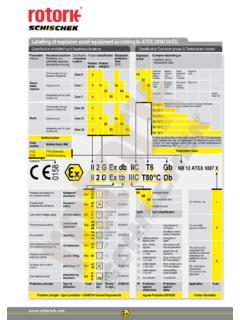
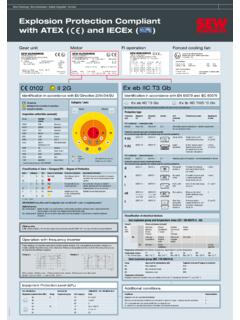
5 If the concentrations are too low (lean mixture) or too high (rich mixture), then no Explosion occurs, but rather a slow burning process, if any at all. The mixture only reacts explosively when ignited in the range between the upper and lower Explosion limit. The Explosion limits are dependent upon ambient pressure and the oxygen content of the air. Depending on the speed of the elapsing burning process, it may be designated as a deflagration, Explosion or detonation. An potentially explosive atmosphere exists if ignition presents a danger to persons or property. A potentially explosive atmosphere, even one with low volume, can lead to hazardous explo-sions in a closed designation Lower Explosion limit [vol. %] Upper Explosion limit [vol. %] of Explosion groups For certain Explosion Protection measures, particularly intrinsic safety and flameproof enclosures, the equipment must be marked with the Explosion group it belongs to.
6 Criteria for classification are the maximum safe gaps and the minimum ignition current. The maximum safe gap and minimum ignition current are measured for various gases and vapors under precisely defined testing ignitability of the gases increases from Explosion group IIA to IIC. The requirements for electrical equipment rise according to the increaseing Explosion group. Electrical equipment permissible for Explosion group/gas group IIC may also be used for all other Explosion protection6 Temperature class Permissible surface temperature for electrical equipment [ C] Ignition temperature range for combustible substances [ C] T1450>450T2300>300 to 450T3200>200 to 300T4135>135 to 200T5100>100 to 135T685>85 to 100 Explosion groups Explosion groupMaximum safe gap [mm]Minimum ignition current ratioIIA> > to to < < permitted ignition energy (ignition gas)160 J (pro-pane)80 J (ethyl-ene)20 J (hydro-gen) Explosion limits of combustible substances In condi-tions other than atmospheric conditions (temperatures: -20 to +60 C, pressures: to bar), the Explosion limits change.
7 The concentration range between the Explosion limits becomes extended, generally from increas-ing pressure and increasing upper Explosion limit is significantly higher with oxygen than with air mixtures. A potentially explosive atmosphere can only occur above a combustible liquid if the fluid surface temperature exceeds a minimum level. Under certain conditions, some chemically unstable substances have no upper Explosion limits. These substances can undergo an exothermic reaction even without the presence of air/oxygen. Temperature classes The ignition temperature of a combustible gas or liquid is the lowest temperature of a heated surface at which the gas/air or vapor/air mixture just barely ignites. Consequently, the highest equipment surface temperature must always be lower than the ignition temperature of the surrounding atmosphere. Temperature classes T1 to T6 are introduced for electrical equipment. Equipment is assigned to the respective temperature class based on its maximum surface tempera-ture.
8 Equipment in a higher temperature class can also be used for applications with a lower temperature class. Combustible gases and vapors are assigned to the respective temperature class according to their ignition ignition energy (mJ) ignition sourcesWelding sparks, impact sparksGrinding sparks (cut-off grinder)Electrostatic discharges, impact sparks7 General principles and definitionsSolid substances in crushed form in the form of dust or fibers are frequently present in industrial sectors, in chemical plants, the food industry or flour mills. Dust is a finely dispersed solid below a particle size of approx. 500 m. If dust layers with small particle size are dispersed, a risk of Explosion is present. The risk of Explosion grows with decreasing particle size. Frequently, explosions result from dispersed dust layers that contain their own ignition source. A dust layer of less than 1 mm distributed uniform-ly on the ground is sufficient to fill a room with normal ceiling height with a potentially explosive dust/air mixture when the dust is uniformly relevant data include parameters for dispersed dusts such as the minimum ignition energy and the ignition temperature, whereas the glow temperature is a character-istic property for dust , vapors and dustsMinimum ignition energy in mJ (millijoules)Carbon flour20 60 Sugar40 Lignite80 Ammonia680 Minimum ignition energy for various materialsMinimum ignition energy A specific amount of energy has to be applied to ignite a potentially explosive atmo-sphere.
9 The minimum ignition energy is the least possible amount of converted energy ( discharge of a capacitor) needed to ignite the corresponding combustible mixture. The minimum ignition energy is between approximately 20 J for hydrogen up to a few joules for certain dusts. BASF - Press PhotoExplosion protection8 Classification of flammable dustsIgnition temperature [Tignition] The lowest temperature of a hot surface [Tmax(1)], detected under specified test conditions, at which the most ignitable mixture of dust with air (dust cloud) temperature [Tglow] The glow temperature is the lowest temperature of a hot surface, detected under specified test conditions, at which a dust layer with 5 mm thickness starts to dust layers thicker than 5 mm can form on equipment, the maximum permitted surface temperature [TMax(2)] must be reduced accordingly. The maximum permitted surface temperature can be reduced according to the chart per EN permitted surface temperature (1): Tmax(1) = 2/3 TignitionMaximum permitted surface temperature (2): Tmax(2) = Tglow - 75 KExample: Minimum ignition temperature: 330 CMinimum glow temperature: 300 C Maximum permitted surface temperature for dust clouds Tmax(1) = 2/3 x 330 C = 220 C Maximum permitted surface temperature for dust layers (5 mm thickness) Tmax(2) = 300 C 75 K = 225 C Permitted surface temperature = 220 C In this case, equipment used must have a max.
10 Surface temperature of < 220 C in case of principles and definitionsDecrease of the maximum permitted surface temperature in case of increasing dust layer thickness (chart per IEC/EN 60079-14)Thermal insulation increases for thicker dust layers, with the result that the dust layer can glow even at low housing temperatures. Therefore, ensure that the equipment surface temperature is reduced. This surface temperature has to be determined according to the graph above for dust layers between 5 mm and 50 mm. These curves take a typical temperature reduction of 75 K into account. C400300200100001020304050mmLayer thicknessGlow temperature at 5 mm layer thickness400 C T mm320 C T mm < C250 C T mm < CMax. permitted equipment surface temperatureIf the layer thickness is greater than 50 mm, or if dust completely covers the equipment, the glow temperature must be measured via laboratory testing.