Transcription of EXPONENTS AND RADICALS
1 EXPONENTS and RadicalsNotesMODULE - 1 AlgebraMathematics Secondary Course 392 EXPONENTS AND RADICALSWe have learnt about multiplication of two or more real numbers in the earlier lesson. Youcan very easily write the following4 4 4 = 64,11 11 11 11 = 14641 and2 2 2 2 2 2 2 2 = 256 Think of the situation when 13 is to be multiplied 15 times. How difficult is it to write?13 13 13 ..15 times?This difficulty can be overcome by the introduction of exponential notation. In this lesson,we shall explain the meaning of this notation, state and prove the laws of EXPONENTS andlearn to apply these. We shall also learn to express real numbers as product of powers ofprime the next part of this lesson, we shall give a meaning to the number a1/q as qth root of shall introduce you to RADICALS , index, radicand etc.
2 Again, we shall learn the laws ofradicals and find the simplest form of a radical. We shall learn the meaning of the term rationalising factor and rationalise the denominators of given RADICALS . OBJECTIVESA fter studying this lesson, you will be able to write a repeated multiplication in exponential notation and vice-versa; identify the base and exponent of a number written in exponential notation; express a natural number as a product of powers of prime numbers uniquely; state the laws of EXPONENTS ; explain the meaning of a0, a m and qpa; simplify expressions involving EXPONENTS , using laws of EXPONENTS ; EXPONENTS and RadicalsNotesMODULE - 1 AlgebraMathematics Secondary Course 40 identify RADICALS from a given set of irrational numbers; identify index and radicand of a surd; state the laws of RADICALS (or surds); express a given surd in simplest form; classify similar and non-similar surds.
3 Reduce surds of different orders to those of the same order; perform the four fundamental operations on surds; arrange the given surds in ascending/descending order of magnitude; find a rationalising factor of a given surd; rationalise the denominator of a given surd of the form yxxba++1 and 1,where x and y are natural numbers and a and b are integers; simplify expressions involving surds. EXPECTED BACKGROUND KNOWLEDGE Prime numbers Four fundamental operations on numbers Rational numbers Order relation in numbers. EXPONENTIAL NOTATIONC onsider the following products:(i) 7 7(ii) 3 3 3(iii) 6 6 6 6 6In (i), 7 is multiplied twice and hence 7 7 is written as (ii), 3 is multiplied three times and so 3 3 3 is written as (iii), 6 is multiplied five times, so 6 6 6 6 6 is written as is read as 7 raised to the power 2 or second power of 7.
4 Here, 7 is called base and2 is called exponent (or index)Similarly, 33 is read as 3 raised to the power 3 or third power of 3 . Here, 3 is called thebase and 3 is called , 65 is read as 6 raised to the power 5 or Fifth power of 6 . Again 6 is base and5 is the exponent (or index). EXPONENTS and RadicalsNotesMODULE - 1 AlgebraMathematics Secondary Course 41 From the above, we say thatThe notation for writing the product of a number by itself several times is called theExponential Notation or Exponential , 5 5 .. 20 times = 520 and ( 7) ( 7) .. 10 times = ( 7)10In 520, 5 is the base and exponent is ( 7)10, base is 7 and exponent is , exponential notation can be used to write precisely the product of a ratioinalnumber by itself a number of ,1653 = and1031 = In general, if a is a rational number, multiplied by itself m times, it is written as again, a is called the base and m is called the exponentLet us take some examples to illustrate the above discussion:Example : Evaluate each of the following:()4353 (ii)72 i Solution:(i)()()34387272727272333== = (ii)()()62581535353535353544= = = Example : Write the following in exponential form.
5 (i) ( 5) ( 5) ( 5) ( 5) ( 5) ( 5) ( 5)(ii) 113 113 113 113 Solution:(i) ( 5) ( 5) ( 5) ( 5) ( 5) ( 5) ( 5) = ( 5)7(ii) 113 113 113 113=4113 EXPONENTS and RadicalsNotesMODULE - 1 AlgebraMathematics Secondary Course 42 Example : Express each of the following in exponential notation and write the baseand exponent in each case.(i) 4096(ii) 729125(iii) 512 Solution:(i) 4096 = 4 4 4 4 4 4 Alternatively 4096 = (2)12 = (4)6 Base = 2, exponent =12 Here, base = 4 and exponent = 6(ii) 729125 = 959595 = 395 Here, base = 95 and exponent = 3(iii) 512 = 2 2 2 2 2 2 2 2 2 = 29 Here, base = 2 and exponent = 9 Example : Simplify the following:433423 Solution:3332323232323= = Similarly4443434= 433423 = 44333423 = 332316168343= Example : Write the reciprocal of each of the following and express them in exponentialform:(i) 35(ii) 243 (iii) 965 EXPONENTS and RadicalsNotesMODULE - 1 AlgebraMathematics Secondary Course 43 Solution.
6 (i)35 = 3 3 3 3 3 = 243 Reciprocal of 35 = 5312431 =(ii) 243 = 2243 Reciprocal of 243 = 2234 = 234 (iii)965 = ()9965 Reciprocal of 965 = 9995656 = From the above example, we can say that if qp is any non-zero rational number and m isany positive integer, then the reciprocal of mmpqqp is . CHECK YOUR PROGRESS Write the following in exponential form:(i) ( 7) ( 7) ( 7) ( 7)(ii) ..4343 10 times(iii) ..7575 20 times2. Write the base and exponent in each of the following: EXPONENTS and RadicalsNotesMODULE - 1 AlgebraMathematics Secondary Course 44(i) ( 3)5(ii) (7)4(iii) 8112 3. Evaluate each of the following34443 (iii) 92 (ii)73 (i) 4.
7 Simplify the following:(i) 657337 (ii) 225365 5. Find the reciprocal of each of the following:(i) 35(ii) ( 7)4(iii) 453 PRIME FACTORISATIONR ecall that any composite number can be expressed as a product of prime numbers. Letus take the composite numbers 72, 760 and 7623.(i) 72 = 2 2 2 3 3= 23 32(ii)760 = 2 2 2 5 19= 23 51 191(iii)7623 = 3 3 7 11 11 = 32 71 112We can see that any natural number, other than 1, can be expressed as a product ofpowers of prime numbers in a unique manner, apart from the order of occurrence offactors. Let us consider some examplesExample : Express 24300 in exponential : 24300 = 3 3 3 3 2 2 5 5 32722362183932 7602 3802 190595193 76233 25417 84711 12111 EXPONENTS and RadicalsNotesMODULE - 1 AlgebraMathematics Secondary Course 45 24300 = 22 35 52 Example : Express 98784 in exponential :298784249392224696212348261743308731029 73437497 CHECK YOUR PROGRESS Express each of the following as a product of powers of primes, , in exponential form:(i) 429(ii) 648(iii) 15122.
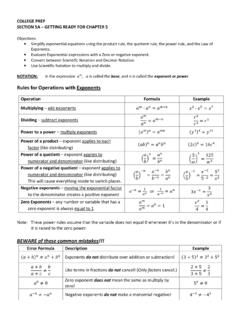
8 Express each of the following in exponential form:(i) 729(ii) 512(iii) 2592(iv)40961331(v) 32243 LAWS OF EXPONENTSC onsider the following(i) 32 33= (3 3) (3 3 3) = (3 3 3 3 3)= 35 = 32 + 3(ii)( 7)2 ( 7)4 = [( 7) ( 7)] [( 7) ( 7) ( 7) ( 7)] = [ ( 7) ( 7) ( 7) ( 7) ( 7) ( 7)] = ( 7)6 = ( 7)2+4(iii) = 43434343434343434343 98784 = 25 32 73 EXPONENTS and RadicalsNotesMODULE - 1 AlgebraMathematics Secondary Course 46 =43434343434343 = 4374343+ = (iv)a3 a4 = (a a a) (a a a a) = a7 = a3+4 From the above examples, we observe thatLaw 1: If a is any non-zero rational number and m and n are two positive integers, thenam an = am+nExample : Evaluate 532323.
9 Solution:Here a = 23 , m = 3 and n = 5. 532323 = 25665612323853= = +Example : Find the value of324747 Solution:As before,324747 = 1024168074747532= = +Now study the following:(i) 75 73 = 3523577777777777777 == = =(ii)( 3)7 ( 3)4 = ()()()()()()()()()()()()()33333333333334 7 = = ()()()()33333 = = ( 3)7 4 EXPONENTS and RadicalsNotesMODULE - 1 AlgebraMathematics Secondary Course 47 From the above, we can see thatLaw 2: If a is any non-zero rational number and m and n are positive integers (m > n), thenam an = am nExample : Find the value of 131625352535 .Solution: 131625352535 = 1253435725352535331316= = = In Law 2, m < n n > m,then()nmmnnmaaaa == 1 Law 3: When n > mnmnmaaa = 1 Example : Find the value of 967373 Solution:Here a = 73, m = 6 and n = 9.
10 967373 = 69173 273433733==Let us consider the following:(i)()236333323333333 +=== =(ii)2222252737373737373 = EXPONENTS and RadicalsNotesMODULE - 1 AlgebraMathematics Secondary Course 482222273++++ 52107373 = =From the above two cases, we can infer the following:Law 4: If a is any non-zero rational number and m and n are two positive integers, then()mnnmaa=Let us consider an : Find the value of 3252 Solution:3252 = 15625645252632= = Zero ExponentRecall that nmnmaaa = , if m > n = mna 1, if n > mLet us consider the case, when m = n mmmmaaa = 001aaaamm= = Thus, we have another important law of EXPONENTS ,.Law 5: If a is any rational number other than zero, then ao = :Find the value of(i) 072 (ii) 043 Solution:(i) Using a0 = 1, we get 072 = 1 EXPONENTS and RadicalsNotesMODULE - 1 AlgebraMathematics Secondary Course 49(ii) Again using a0 = 1, we get 043 = 1.