Example: marketing
Facial Emotion Recognition in Real Time
expressions vary dynamically. Most applications of emotion recognition examine static images of facial expressions. We investigate the applica-tion of convolutional neural networks (CNNs) to emotion recognition in real time with a video input stream. Given the computational requirements and complexity of a CNN,
Tags:
Information
Domain:
Source:
Link to this page:
Documents from same domain

Attention and Transformers Lecture 11
cs231n.stanford.edugraph with shared weights h 0 f W h 1 f W h 2 f W h 3 x 3 y T ... Extract spatial features from a pretrained CNN Image Captioning using spatial features 11 CNN Features: H x W x D h 0 [START] Xu et al, “Show, Attend and Tell: Neural Image Caption Generation with Visual Attention”, ICML 2015 z 0,0 z 0,1 z 0,2 z 1,0 z 1,1 z 1,2 z 2,0 z 2,1 z ...

CNNs for Face Detection and Recognition
cs231n.stanford.edudevelopment of object classification, localization and detec-tion techniques. 2.1. Sliding Window In the early development of face detection, researchers tended to treat it as a repetitive task of object classifica-tion, by imposing sliding windows and performing object classification with the neural networks on the window re-gion.

Convolutional Neural Networks for Visual Recognition
cs231n.stanford.eduProgressive GAN, Karras 2018. Models from Single RGB Images”, ECCV 2018 Beyond recognition: Segmentation, 2D/3D Generation. Fei-Fei Li, Ranjay Krishna, Danfei Xu Lecture 1 - 15 March 30, 2021 Scene Graphs Krishna et al., Visual Genome: Connecting Vision and Language using Crowdsourced Image Annotations, IJCV 2017
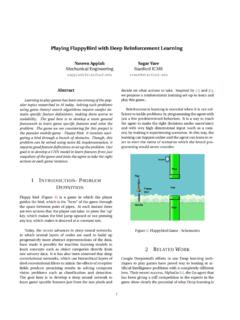
NaveenAppiah SagarVare - Stanford University
cs231n.stanford.eduNaveenAppiah Mechanical Engineering nappiahb@stanford.edu SagarVare Stanford ICME svare@stanford.edu ... the popular mobile game - Flappy Bird. It involves navi-gating a bird through a bunch of obstacles. Though, this ... the game emulator and learns to make good decisions over time. It is this simple learning framework and their

Fei-Fei Li & Justin Johnson & Serena Yeung Lecture 2 ...
cs231n.stanford.eduFei-Fei Li & Justin Johnson & Serena Yeung Lecture 2 - April 6, 2017 Administrative: Piazza For questions about midterm, poster session, projects,

Lecture 9: CNN Architectures
cs231n.stanford.eduLecture 9 - 22 May 2, 2017 ImageNet Large Scale Visual Recognition Challenge (ILSVRC) winners First CNN-based winner. Fei-Fei Li & Justin Johnson & Serena Yeung Lecture 9 - 23 May 2, 2017 ImageNet Large Scale Visual Recognition Challenge (ILSVRC) winners ZFNet: Improved hyperparameters over AlexNet. Fei-Fei Li & Justin Johnson & Serena Yeung ...

Vector, Matrix, and Tensor Derivatives
cs231n.stanford.eduErik Learned-Miller The purpose of this document is to help you learn to take derivatives of vectors, matrices, and higher order tensors (arrays with three dimensions or more), and to help you take ... At this point, we have reduced the original matrix equation (Equation 1) …

Lecture 14: Reinforcement Learning
cs231n.stanford.eduFei-Fei Li & Justin Johnson & Serena Yeung Lecture 14 - May 23, 2017 Markov Decision Process 19 - Mathematical formulation of the RL problem - Markov property: Current state completely characterises the state of the

Lecture 11: Detection and Segmentation
cs231n.stanford.eduFei-Fei Li & Justin Johnson & Serena Yeung Lecture 11 - 1 May 10, 2017 Lecture 11: Detection and Segmentation

Lecture 13: Generative Models
cs231n.stanford.eduFei-Fei Li & Justin Johnson & Serena Yeung Lecture 13 - May 18, 2017 Generative Models 17 Training data ~ p data (x) Generated samples ~ p model (x) Want to learn p
Related documents

So How Does the Mind Work? - Steven Pinker
stevenpinker.comprocessing or computation. Beliefs are a kind of information, thinking a kind of computation, and emotions, motives, and desires are a kind of feedback mechanism ... intelligence is made possible only by specific biochemical properties of neural tissue. It differs from the assertion that mental life can be understood only in ... such as fear ...

IMAGE PROCESSING FACIAL EXPRESSION RECOGNITION
rcciit.orgImage processing is the field of signal processing where both the input and output signals are images. One of the most important application of Image processing is Facial expression recognition. Our emotion is revealed by the exp ressions in our face. Facial Expressions plays an important role in interpersonal communication.
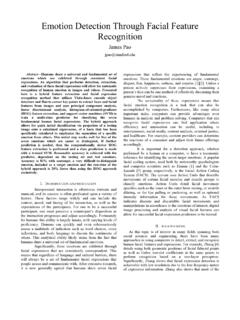
Emotion Detection Through Facial Feature Recognition
web.stanford.edudisgust, fear, happiness, sadness, and surprise [1][2]. Unless a person actively suppresses their expressions, examining a person’s face can be one method of effectively discerning their genuine mood and reactions. The universality of these expressions means that facial emotion recognition is a task that can also be
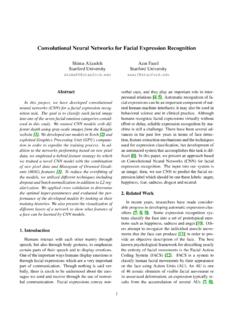
Convolutional Neural Networks for Facial Expression ...
cs231n.stanford.eduon Convolutional Neural Networks (CNN) for facial expression recognition. The input into our system is an image; then, we use CNN to predict the facial ex-pression label which should be one these labels: anger, happiness, fear, sadness, disgust and neutral. 2. Related Work In recent years, researchers have made consider-

Emotion from facial expression recognition
www.ehu.eusFacial expressions (III) Paul Ekman’s 6 universal emotions: – Same facial expressions for everybody. – Surprise, Fear, Anger, Disgust, Happiness, Sadness. Neutral facial expression and neutral emotion.

Factors Affecting Reaction Time - Human Performance
www.hptinstitute.comidentifying emotions. Alves et al. (2009) confirmed that faces showing happiness or fear were identified most rapidly when presented to the left visual field (e.g., and examined by the right hemisphere), and that neutral expressions were detected most rapidly by the right visual field.