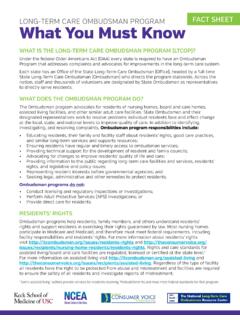
Transcription of FACT SHEET
1 fact SHEET Nursing Home Discharges You ve Been Told to What? Many involuntary discharges can be resolved successfully. You have rights. Become informed and act. 1. All notices of discharge must be communicated in writing, in a language and manner you understand. 2. Most discharge notices must be given at least 30 days prior to the discharge date. 3. You have the right to appeal and must do so before the date of discharge 4. Federal law gives you rights and legal protections when facing discharge. 5. If you receive a notice, contact the Long-Term Care Ombudsman program (LTCOP) immediately.
2 Visit to locate a program or call the Eldercare Locator at 1-800-677-1116. Ombudsman program representatives are knowledgeable about discharge requirements and empowered by law to advocate for you. THE REASON(S) FOR DISCHARGE MUST BE VALID There are only 6 reasons why a facility can transfer or discharge a resident against their will: o The facility cannot meet the resident s needs; o The resident no longer needs nursing facility services; o The resident s presence endangers the safety of others in the facility; o The resident s presence endangers the health of others in the facility; o The resident has failed to pay; or o The facility is closing.
3 FACTS TO KNOW RIGHT AWAY IMPORTANT INFORMATION REGARDING DISCHARGE Facts The law requires the nursing home to problem-solve the reason for discharge and make attempts to address the issue(s). A doctor must document the reason for discharge in your medical record. The facility must state the reason for discharge in the written notice. If the reason for discharge is that the facility cannot meet the resident s needs, the facility must document the following in your record: o The specific need(s) that allegedly cannot be met. o What the facility has done to try to meet those needs.
4 O The services available in the new facility that will supposedly meet your needs. Except for specialized needs such as acute psychiatric, bariatric, or ventilator care, nursing homes are certified to provide similar types of care and services. If you have submitted paperwork for third party payment and payment status is pending, such as applying for Medicaid, the facility cannot discharge you for failure to pay. The facility is responsible for notifying residents of their change in payment status and should ensure residents have the assistance they need in completing the paperwork.
5 If a resident s initial application to Medicaid is denied and the resident appeals, the resident cannot be discharged until the appeal is decided. WRITTEN NOTICE REQUIRED A discharge notice must be in writing and in a language and manner you understand. It must include: o The reason for the discharge, o The proposed effective date, o The location to which you will be discharged, o Information on your rights to appeal the discharge and have an administrative hearing, and o Contact information for the LTCOP and, if applicable, the agencies responsible for advocacy on behalf of persons with mental illness and developmental disabilities.
6 The notice must be given to the resident and the resident s representative. Most discharge notices must be given at least 30 days prior to the discharge date. The listed location must be specific, appropriate, available, and agreeable to admitting you. Tips Tips Facts fact Tips Facts Check your written notice. If it does not include all the information listed above, it is not valid. The facility must start over and issue another notice. Verbal notice is not an official discharge. All discharges must be in writing. For example, in response to disagreements about care, nursing home staff may suggest that a resident or their family member consider finding another facility.
7 Such as, you may be happier in another facility, we ll start looking for another nursing home for you, or our facility can t meet your mother s needs and we need to find a facility that can. Residents have the right to participate in their care planning and share concerns about their care, if you feel facility staff are pressuring you to move, contact the Long-Term Care Ombudsman Program. YOU CAN APPEAL THE DISCHARGE AND REMAIN IN THE FACILITY PENDING THE OUTCOME You have the right to appeal your notice of discharge and remain in the facility pending the outcome of the appeal.
8 The facility must help you complete and file a request for an appeal. File your appeal before the date of discharge. Contact the Long-Term Care Ombudsman Program for information, support, and advocacy in appealing the discharge and/or assistance finding legal assistance providers. A DETAILED DISCHARGE PLAN IS REQUIRED You have the right to participate in all aspects of discharge planning. The written discharge plan must include a living location, services, care, and medications, if needed. The facility must prepare and orient you for a safe and orderly discharge in a language and manner you understand.
9 Ask to visit your new home. This is considered part of orientation. It is the facility s responsibility to ensure that you arrive safely to your new location with your possessions, including transferring any personal funds to you or a new account. fact Tips Tips Facts Tips IF YOU ARE AWAY, YOU CAN RETURN You have the right to return to the facility following hospitalization or therapeutic leave, including the right to return to your bed or the first available bed. The facility must give you information about these rights, as well as a copy of its bed-hold policy in advance of your leave.
10 Sending you to the hospital does not relieve the facility of the responsibility of following the discharge requirements. If the facility decides that you cannot return, it must issue a discharge letter that gives all the notice requirements (including 30 days notice, and your appeal rights), documentation, and information required under law. If the facility refuses to re-admit you, contact the Long-Term Care Ombudsman program and the state s licensing and certification agency that oversees nursing homes to file a complaint. Locate and Learn about the Long-Term Care Ombudsman Program or call Eldercare Locator at 1-800-677-1116.