Transcription of Fact sheet Sepsis - CPPE
1 Fact sheet Sepsis Page 1 Contents Definition 2 Prevalence and incidence 2 Signs and symptoms 3 Causes/risk factors 4 Pathophysiology (mechanism of disease) 4 Prognosis and complications 6 Diagnosis/detection 6 Treatment 7 Patient support 8 Further resources 8 External websites 9 References 9 Fact sheet Sepsis Page 2 Definition The National Institute for Health and Care Excellence (NICE) describes Sepsis as a clinical syndrome caused by the body's immune and coagulation systems being switched on by an infection.
2 Sepsis with shock is a life-threatening condition that is characterised by low blood pressure despite adequate fluid replacement, and organ dysfunction or failure. 1 Currently there is debate around the terminology surrounding Sepsis . Previously, the terms systemic inflammatory response syndrome (SIRS), severe Sepsis and septic shock were used; it has been suggested that only Sepsis and (the more serious) septic shock should be used. 1 Please note some resources may use the terms SIRS and severe Sepsis . More information about the current terminology can be found in The UK Sepsis Trust s The Sepsis Manual.
3 This document is a comprehensive manual that supports the education and training of healthcare professionals at every level. For this reason, we recommend working through the manual before leaving this topic. Before working through the rest of the information on this page, we recommend that you watch the following video: The UK Sepsis Trust - 1. The impact of Sepsis Prevalence and incidence Conservative estimates suggest that we see at least 200,000 cases of Sepsis in the UK each year, with around 48,500 deaths1 and a direct cost to the NHS of at least billion. Sepsis costs our society as much as billion every year.
4 It is highly likely that these numbers are under-estimates, since a proportion of the more than million patients suffering severe infection in England every year are likely to have uncoded Sepsis . Whichever way we cut it, Sepsis is There are several learning resources available via elearning for healthcare (elfh) which we recommend, including: the Sepsis Challenge (an informative quiz) THINK Sepsis : The identification and management of Sepsis in primary care. Identifying and managing Sepsis in primary care is an important measure in reducing deaths, as 70 percent of Sepsis cases develop in a primary care setting.
5 Fact sheet Sepsis Page 3 The elfh e-learning module addresses the high-risk areas for the early identification and management of Sepsis : Session 1 Overview of Sepsis , introduces key facts about Sepsis , and outlines the size of the problem, common community presentations and key actions that influence outcomes Session 2 Adult Sepsis will cover the subtle ways in which Sepsis may present and highlight the history, examination, and the management of the septic patient Session 3 Childhood Sepsis will introduce key facts about childhood Sepsis . It outlines the community presentations and key actions that influence outcomes Session 4 Complex Sepsis Issues and Future Development will explore neutropenic Sepsis and Sepsis in maternity, potential opportunities for prevention, and some of the recent changes and innovation relevant to Sepsis Session 5 Sepsis , Care Homes and the Frail Elderly, will provide an introduction to key facts about managing Sepsis in the elderly elfh also run a course aimed at all clinical staff working in paediatrics, which consists of films and workbooks.
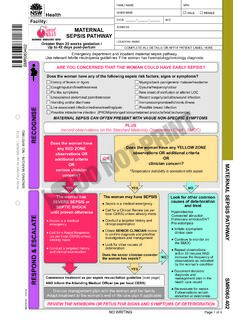
6 You can access this here: THINK Sepsis : The identification and management of Sepsis in Paediatrics. Return to contents Signs and symptoms The UK Sepsis Trust summarise the symptoms that people should be advised to look out for in the below graphic. Image used with permission from The UK Sepsis Trust. NICE quality standard Sepsis [QS161] states the following, Symptoms of Sepsis can include, but are not limited to: high body temperature or low body temperature Fact sheet Sepsis Page 4 fast heartbeat/breathing feeling dizzy or faint/loss of consciousness a change in mental state, for example, confusion or disorientation diarrhoea/nausea and vomiting slurred speech severe muscle pain breathlessness reduced urine production cold, clammy and pale or mottled skin.
7 3 Return to contents Causes/risk factors Sepsis can be the clinical manifestation of infections acquired both in the community setting or in health care facilities. Any initial site of infection can lead to Sepsis , eg, infection of the urinary or respiratory tract. Per NHS choices, some people are more likely to develop Sepsis . Anyone with an infection can get Sepsis . However, some people are more likely to get an infection that could lead to Sepsis , including: babies under one, particularly if they're born early (premature) or their mother had an infection while pregnant people over 75 people with diabetes people with a weakened immune system, such as those having chemotherapy treatment or who recently had an organ transplant people who have recently had surgery or a serious illness women who have just given birth, had a miscarriage or had an abortion.
8 You cannot catch Sepsis from another person. It happens when your body overreacts to an The National Confidential Enquiry into Patient Outcomes and Death (NCEPOD) recommends early identification and immediate management of patients with Sepsis , raising awareness of the condition and management in its care review: Just Say Sepsis ! Return to contents Pathophysiology (mechanism of disease) To understand the pathophysiology of Sepsis , we need to understand how our immune system normally functions. When white blood cells encounter infections outside of the blood stream, they release signals locally to cause blood vessels to dilate and become more permeable.
9 This allows more white blood cells to reach this area and this leads to localised inflammation. During this process there are also signals released which counteract inflammation. The diagram below is a very simple representation of this process as occurring in response to a pathogen outside a blood vessel. Fact sheet Sepsis Page 5 If a person s immune system cannot fight an infection, sometimes it can enter the blood stream. When white blood cells encounter infection in the blood, they may trigger an immune response which is too great and causes a systemic inflammatory response.
10 In this systemic reaction, inflammatory signals can cause blood vessel dilation and increased permeability of blood vessels all over the body. This can lead to systemic swelling, low blood pressure, reduced perfusion and oxygenation and, therefore, organ dysfunction. The pathophysiology of Sepsis is complex and the above description is highly simplified. If you wish to read more, the following article from the British Medical Journal (BMJ) provides further detailed information on the pathophysiology of Sepsis and also discusses its management : Sepsis : pathophysiology and clinical management .