Example: confidence
GGUIDELINES - Indian Pediatrics
Consensus Guidelines on Evaluation and Management of the Febrile Child ... Keywords: Consensus statement, Diagnosis, Fever, Infection, Sepsis. A ll over the world, fever in children is one of the most common reasons for parents to seek medical care. It is estimated that ... its formal specialty status recognition [10]. Development
Tags:
Information
Domain:
Source:
Link to this page:
Documents from same domain

Infant and Young Child Feeding Guidelines, 2016
indianpediatrics.netThe guidelines were finalized during the IYCNCON 201 5 at New Delhi in August 2015. Objectives: To formulate, endorse, adopt and disseminate guidelines related to Infant and Young Child feeding from an Indian perspective (including human milk banking, infant feeding in the HIV situation, and micro-nutrients).

Ages and Stages Questionnaire as a Screening Tool for ...
indianpediatrics.netAssessment tools: The Ages and Stages Questionnaire-Second Edition is a set of 19 age-specific parent-completed questionnaires aimed at assessing the developmental status of infants and young children up to 5 years of age. Each questionnaire is valid for 1 month on either side of the target age and consists of 30 simple
Family-Centered Care to Complement ... - Indian Pediatrics
indianpediatrics.netTrial Registration: Clinical Trial Registry of India (CTRI/2013/ 09/003969) Accompanying Editorial: Pages 451-2. METHODS This study designed as a randomized controlled trial was conducted between October 2010 to March 2012 in a setting of 16-bedded referral neonatal unit of Northern India with 2 or 3 nurses and one resident doctor available

Consensus Statement of the Indian Academy of Pediatrics …
indianpediatrics.net• Craniofacial anomalies • Birth weight less than 1500 gram • Hyperbilirubinemia at a serum level requiring exchange transfusion • Ototoxic medications used in multiple courses, or in combination with loop diuretics. • Bacterial meningitis • APGAR scores 0-4 at 1 minute or 0-6 at 5 minute • Mechanical ventilation for 5 days or longer

Laparoscopic Versus Open Appendectomy for Acute ...
indianpediatrics.netand safe treatment option for acute appendicitis. In recent years, laparoscopic appendectomy has become a standard therapeutic procedure for acute appendicitis in many hospitals [1-4]. However, there is limited information about the comparison between open and laparoscopic surgery in children with acute appendicitis. We

School Eye Screening and the National Program for Control ...
indianpediatrics.netblindness whereas amongst children outside blind schools, refractive errors are important causes of visual impairment and blindness. Myopia is a common cause of visual impairment which is usually acquired and nearly always progressive. It rarely occurs before the age of 5 years and new cases appear throughout childhood and adolescence,

Acute Respiratory Infection and Pneumonia in India: A ...
indianpediatrics.netMortality due to pneumonia accounts for approximately one-fourth of the total deaths in under five children, in India. ... The National Health Profile of India report published by the Central Bureau of Health Intelligence [5] mentions 26 544 613 cases of ARI ... estimates based on out-dated data and/or highly sensitive diagnosis [8].

Consensus Statement - Indian Pediatrics
indianpediatrics.netEuthanasia is ‘active’ when a deliberate intervention is undertaken with the express intention of ending life to relieve intractable suffering, and ‘passive’ when it involves withholding life support system for continuance of life [2]. End-of-Life care: This refers to care of a person who has
Current Perspective on Exchange Transfusion - Indian …
indianpediatrics.netcollege, Vellore from 1964-1965. Of 3686 live-births, non-hemolytic hyperbilirubinemia was reported in 30 mature and 35 premature infants while 24 neonates had hemolytic disease (11 Rh incompatibility, 13 ABO incompatibility). The ET was performed in 4 of 30 mature and 4 of 35 immature neonates with non-hemolytic hyperbilirubinemia. Among
Related documents
Surviving sepsis campaign: international guidelines for ...
link.springer.comSurviving sepsis campaign: international guidelines for management of sepsis and septic shock 2021 ... tication and appropriate management in the initial hours ... appropriate resuscitation immediately upon recognition of sepsis or septic shock and having a low threshold for com-

Modified Early Obstetric Warning Score (MEOWS) in ...
doclibrary-rcht.cornwall.nhs.ukSeverely ill obstetric woman-the management and early recognition of Sepsis with BUFFALO 1.2. This version supersedes any previous versions of this document. 1.3. This guideline makes recommendations for women and people who are pregnant. For simplicity of language the guideline uses the term women
Sepsis – Recognition and emergency management in …
childrens.health.qld.gov.auCHQ-GDL-60010 – Sepsis – Recognition and emergency management in children - 2 - Septic shock is a subset of sepsis in which profound circulatory, cellular, and metabolic abnormalities are associated with a greater risk of mortality.14 It is identified by sepsis and cardiovascular organ dysfunction, acknowledging that hypotension is a late sign in children.10
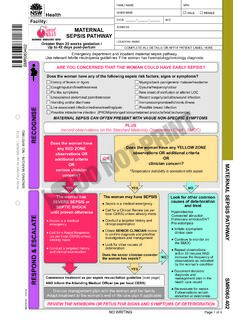
MATERNAL ADDRESS SEPSIS PATHWAY
www.cec.health.nsw.gov.auSEPSIS MANAGEMENT PLAN Women with presumed sepsis are at high risk of deterioration despite initial resuscitation with intravenous antibiotics and fluids. These women require a management plan that must to be discussed with the Attending Medical Officer (AMO) and Intensive care specialist.

Fact sheet Sepsis - CPPE
www.cppe.ac.ukAdditionally, Sepsis (SEP) is a Health Education England programme aimed at improving the diagnosis and management of those with sepsis. There are two sections: • Sepsis in Primary Care – this course is aimed at all clinical staff that work in primary care and consists of five e-learning sessions.
ACUTE ONCOLOGY INITIAL MANAGEMENT GUIDELINES
www.ukons.orgPatients with a suspected neutropenic sepsis will require IV antibiotics within 1 hour of presentation for assessment; this should be managed as per guideline 12 on P.20-21 . ED/AMU Sepsis Screening &Action Tool;

RCPCH
www.rcpch.ac.uksepsis and macrophage activation syndromes. It can also present with unusual abdominal symptoms with excessive inflammatory markers. Early recognition by paediatricians and specialist referral including to critical care is essential. Advice currently given to families and carers of children and young people (for example RCPCH
Version 2.0. 26.03.2018. Review date: 01.03.2020 © UKONS ...
www.ukons.org5 5 General Information and Management Principles - continued • Neutropenia can occur: • At any time during a course of certain SACT or up to 6 weeks after • With certain radiotherapy treatment • At any time in a patient with disease-related immunosuppression Patient ïs with a suspected neutropenic sepsis will require IV antibiotics within 1 hour of presentation for