Example: quiz answers
Facts on College Student Drinking
Student Drinking MARCH 2021 FAST FACTS • Of the 19 million undergraduate students enrolled in college in 2018, 9 million were under age 21, the U.S. minimum legal drinking age. 1 • College students have an increasing risk for an alcohol use disorder as they near the legal drinking age. While 104,000 of 18-year-old college students met the ...
Tags:
Information
Domain:
Source:
Link to this page:
Documents from same domain
Medication for the Treatment of Alcohol Use Disorder: A ...
store.samhsa.govMedication for the Treatment of Alcohol Use Disorder: A Brief Guide U.S. Department of Health and Human Services Substance Abuse and Mental Health Services Administration
TIP 63: Medications for Opioid Use Disorder
store.samhsa.govopioid use than no medication in randomized clinical trials, which are the gold standard for demonstrating efficacy in clinical medicine. 6,7,8,9,10 . Methadone and buprenorphine treatment have also been associated with reduced risk of overdose death. 11,12,13,14,15 .
SAMHSA Opioid Overdose Toolkit
store.samhsa.govOPIOID USE DISORDER FACTS . individuals who otherwise might have died in the absence of treatment. 5 . Naloxone comes in several forms, including injectable, intranasal, and auto- injector.
Federal Guidelines for Opioid Treatment Programs
store.samhsa.govopioid drugs for the treatment of opioid addiction. As stated in 42 CFR § 8.12(i)(2), these regulations apply to “opioid agonist treatment medications that are approved by the Food and Drug Administration.” Currently, these drugs are methadone and pharmaceutical products containing buprenorphine, hereafter referred to as buprenorphine.
Managing Chronic Pain in Adults With or in Recovery From ...
store.samhsa.govTreatment Improvement Protocol (TIP) Series 54. HHS Publication No. (SMA) 12-4671. Rockville, MD: Substance Abuse and Mental Health Services Administration, 2011. originating office . Quality Improvement and Workforce Development Branch, Division of Services Improvement, Center for Substance Abuse Treatment, Substance Abuse and Mental Health ...
TAP 21 Addiction Counceling Competencies: The Knowledge ...
store.samhsa.govAddiction Counseling Competencies: The Knowledge, Skills, and Attitudes of Professional Practice (The Competencies) is a key component of that strategy. In 1998, in cooperation with its Addiction Technology Transfer Center (ATTC) Network, SAMHSA published TAP 21, a comprehensive list of 123 competencies that substance abuse
Substance Use Disorders Recovery with a Focus on ...
store.samhsa.govrecovery from a substance use disorder (SUD). SUD occurs when an individual’s continuous drug or alcohol misuse leads to “clinically significant impairment. "1 . Symptoms can include severe health problems, disability, and a failure to meet responsibilities at work, school, or home. 1 . SUD impacts individuals, families, and communities by
What are Peer Recovery Support Services
store.samhsa.govPeer Recovery Resource Connecting . The service activities of peer leaders in connecting peers to recovery resources might be likened to case management in substance use disorder treatment. The purpose of resource connecting services is to connect the peer with professional and nonprofessional services and resources available in the community
Counselor's Treatment Manual
store.samhsa.govCounselor’s Treatment Manual: Matrix Intensive Outpatient Treatment . Project (MTP). The study compared the clinical and cost effectiveness of a comprehensive treatment model that follows a manual developed by the Matrix Institute with the effectiveness of treatment approaches in use at eight community-based treatment programs, including
Counselor’s Family Education Manual
store.samhsa.govCounselor’s Family Education Manual: Matrix Intensive Outpatient Treatment and abuse, the Methamphetamine Treatment Project (MTP). The study compared the clinical and cost effectiveness of a comprehensive treatment model that follows a manual devel- oped by the Matrix Institute with the effective-ness of treatment approaches in use at eight
Related documents

Sociocultural Influences on Smoking and Drinking
pubs.niaaa.nih.govand/or drinking. The article then dis-cusses similar mechanisms that may sustain alcohol and tobacco use among adults. Some sociocultural factors influ-ence smoking and drinking across much of the adult population. Other factors that predict continued tobacco use among adults might differ for alcohol abstainers, moderate drinkers, heavy

What Is Excessive Alcohol Use?
www.cdc.govbinge drinking is 4 or more drinks • consumed on ' one occasion* bi nge dri nking is ~ 5 or more drinks .c..~ consumed on ,.,.,, one occasion* *one occasion - 2-3 hours -; ~~~~~+ ~ forwomen, ~ heavy drinking is .. ,~ ~ 8 drinks or more \\t~~ per week • any alcohol use by pregnant women for men, heavy drinking is 15 drinks or more per week

ALCOHOL USE - SAMHSA
www.samhsa.govALCOHOL USE FACTS & RESOURCES ALCOHOL USE FACTS 88,000 alcohol related DEATHS per year (2006 2010) WHAT IS A STANDARD DRINK? 12 f oz 8-9 f oz of 5 f oz 1.5 f oz of malt liquor of shot beer 12 oz glass wine gin, rum, vodka, etc. about 5% about 7% about 12% about40% alcohol alcohol alcohol alcohol . UNDERAGE DRINKING IS RISKY DRINKING
Australian/New Zealand Standard - SAI Global
www.saiglobal.comCommittee CH-034, Materials in Contact with Drinking Water, to supersede AS/NZS 4020:2002, Testing of products for use in contact with drinking water. In preparing this Standard, consideration has been given to comparable overseas Standards, to minimize duplication of effort and to maintain commonality, wherever reasonable, with those Standards.

Version 8 SOCRATES The Stages of Change Readiness and ...
casaa.unm.edudrinking, and may have experienced some success in this regard. Change is underway, and they may want help to persist or to prevent backsliding. A high score on this scale has been found to be predictive of successful change.
Per- and Polyfluoroalkyl Substances (PFAS) in Drinking Water
www.nj.govhave important industrial and commercial use s. PFAS are used in the production of some non -stick cookware, in waterproof and stain proof coatings, in “leak-proof” coatings on food packagi ng materials, in fire-fighting foams, and other applications. …
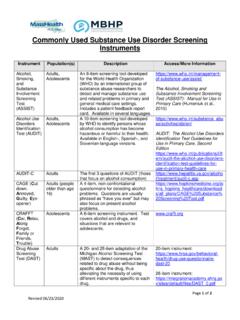
Commonly Used Substance Use Disorder Screening Instruments
www.masspartnership.comof-substance-use/assist/ The Alcohol, Smoking and Substance Involvement Screening Test (ASSIST): Manual for Use in Primary Care (Humeniuk et al., 2010) Alcohol Use Disorders Identification Test (AUDIT) Adults, Adolescents A 10-item screening tool developed by WHO to identify persons whose alcohol consumption has become
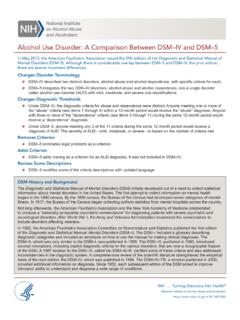
Alcohol Use Disorder: A Comparison Between DSM-IV and …
www.niaaa.nih.govAlcohol Use Disorder: A Comparison Between DSM–IV and DSM–5 In May 2013, the American Psychiatric Association issued the fifth edition of the Diagnostic and Statistical Manual of Mental Disorders (DSM–5). Although there is considerable overlap between DSM–5 and DSM–IV, the prior edition, there are several important differences: