Example: air traffic controller
Feedstuff Comparisons – As Fed versus Dry Matter
Sep 06, 2012 · This is the same as moving the decimal two places to the right. The initial 0.5851 result from the TDN dry matter calculation is equivalent to 58.51%. Therefore, the dry matter analysis would be as follows: Nutrient Analysis – Dry Matter Basis – Feed Example #1 Moisture 0% Dry Matter 100% Total Digestible Nutrients (TDN) 58.51%
Tags:
Information
Domain:
Source:
Link to this page:
Documents from same domain

4-H Shooting Sports - Mississippi State University
extension.msstate.eduTo develop an understanding of clay target-throwing traps and equipment. 5. To develop the ability to recognize and follow a clay target in flight. ... 4-H Shooting Sports Fundamentals of Shotgun Shooting Equipment & Handling. ... -Demonstrate using different chokes. 2. Show literature showing importance of choke. 3. Show how to tell choke of ...

Beef Cattle Handling Facilities - Mississippi State University
extension.msstate.edudrinking water for cattle and additional space. The number of cattle that will comfortably fit in a pen is based on the width and length of the pen and the size of the cattle. In general, cattle need 14 to 20 square feet of space each (see Table 1). Pen areas should be roughly tripled when holding animals for extended periods, such as overnight.

Reducing Images to 2MB Max File Size
extension.msstate.eduReducing Images to 2MB Max File Size . When uploading images on Community Connections, you must make sure the file size is less than or equal to 2MB. This guide is designed to help you find you rfile size and reduce the file size if necessary. ... Center for Technology Outreach .

Estimating Cattle Age Using Dentition
extension.msstate.eduEstimating Cattle Age Using Dentition Knowing cattle age is useful for both cattle management and marketing. Age affects cattle value. Both replacement and market cows typi-

ServSafe@ Practice Tests and Answer Keys - Diagnostic Test
extension.msstate.edu!9 When should a food handler with a sore throat and fever be excluded from the operation? A Customers served are primarily a high-risk population B Fever is over 100°F (38°C) C Sore throat has lasted for more than 5 days D Before the regulatory authority is notified @0What is a basic characteristic of a virus? A Destroyed by cooking B Grows ...
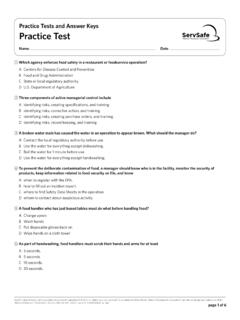
ServSafe Practice Test 7th Edition
extension.msstate.eduC where to find Safety Data Sheets in the operation. D whom to contact about suspicious activity. 5 A food handler who has just bused tables must do what before handling food? A Change apron B Wash hands C Put disposable gloves back on D Wipe hands on a cloth towel 6 As part of handwashing, food handlers must scrub their hands and arms for at least
Understanding the Ruminant Animal Digestive System
extension.msstate.eduanimal age. Ruminant Feeding Types Based on the diets they prefer, ruminants can be classified into distinct feeding types: concentrate selectors, grass/roughage eaters, and intermediate types. The relative sizes of various digestive system organs differ by ruminant feeding type, creating differences in feeding adaptations.

Fluid Fertilizers - Mississippi State University
extension.msstate.eduFluid Fertilizers Fluid fertilizers are popular because of the ease of handling and use. Movement is by pump, and they usually require less labor to handle. Some pesticides can be injected into the fluid, saving trips across the field. Fertilizers custom blended to specifications are available. Properly applied, fluid fertilizers are no more or ...

Beef Cattle Behavior and Handling
extension.msstate.eduBeef Cattle Behavior and Handling Understand Behavior to Improve Handling By understanding cattle behavioral con-cepts and sensory characteristics, handlers can take advantage of natural cattle behav-iors for low-stress handling. This can im-prove the overall safety of cattle handling. Proper animal handling also can result in a

P2632 Simple Ration Formulation: Pearson's Square
extension.msstate.edugrams are below: 1. To convert lb to kg: a. 1 lb = 0.454 kg b. 10 lb * 0.454 = 4.54 kg 2. To convert kg to lb: a. 1 kg = 2.2 lbs b. 10 kg * 2.2 = 22 lbs Converting As-Fed to Dry Matter Feeds can be reported on a dry matter (DM) or wet/as-fed basis. Almost always, nutrient concentra - tions will be reported as a percent of dry matter.
Related documents
Unified Soil Classification System
www.environment.nsw.gov.auWide range in grain size and substantial amounts of all grain particle sizes. SW: Predominantly one size or a range of sizes with some intermediate sizes missing: SP: ... After moving particles >0.4 mm (No 40 sieve size), prepare a pat of moist soil with a volume of about 10 cm: 3. Add enough water, if necessary, to make the soil soft but not ...

Successful Aging Puzzle Packet - Dana Foundation
dana.orgWhole-grain . Dana.org. Successful Aging & Your Brain . See Your Doctor . Nearly one in five Americans is afflicted with a brain disorder – conditions that range from learn- ... Get Moving! Jumble . Unscramble the words below to see what regular exercise can do for your body (hint: for help, see the ...
In Brief: Your Guide to Lowering Your Blood Pressure with DASH
www.nhlbi.nih.govMuch Are You Moving?” chart on page 4 for 1 or 2 days to compare what you usually eat with the DASH eating plan—and note how active you are. This should help you decide what changes you need to make in your food choices—and in the sizes of the ... and whole grain foods
4 Steps to Manage Your Diabetes for Life
www.cdc.govone quarter with a whole grain, such as brown rice or whole wheat pasta. Be active. • Set a goal to be more active most days of the week. Start slow by taking 10 minute walks, 3 times a day. • Twice a week, work to increase your muscle strength. Use stretch bands, do yoga, heavy gardening (digging and planting with tools), or try push-ups.
Materials Handling and Storage
www.osha.gov3 Using the following personal protective equipment prevents needless injuries when manually moving materials: Hand and forearm protection, such as gloves, for loads with sharp or rough edges. Eye protection. Steel-toed safety shoes or boots. Metal, fiber, or plastic metatarsal guards to protect the instep area from impact or compression.