Example: confidence
Feeling Faces: Large Cards (English-Blank)
help you point out and explain the different facial expressions. Feelings Cube Activity Use these cards in a ‘Pocket Dice’ to create a Feelings Cube. Preschool Age Children X Have children take turns rolling the dice. X Have children label the emotion the dice lands on. X Encourage all children to model the emotion the dice lands on.
Tags:
Information
Domain:
Source:
Link to this page:
Documents from same domain
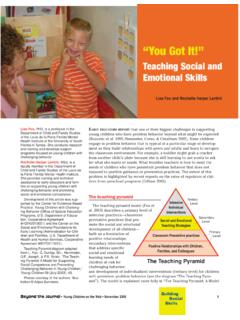
YouGotIt Teaching Social Emotional Skills
challengingbehavior.cbcs.usf.educhild a social or emotional skill, it is important to ensure that you have explained the skill in concrete terms so the child understands what the skill is and when to use it. Children who have social develop-ment challenges may find the nuances of social behavior difficult to interpret. Thus, it is important

Early Childhood Program-Wide PBS Benchmarks of Quality …
challengingbehavior.cbcs.usf.eduMay 25, 2021 · Early Childhood PW PBS BOQ CULTURAL RESPONSIVENESS COMPANION 2021 6 EC-BOQ Item 5 The program has a child discipline policy statement that includes the promotion of social and emotional skills, use of positive guidance and prevention approaches, and eliminates the use of suspension and expulsion. Culturally Responsive Elements/ Adaptations ...
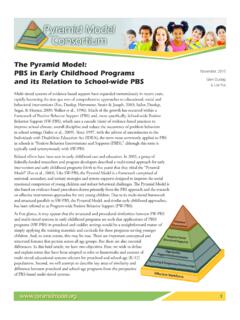
The Pyramid Model: PBS in Early Childhood …
challengingbehavior.cbcs.usf.eduPBS in Early Childhood Programs and its Relation to School-wide PBS Multi-tiered systems of evidence-based support have expanded tremendously in recent years, ... variety of terms including nonaversive behavior management, positive behavioral support, and positive behavior supports.
Program-Wide PBS and School-Wide PBIS Crosswalk
challengingbehavior.cbcs.usf.eduProgram-Wide PBS and School-Wide PBIS Crosswalk1. Lise Fox, Rob Corso, and Denise Binder . Pyramid Model Consortium . and. Brandi Simonsen, Heather George, Jen Freeman, and George Sugai . Center for Positive Behavioral Interventions and Supports . University of Connecticut .

Making Life Easier - University of South Florida
challengingbehavior.cbcs.usf.edusoothing to touch or cuddle while resting. Provide your child with calming, rest-inducing activities, sounds or objects in the routine. Avoid activities that might excite your child in the hour before bedtime or nap. It is not a time for rough-housing, tickle games, or active play. It is not a time for DVDs or computer games.

Talking to Very Young Children about Race
challengingbehavior.cbcs.usf.eduJul 20, 2020 · Talking to ery oung Children about Race 2 ChallengingBehavior.org | National Center for Pyramid Model Innovations These conversations should become a pattern during the early childhood years and not a single event. Often adults in a variety of settings (e.g., medical,

Self-Regulation Skills: Breathing Strategies
challengingbehavior.cbcs.usf.eduJan 08, 2020 · Controlled Breathing: Smell the Flower, Blow Out the Pinwheel Using visual on the following page, have children smell the flower (to breathe in through their nose) and blow out the pinwheel (to exhale through their mouth). Repeat several times. Belly Breathing
Promoting Positive Peer Social Interactions
challengingbehavior.cbcs.usf.eduPositive social interactions are interactions that take place between peers that are positive in nature and successful for both ... There are many articles, books, and curricula that provide information on increasing peer interactions. For further information, see the following: Chandler, L. (1998). Promoting positive interaction between ...
The Pyramid Model: PBS in Early Childhood Programs ...
challengingbehavior.cbcs.usf.eduRelated efforts have been seen in early childhood care and education. In 2003, a group of federally-funded researchers and program developers described a multi-tiered approach for early intervention and early childhood programs (birth to five years) that they titled the “Pyramid Model” (Fox et al., 2003).

Taking a Break: Using a Calm Down Area at Home
challengingbehavior.cbcs.usf.eduJul 07, 2020 · A calm down area provides a child a place to calm down and take a break. It is one strategy that might be used when children are feeling anxious, stressed, or overwhelmed. Families can help children learn how to take a break from activities or interactions that are challenging to them. Just like adults, young children might react to
Related documents

FACIAL RECOGNITION TECHNOLOGIES - Webflow
global-uploads.webflow.comEmotion , affect , and facial expression classification . Facial recognition technologies can be used to classify facial expressions, such as “smile,” “frown,” or “scowl.” They can also be used for the closely related problem of inferring the emotional state or affect of