Example: confidence
Fertilizer rate calculations
•Guidelines for N, P, K and 5 micro-nutrients for production of most MT crops are provided in Fertilizer Guidelines for Montana Crops (EB0161). •They are based on soil analysis – discussed earlier. See Soil Sampling and Laboratory Selection (MT4449-1), Soil Sampling Strategies (MT200803AG). There is not a good soil test for S.
Tags:
Information
Domain:
Source:
Link to this page:
Documents from same domain

MODULE NO. 2 Plant Nutrition 1 and Soil Fertility
landresources.montana.eduMODULE 2 Plant Nutrition and Soil Fertility 5 for carbohydrates supplied by the host plant. Some crops, such as corn, are highly dependent on this association, …

Comparisons of Manure, Compost, and …
landresources.montana.eduby Clain Jones, Extension Soil Fertility Specialist clainj@montana.edu (406) 994-6076 Comparisons of Manure, Compost, and Commercial Fertilizers

Factors Affecting Factors ffecting Nitrogen Fertilizer ...
landresources.montana.eduDept. of Land Resources and Environmental Sciences, Montana State University, Bozeman This bulletin explains the various soil and climate factors that interact to affect ammonia volatilization from nitrogen fertilizers. Understanding these factors can help crop producers avoid applying urea and other nitrogen fertilizers in

Soil Water - Land Resources and Environmental …
landresources.montana.edubasic physical, chemical and biological properties that affect agricultural soils. Processes such as fertility, water and solute movement and retention, and organic matter accumulation and decomposition are all affected by soil properties. Some of the properties presented in this module ... Soil&Water MANAGEMENT MODULE 1 1 SW

CCA 1.5 NM Plant Nutrient Functions and …
landresources.montana.eduModule 9 • Plant Nutrient Functions and Deficiency and Toxicity Symptoms 3 is necessary to confirm nutrient stress. Precautions in identifying nutrient stress
Comparisons of Manure, Compost, and Commercial Fertilizers
landresources.montana.eduMonoammonium phosphate MAP 11-13 48-62 - Diammonium phosphate DAP 18-21 46-54 - Potassium chloride KCl - - 60 Urea UR 46 - - (Modified from Havlin et al., 1999) Typical Total Nutrients for Manure National averages of nitrogen (N), phosphorus (P …
Related documents
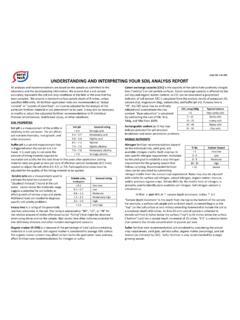
UNDERSTANDING AND INTERPRETING YOUR SOIL ANALYSIS …
servitechlabs.comthat follows sampling. ... The soil analysis ranges in the following table are considered to be general guidelines. The particular range may be different for individual crops or the range may be affected by a soil characteristic, like pH or texture. ...

Geotechnical Manual (GEO)
onlinemanuals.txdot.gov3. Field Operations. Requirements for drilling, sampling, and field testing. 4. Soil and Bedrock Logging. Description of material order, level of description, and classification. 5. Foundation Design. Guidelines for selecting foundation types, drilled shafts, piling, and requirements for scour analysis. Table 1-1: Manual Revision History

What Is Soil Electrical Conductivity? - LSU AgCenter
www.lsuagcenter.comDirected soil sampling within more accurate soil boundaries Soil texture, organic matter, Celectrical conductivity, drainage issues Variable rate seeding Celectrical conductivity, topsoil depth Variable rate nutrient application based on soil productivity Soil texture, depth to claypan
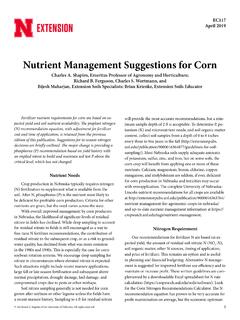
Nutrient Management Suggestions for Corn
extensionpublications.unl.eduSoil nitrate-N can be estimated by sampling soil with a single 0–2 foot sample. A default value for the 2 foot depth of 3.0 ppm is suggested for medium and fine textured soils and 1.5 ppm for sandy soils. The depth-weighted average is then calculated as the sum of the nitrate-N concentration for 0–2 ft depth soil sample

SECTION 5 Methods of sampling and analysis
www.fao.orgappropriate sampling procedures. The use of recognized international sampling methods will ensure a standardized administra-tive and technical approach and will facilitate the interpretation of results of analysis related to lots or consignments of feed. GUIDELINES ON SAMPLING The objectives and sampling purposes to be

Design Manual Engineering Properties of Soil and Rock
www.iowadot.govFor the detailed measurement and interpretation of soil and rock properties, follow the guidelines provided in Section . 200D-1. and FHWA-IF-02-034, Evaluation of Soil and Rock Properties, Geotechnical Engineering Circular No. 5 (Sabatini, et al., 2002), except as specifically indicated herein. Engineering Properties of Soil

Soil Quality - USDA
www.nrcs.usda.govSampling Guidelines Important: When, where, and how deep to sample and how many samples to take is primarily dependent on the questions being asked or problems being addressed by the farm or land manager. When to sample? Timing of sampling is important, because soil properties vary within a season and with manage-ment operations, such as tillage.