Example: barber
FIGURE 1 Bulletin
imprisonment rate for sentenced prisoners was the lowest since 1997, at 440 prisoners per 100,000 U.S. residents of all ages and 568 per 100,000 U.S. residents age 18 or older (fgure 1). (Counts of sentenced prisoners include those who have received a sentence of more than one year.) Findings in this report are based on the
Tags:
Information
Domain:
Source:
Link to this page:
Documents from same domain

Substance Dependence, Abuse, and Treatment of Jail Inmates ...
bjs.ojp.govOver half of all female jail inmates reported substance dependence There was little difference in the overall prevalence of substance dependence or abuse between men (68%) and women (69%) in local jails (table 2). When substance dependence or abuse was estimated separately, female jail inmates had higher rates of substance dependence than male ...

Family Violence Statistics
bjs.ojp.gov3.5 million victims of family violence between 1998 and 2002, less than 1% died as a result of the incident. The majority (73%) of family violence victims were female. Females were 84% of spouse abuse victims and 86% of victims of abuse at the hands of a boyfriend or girlfriend.

Human Trafficking Data Collection Activities, 2021
bjs.ojp.govHuman Trafficking Data Collection Activities, 2021. The Combat Human Trafficking Act of 2015 (CHTA) (34 U.S.C. § 20709(e)) requires the director of the . Bureau of Justice Statistics (BJS) to prepare an annual report on human trafficking. The report must include information on the following: arrests for human-trafficking offenses by state law

Correctional Populations in the United States, 2019 ...
bjs.ojp.govauthority of a sheriff, police chief, or city or county administrator. Facilities are intended for adults but may hold juveniles before or after they are adjudicated. Facilities include jails, detention centers, city or county correctional centers, special jail facilities (such as medical or treatment centers and prerelease centers)

Education and Correctional Populations - Bureau of Justice ...
bjs.ojp.gov2 Education and Correctional Populations Sources: BJS, Survey of Inmates in State and Federal Correctional Facilities, 1997 and 1991; BJS, Survey of Inmates in Local Jails, 1996 and 1989; BJS, Survey of Adults on Probation, 1995; Bureau of Labor Statistics, Current Population Survey, March supplement, 1997.

Mental Health Problems of Prison
bjs.ojp.gov• Female inmates had higher rates of mental health problems than male inmates (State prisons: 73% of females and 55% of males; local jails: 75% of females and 63% of males). • About 74% of State prisoners and 76% of local jail inmates who had a mental health problem met criteria for substance dependence or abuse.

Bureau of Justice Statistics Special Report
bjs.ojp.govdiffered substantially in their relation-ship to those they victimized. An estimated 62% of female violent offenders had a prior relationship with the victim as an intimate, relative, or acquaintance. By contrast, about 36% of male violent offenders were estimated to have known the victim. Victims who were intimates accounted
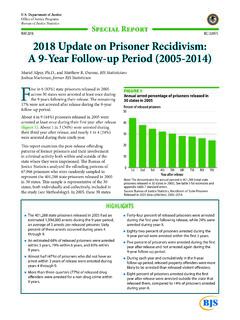
2018 Update on Prisoner Recidivism: A 9-year Follow-up ...
bjs.ojp.govTis report examines the post-release ofending . 20 patterns of former prisoners and their involvement in criminal activity both within and outside of the 10 state where they were imprisoned. Te Bureau of Justice Statistics analyzed the ofending patterns of 0 67,966 prisoners who were randomly sampled to

Federal Prisoner Statistics Collected under the First Step ...
bjs.ojp.govFederal Prisoner Statistics Collected under the First Step Act, 2021. T. he First Step Act of 2018 (FSA) requires . the Bureau of Justice Statistics (BJS), through its National Prisoner Statistics program, to collect data from the Federal Bureau of Prisons (BOP) on a number of topics and to report these data annually. 1 . BJS is required to

Mortality in Local Jails, 2000–2019 – Statistical Tables
bjs.ojp.govmortality data, up slightly from 180 in 2018. When the U.S. resident population was adjusted to resemble the sex, race or ethnicity, and age distribution of local jail inmates, inmates were more than twice as likely as U.S. residents to die by suicide in 2019. Almost 77% of …
Related documents

Life imprisonment - Penal Reform International
cdn.penalreform.orgLife imprisonment and specific populations Women Women make up less than 3 per cent of prisoners serving life sentences, which is significantly less than the percentage of women in the overall world prison population – 6 per cent. Eight countries (Albania, Azerbaijan, Belarus, Kazakhstan, Kyrgyzstan, Moldova,

The rehabilitation and social reintegration of women prisoners
cdn.penalreform.orgof Women Prisoners and Non-custodial Measures for Women Offenders (the Bangkok Rules) were adopted by the United Nations (UN) General Assembly on 21 December 2010. The Rules give guidance to policymakers, legislators, sentencing authorities and prison staff on how to reduce the unnecessary imprisonment of women

THE BANGKOK RULES
www.unodc.orgConsidering the alternatives to imprisonment as provided for in the TokyoRules, and taking into consideration the gender specificities of, and the consequent need to give priority to applying non-custodial measures to, women who have come into contact with …

Effective interventions for Women offenders: A Rapid ...
assets.publishing.service.gov.ukpatients (1,045 women) in opioid maintenance treatment over a seven-year period prior to, during and after treatment. They found that, for both men and women, criminal convictions were reduced relative to their waiting-list pre-treatment levels. Women’s rates of criminal convictions were lower than the corresponding rates for men. This result is

Alternatives to Imprisonment
www.unodc.orgimprisonment will reduce overcrowding and make it easier to manage prisons in a way that will allow states to meet their basic obligations to the prisoners in their care. Imprisonment is expensive The cost of imprisonment worldwide is hard to calculate, but the best estimates are in the region of US$ 62.5 billion per year using 1997 statis-
LGBT Issues in Jamaica - Human Rights First
www.humanrightsfirst.orga punishment of up to 10 years of imprisonment with hard labor for those convicted of the “abominable crime of buggery.” Members of the Jamaican LGBT community are denied access to basic rights and services, resulting in alarming rates of homelessness and HIV. Despite a history of persecution and marginalization, Jamaican LGBT activists