Transcription of Final Year Project Proposal - NTU
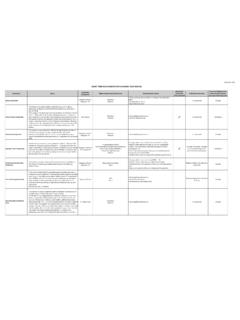
1 FYP AY2011/12 A/P Gan Chee Lip Final year Project Proposal 1 Project Title: Electromigration reliability study of metallic nanowires Supervisor: Assoc. Prof. Gan Chee Lip Graduate Mentor: Ms Chun Shu Rong Description: As scaling of devices continues, a 50 m solder bump is experiencing a high current density in the order of 104 A/cm2. This poses serious reliability problem in terms of electromigration for future devices. Thus, arrays of metallic nanowires have been proposed as an alternative to solder bump interconnection. An electromigration statistical study of a bottom-up fabricated single nanowire will be done so as to model the nanowire arrays electromigration behavior.
2 Methodology: Metallic nanowires can be fabricated via electrodeposition through porous alumina template. Free standing nanowires can be achieved by removal of the template and liberation in a bottle of solvent. This is followed by alignment of single nanowire between two electrode pads using the dielectrophoresis method. After which, platinum will be use to connect to two other electrode pads for four-point electrical measurement and electromigration test using wafer-level and package-level testing. Equipment: Anodization setup (NTU) Potentiostat (NTU) Scanning Electron Microscopy (NTU) Function generator (NTU) Probe Station (NTU) Remarks: - FYP AY2011/12 A/P Gan Chee Lip Final year Project Proposal 2 Project Title: Electrical characterization of low temperature bonding via copper nanowires for 3D ICs Supervisor: Assoc.
3 Prof. Gan Chee Lip Graduate Mentor: Ms Chun Shu Rong Description: Three-dimensional (3D) integration is known to be a promising solution to scaling issues in CMOS circuits. It enables improvements in integrated circuits (ICs) performance, power consumption, system functionality and form factor. Wafer or chip bonding is an enabling technology for fabrication of 3D ICs and low temperature bonding is desired for compatibility with back-end-of-line processing conditions in order not to affect the device performance. Hence, it is necessary to research on ways to bring down the bonding temperature effectively.
4 It has been well understood that the surface melting point of material decreases as the surface to volume ratio increases. This characteristic can be applied to lower down the bonding temperature by changing the copper film with copper nanowires. To successfully integrate nanowires into the bonding system, characterization on the nanowires bonding needs to be investigated. In this Project , the focus will be on contact resistance measurement of copper nanowires bonding and the effect of decreasing nanowire diameters. Methodology: First, the nanoporous alumina templates are fabricated using a two-step anodization method.
5 Second, copper nanowires are grown through the template using electrodeposition method. Finally, the template will be etched away, leaving the nanowires standing on the substrate/chip. Two chips are then bonded at low temperature. Electrical characterization is done using the probe station while SEM/XRD is needed to characterize the fabricated nanowires. Equipment: Anodization equipment (NTU) Potentiostat (NTU) Furnace for bonding (NTU) Probe station (NTU) SEM/XRD (NTU) Remarks: - FYP AY2011/12 A/P Gan Chee Lip Final year Project Proposal 3 Project Title: Fabrication and characterization of copper nanowires-solder interconnection Supervisor: Assoc.
6 Prof. Gan Chee Lip Graduate Mentor: Ms Ng Mei Zhen Description: Copper-to-copper bonding has been investigated as a solution for three-dimensional (3D) integration. Copper nanowires have been further studied to lower the bonding temperature required. Although it gives the best electrical properties, the bond strength is typically weaker than films. Thus to further improve the mechanical strength and thus reliability, using solders to bond the copper nanowires is envisioned to improve the properties. Methodology: First, the nanoporous alumina templates are fabricated using a two-step anodization method.
7 Second, copper nanowires are grown through the template using electrodeposition method. Finally, the template will be etched away, leaving the nanowires standing on the substrate/chip. Solder will be sputtered deposited on another chip. The two chips are then bonded at different temperatures. Mechanical, structural and electrical characterizations are then carried out using shear test, SEM/XRD and electrical probe station respectively. Equipment: Anodization equipment (NTU) Potentiostat (NTU) Furnace for bonding (NTU) Probe station (NTU) SEM/XRD (NTU) Shear tester (Simtech) Remarks: - FYP AY2011/12 A/P Gan Chee Lip Final year Project Proposal 4 Project Title: Graphite oxide/polymer nanocomposite film as gate insulators Supervisor: Assoc.
8 Prof. Gan Chee Lip Graduate Mentor: Mr Han Xuanding Description: Graphite oxide is a derivative of graphene, where the basal planes and edges are attached with hydrophilic oxygen functional groups, leading to the ease of dispersion in polar solvents. This group of material is attractive for fabrication of low cost electronics on large area, flexible substrate by printing techniques. In this Project , graphite oxide/polymer nanocomposite films will be studied for application as gate insulators. Methodology: MOS structure will be fabricated with the graphite oxide/polymer nanocomposite as the insulator film.
9 Electrical characterization such as I-V, breakdown voltage and leakage currents, will be performed to investigate the performance of the insulator film. Equipment: Contact Angle Measurement (NTU) FTIR (NTU) Probe Station (NTU) Remarks: - FYP AY2011/12 A/P Gan Chee Lip Final year Project Proposal 5 Project Title: Electrical characterization of copper/low-k dielectrics test structures Supervisor: Assoc. Prof. Gan Chee Lip Graduate Mentor: Ms Ong Ran Xing Description: Low-k dielectric such as carbon doped silicon oxide and copper are being used to replace silicon dioxide and aluminum metallization to reduce resistance-capacitance (RC) delays.
10 SiOC has weaker thermomechanical properties than SiO2, such as lower elastic moduli, hardness and interfacial adhesion. The SiOC may have difficulty withstanding the thermal and mechanical stresses of packaging and assembly, hence the need to evaluate the long-term interconnect dielectric reliability. The objective of this Project is to study the failure mechanism of the Cu/low k interconnect system. Methodology: To perform physical and electrical failure analysis on conventional test structures and non-conventional small area tests structures. Main focus will be on the voltage ramp test to understand the conduction mechanism.