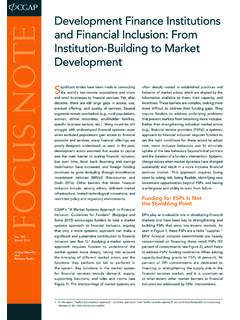
Transcription of Financial Inclusion and Development: Recent …
1 Global and national-level policy makers have been embracing Financial Inclusion as an important development priority. The G20 made the topic one of its pillars at the 2009 Pittsburgh Summit (G20 2009). By fall 2013, more than 50 national-level policy-making and regulatory bodies had publicly committed to Financial Inclusion strategies for their countries (World Bank 2013a, AFI 2013). And the World Bank Group in October 2013 postulated the global goal of universal access to basic transaction services as an important milestone toward full Financial Inclusion a world where everyone has access and can use the Financial services he or she needs to capture opportunities and reduce vulnerability (World Bank 2013b).Policy makers have articulated these objectives in the conviction that Financial Inclusion can help poor households improve their lives and spur economic activity.
2 But what is the evidence for this type of positive impact? This Focus Note takes impact to mean those effects that can be traced to a specific intervention and that would not have occurred otherwise, thus analysis at the micro and local economic levels focuses primarily on the relatively new evidence from randomized control trials (RCTs) or quasi-randomized impact evaluations. At the macroeconomic level it highlights studies using country panel data comparisons. This Focus Note is organized in three sections. The first section describes the extent to which poor households typically live and work in the informal economy and explores the implications of this for how access and use of Financial services can benefit them. The second section summarizes Recent empirical impact evidence at the microeconomic, local economy, and macroeconomic levels.
3 The third section tees up two areas in which inclusive, low-cost Financial systems can generate additional, indirect benefits for other public-sector and private-sector efforts. In summary, the accumulating body of evidence supports policy makers assessments that developing inclusive Financial systems is an important component for economic and social progress on the development agenda. 1. A Vast Majority of Poor Households Live and Work in the Informal Economy Traditional economic theory distinguishes between the objectives and needs of individual households and firms. Individuals are selling their labor power in the market and strive to smooth life-cycle consumption. When people are young, they need to invest; at the prime of their earnings power, they save; and in old-age, they dis-save. In the aggregate, the household-sector saves. Firms, on the other hand, compete for investable funds to finance their operations and growth.
4 In the aggregate, firms are net users of savings. Financial markets are supposed to make the match between savers and users and to allocate capital toward the highest productive usage ( , Mankiw and Ball 2011).But the poor are typically excluded from the wage-earning employment opportunities that traditional economic theory presupposes. They live and work in the informal economy not by choice, but by necessity. In economic terms, they are consuming households and self-employed firms at the same time; thus consumption and production decisions are intertwined. As a result, they need a broad range of Financial services to create and sustain livelihoods, build assets, manage risks, and smooth consumption. The traditional distinction between consumer Financial needs versus the Financial needs of firms is often blurred. Empirically, Financial diaries literature has illustrated this point by showing how poor families in the informal economies of developing countries actively manage their Financial lives to achieve these multiple objectives (Collins, Murdoch, Rutherford, and Ruthven 2009).
5 They save and borrow constantly in informal ways. At any given time, the average poor household has a large number of ongoing Financial relationships. Financial management is, for Financial Inclusion and development : Recent Impact EvidenceNo. 92 April 2014 Robert Cull, Tilman Ehrbeck, and Nina HolleFOCUS NOTE2the poor, a fundamental and well-understood part of everyday life. Estimates of the share of the world population living and working in the informal economy vary between 50 percent and 60 percent (World Bank 2012). The Gallup World Survey 2012 reports that only about 40 percent of adults globally have fixed employment in excess of 30 hours per week. These are averages across all countries and income groups. The share of informality is considerably higher for poorer countries and poorer income segments and can reach well over 80 percent or even 90 percent in some developing countries (ILO 2013).
6 The share of informal employment is mirrored in the estimates for Financial access. Globally, about half of all working-age adults are excluded from formal Financial services. For the lowest income quintile, 77 percent are excluded (Demirg -Kunt and Klapper 2012). In countries such as Cambodia, the Central African Republic, and Niger only 2 4 percent of all adults have an account at a formal Financial institution. Without access to formal Financial services, poor families must rely on age-old informal mechanisms: family and friends, rotating savings schemes, the pawn-broker, the moneylender, money under the mattress. At times, these informal mechanisms represent important and viable value propositions. Often, however, they are insufficient and unreliable, and they can be very expensive. Financial exclusion tends to impose large opportunity costs on those who most need opportunity.
7 2. Increasingly Robust Evidence of Beneficial Economic Impact Across a range of possible impact levels, Recent evidence suggests that access to and use of formal Financial services is beneficial. A. Microeconomic LevelTo assess whether any intervention works, the most rigorous method is to ask the counter-factual: what would have happened without it. An increasingly influential group of development economists argues that the most adequate tool in empirical microeconomics is the use of randomized evaluations. This methodology uses an approach similar to clinical trials where access to a specific new drug is randomly assigned, and the impact of a change in access on a group is then compared to a second group that does not have the same access but is otherwise While other methodologies are equally important in understanding how Financial Inclusion affects the lives of the poor, this section of the Focus Note highlights experimental research using RCTs despite their own the still relatively small, albeit growing, number of this type of randomized evaluation (some 25 cited in this overview)
8 , the general thrust of this new body of evidence suggests that Financial services do have a positive impact on a variety of microeconomic indicators, including self-employment business activities, household consumption, and well-being (Bauchet et al. 2011).2 The impact varies across individual Financial product categories. RCTs to date have largely been conducted at individual product levels, whereas some observers would argue that research ought to measure whether access to a broad range of services improves household ability to make appropriate According to the randomized impact evaluations of microcredit to date, two main patterns stand out: small businesses do benefit from access to credit while the linkage to broader welfare is less clear. 1 The application of this approach to economics is increasingly considered a highly reliable means of assessing micro-level impact.
9 The main strength of this approach is that it corrects for selection bias, a prominent failure of many other approaches. Compared to other methodologies, which are starting from theoretical questions and assumptions, it also has the advantage of not specifically testing one, conceivably narrow underlying economic theory. It simply assesses whether a specific, controlled change has a discernable impact relative to the control group. However, RCTs have their own methodological weaknesses, which are described, , by Ravallion (2009) and Barret and Carter (2010). One main concern is the lack of external validity, which means that inferences for other settings or even scaling up based on the results of an RCT can be difficult. Other caveats include the choice of the proxy variable to measure welfare impact, ethical dilemmas, and cost The experimental literature for Financial Inclusion is rapidly evolving with new papers being published at a high rate.
10 This part of the Focus Note updates and expands previous work by Bauchet, et al. (2011).3 Most of the studies to date provide mixed evidence on the impact of microcredit on important measures of household welfare such as an increase in consumption or income in poor households over the typically relatively short time horizon studied (Banerjee, Duflo, Glennerster, and Kinnan 2010 and 2013; Cr pon, Devoto, Duflo, and Parient 2011; Karlan and Zinman 2011; Angelucci, Karlan, and Zinman 2013). An update of the Spandana study in Hyderabad (Banerjee, Duflo, Glennerster, and Kinnan 2013), which provides one of the first, longer-term results by going back to borrowers after three years, also did not find later-stage improvements in welfare as a result of access to the initial microcredit. There was no evidence of improvements for longer-term welfare indicators, such as education, health, or women s , some studies suggested nuances and found some welfare impacts.