Transcription of Financial Information Kit - Charity Central
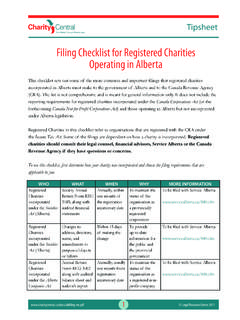
1 Financial Information KitThe purpose of this kit is to provide basic Information on keeping Financial records to facilitate compliance by registered charities with the requirements of the canada Revenue of this kit:n FAQs: Financial Reporting and Registered Charities n Six Tipsheets Choosing a Professional Accountant Setting Up a Chart of Accounts for a Small Organization Setting Up Financial Books and Records Financial and Other Information Needed to Complete the Registered Charity Information Return (T3010) Getting Ready for an External Audit What Can You Prepare? Other Tips on Working with your Auditor Common Issues During an Auditn Additional Resources We re Calling to Set Up a Time to do an Audit (LawNow Article Series)This kit is available for free download at of this fact sheet has been made possible by a Financial contribution from the canada Revenue Agency.
2 Legal Resource Centre 2010 E: Legal Resource Centre 20101 Choosing a Professional AccountantPA1 Once we re a registered Charity , do we need a professional accountant? No. It is not necessary to have a professional a professional accountant is not related to your registered Charity status with the canada Revenue Agency (CRA). The CRA recommends that charities file audited Financial statements if their gross income from all sources is more than $250,000. You should evaluate the needs of your organization and the resources that you have available from within the organization. Someone in the organization needs to understand what is required in being a registered Charity , including completion of the Registered Charity Information Return (T3010), and where to find the necessary Information and resources.
3 The Charity s treasurer should sign any Financial statements that have not been professionally does a professional accountant do that our accounting clerk or volunteer bookkeeper can t? While bookkeeping records your organization s transactions, accounting involves the whole process of recording, classifying, presenting, and interpreting the Financial transactions. There is a big difference between accounting and bookkeeping. Recording and preserving the transactions is bookkeeping. This function ensures that appropriate records and documentation exist for all Financial transactions. Presenting the Financial transactions through Financial statements and other required reports is an accounting function. These statements and reports show the results of operations and the Financial condition of the organization.
4 The interpretation part of the accounting process involves analysis, explanation, and use of the Information presented in Financial reports. A professional accountant is trained and experienced in interpreting and reporting Financial Information from a perspective that an accounting clerk might not have. You may be lucky enough to have a volunteer who is a professional accountant, but who may not have the time or the expertise in not-for-profit reporting to fill the role completely. If this is the case, you still need to examine your need for a professional accountant with the needed expertise. Financial Reporting and Registered Legal Resource Centre 20102 Each of these websites has links to the provincial sites. T3010 in English is available on CRA website at in French is available on CRA website at should we look for in choosing a professional accountant, whether volunteer or paid?
5 Your professional accountant should have experience working with charities and understand the compliance requirements of being a registered Charity . Whether volunteer or paid for their services, your accountant should have the time to provide all the services you need. Ideally, a prospective professional accountant should provide references from other charities for which he or she is providing services. PA6We re a new not-for-profit organization that recently received registered Charity status. Should we get a professional accountant to set up our accounting records? Accounting systems can be set up by anyone with experience in accounting or bookkeeping. A professional accountant can provide valuable advice if your Charity has complex operations or a specific or unusual circumstance requiring professional expertise.
6 In particular, anyone setting up your accounting records should know what s required to complete the T3010 (Registered Charity Information Return). T3010 in English is available on CRA website at in French is available on CRA website at types of accountants are considered professional accountants in canada ? In canada , the provinces govern the accounting profession and the different services that each type of accountant may provide. All provinces recognize the three main accounting designations in canada : CGA (Certified General Accountant) CA (Chartered Accountant) CMA (Certified Management Accountant). PA4 What type of professional accountant do we need for what? As mentioned in FAQ PA3, the provinces determine what services each designation can provide to the public.
7 Services are usually categorized as assurance services that include audit and review services, and non-assurance services, which include compilations or notice-to-reader engagements (see FAQ FMR7) and tax filings that include Registered Charity Information Returns (T3010). Once your organization decides what services you need, refer to the provincial website of each accounting body to determine which designation can best meet your needs. Most of these websites will also contain a referral list of accountants in your area that provide the services you re looking for. The national websites for the accounting bodies are Certified General Accountants Association: Institute of Chartered Accountants: Society of Certified Management Accountants: Legal Resource Centre 20103PA7 How should the accounting records be set up so we can easily complete the Registered Charity Information Return (T3010)?
8 Your Charity needs to consider all the users of your Financial Information and their requirements. One of the most important users of a Charity s Financial Information is the canada Revenue Agency (CRA). You need to understand the Financial Information required for the T3010: The balance sheet Information for the T3010 is basically the same as in any set of Financial statements. The revenue and expense accounts on the T3010 are designed to provide the CRA with Information they need to monitor charities. The CRA s categories may not provide Information in the same way as you need for management purposes or to meet other user needs. Your Charity should design your accounting system so that you can easily transfer Information to the T3010 return.
9 Keep track of where the Information originates in the accounting system so that you can report consistently to the CRA from one year to the next. This is particularly important when the person who is completing the return changes from year to year, as may be the case when a volunteer or an external accounting firm does the work. For more Information , see the Tipsheet #4 Financial and Other Information Needed to Complete the Registered Charity Infomration Returm (T3010) T3010 in English is available on CRA website at in French is available on CRA website at Management and Reporting FMR1 What s the difference between Financial statements from our accounting system and audited Financial statements ? Having audited Financial statements usually means that a person independent of the organization s management has gathered evidence to support the Financial Information that management provided.
10 This independent person or body adds a report to the Information expressing whether the Information has been fairly presented. (When accountants say the Information is fairly presented, they mean that it is complete and has been shared openly and honestly.) You need to address the fact that audited Financial statements are not always done by professional accountant. Those involved in not for profit organizations generally think of audited Financial statements as those audited by professional accountants. The bylaws of some organizations indicate that two members of the organization can also provide the audit services and report to the board. When external professional accountants perform an audit and issue their audit opinion, they follow generally accepted auditing standards and report using generally accepted accounting principles.