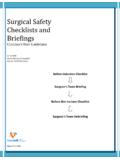
Transcription of Five Steps to Safer Surgical Interventions
1 Five Steps to Safer Surgical Interventions Local safety Standards for Invasive Procedures 1. JH 01/18. Policy Title: Five Steps to Safer Surgical Interventions Executive Summary: A definitive policy for the roles and responsibilities of the key clinical staff involved in the process of the WHO checklist 5 Steps to Safer surgery. The policy also reflects the LocSSIPs based on NatSSIPs relevant to the aspects of perioperative care covered. Supercedes: Policy Description of 30/11/2017 Incorporation of LocSIPPs related to the five Steps Amendment(s): process.
2 Inclusion of prosthesis verification, prevention of retained foreign objects and expansion of handovers, documentation training and audit sections. This policy will impact on: Clinical practices, administrative practices, employees. Financial Implications: Policy Area: ABU Document ECT002362. Reference: Version Number: Effective April 2013. Date: Issued By: Clinical Manager Review Date: April 2021. Theatre Services Author: Clinical Manager Impact June 2013. Theatre Services Assessment PDF Theatres Date: APPROVAL.
3 RECORD. Committees / Group Date Consultation: Planned Care SQS 25/03/2018. Approved by Committees: Planned Care SQS 25/03/2018. Approved by Director: Received for information: Trust Internet 05/04/2018. 2. JH 01/18. Contents Introduction 1. Policy Aim 5. 2. Roles & Responsibilities 6. 3. Policy 6. Briefing 7. Sign In 8. Time Out 10. Prosthesis Verification 11. Prevention of Retained Foreign 11. Objects Sign Out 13. Handover 13. Documentation 15. Debrief 16. 4. Training Requirements 16. 5. Audit 16.
4 6. References 17. Appendices Appendix 1 18. Appendix 2 19. Appendix 3 21. Appendix 4 22. Appendix 5 23. Appendix 6 24. Appendix 7 28. Appendix 8 32. Equality & Diversity Assessment 3. JH 01/18. 4. JH 01/18. Introduction The Safer Surgery Saves Lives initiative was launched by the World Health Organisation (WHO) in 2008 to reduce the number of Surgical errors and enhance patient safety during the perioperative phase of care. In one year from 1st January 2009 to 31st December 2009 the National Patient safety Agency (NPSA) National Reporting and Learning System (NRLS) received just over 155,000 reports of patient safety incidents from Surgical specialities in England and Wales.
5 The nature of the report varied greatly with the vast number reported as leading to no harm, however over 1000 where reported to have led to severe harm or even death. The launch saw the introduction of a new Surgical safety checklist for Surgical teams to use in perioperative environments which can also be adapted for radiological suites and endoscopy units as part of a major drive to make surgery Safer worldwide (DoH, 2008). The NPSA (2009) has adapted this checklist for use in England and Wales and it is intended for use with ALL patients undergoing Surgical procedures.
6 The goal is to strengthen the commitment of ALL clinical staff to address safety issues in the perioperative setting. The checklist highlights generic core safety standards that may be applied to all perioperative settings and forms part of the Five Steps to Safer Surgery initiative (NPSA, 2010). The NPSA guidance recommends that the core standards can be added to but must not be removed when adapting checklists for local use. The Five Steps are: STEP 1: BRIEFING. STEP 2: SIGN IN. STEP 3: TIME OUT.
7 STEP 4: SIGN OUT. STEP 5: DEBRIEFING. 4. JH 01/18. The above process is intended to incorporate the following outcomes: Improved communication within teams Improved anaesthetic safety practices To ensure correct site surgery Reduced Surgical site infections In 2015 NHS England Patient safety Domain published the National safety Standards for Invasive Procedures [NatSSIPs] (NHS England Patient safety Domain, 2015). These NatSSIPs are intended to provide a framework to produce Local safety Standards for Invasive Procedures (LocSSIPs).
8 These build on the WHO Safer Surgical Checklist to further improve patient care and safety . They aim to reduce never events with regard to both technical and human factors. This policy is benchmarked against the NapSSIPs to create LocSSIPs for this organisation 1. Policy Aim This policy aims to provide local standards for the safe care of patients undergoing invasive Surgical procedures. The WHO Surgical safety Checklist is used as a core set of safety checks, identified for improving performance at safety critical time points within the patients' perioperative pathway including correct site surgery and forms part of a 5 step process.
9 The 3 Steps in the checklist (Sign In, Time Out, Sign Out) are not intended as a tick-box exercise but as a tool to initiate effective communication between relevant members of the clinical team to ensure the safety of surgery. A. guidance tool has been devised to inform staff how to complete the checklist (Appendix 1). The checklist is intended for use within any perioperative environment. This policy aims to improve communication between professionals to minimize the risk of adverse events during the perioperative pathway.
10 5. JH 01/18. 2. Roles and Responsibilities Chief Executive - Has ultimate responsibility for the implementation and monitoring of the policies in use in the Trust. This responsibility may be delegated to an appropriate colleague. Clinical Director It is the responsibility of the Clinical Directors and Associate Directors of the service lines to ensure that all staff are aware of an follow this policy Lead Clinicians Responsible for communicating and ensuring compliance with the policy by clinical teams Clinical Manager, Theatres Responsible for the operational implementation, supporting staff and auditing compliance with the policy.