Transcription of Food Code Fact Sheet #7 - oregon.gov
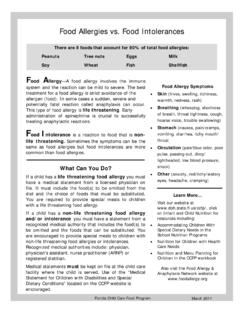
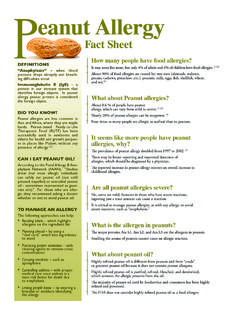
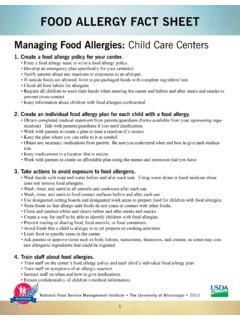
1 food Code fact Sheet #7 W h a t y o u s h o u l d k n o w a b o u t t h e n e w C o d e Allergens FSP_mse/dwo/sk The person in charge must be able to describe the eight major food allergens and the symptoms that a major food allergen could cause in a sensitive individual who has an allergic reaction. With one in 25 Americans re- porting a food allergy, food es- tablishmets are increasingly likely to have customers who re- quire a special meal according to food Allergy & Anaphylaxis Net- work Eight foods account for 90% of all food -allergic reactions. They are: 1.
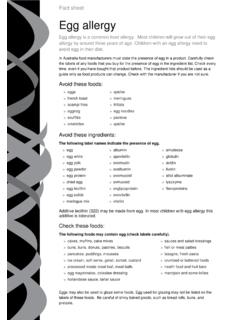
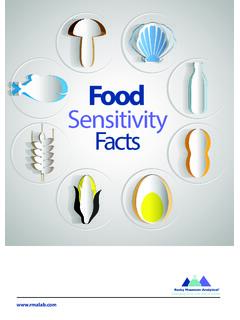
2 Milk ( , butter, yogurt, cheeses, chocolate milk, ice cream and desserts) 2. Egg (anything containing egg) 3. Peanut 4. Tree nuts ( , walnuts, al- monds, hazel, cashew, pista- chio, and pecan) 5. Fish ( , flounder, salmon, bass, and cod) 6. Shellfish ( , crab, lobster, and shrimp) 7. Wheat ( , bread, flour, roux, breading, desserts, soup bases, and some flavor- ings), and 8. Soy ( , tofu and sauce). Risky types of foods include des- serts, sauces, salad bars, buffets, deep fried foods and meals with many ingredients. A food allergy is a potentially seri- ous response to consuming cer- tain foods or food additives. For those who are sensitive, a reac- tion can occur within minutes or hours, and symptoms can range from mild to life threatening.
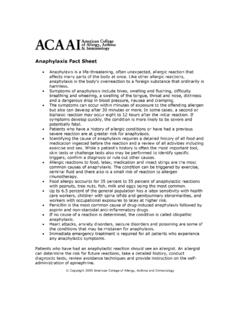
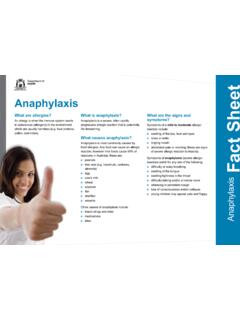
3 Al- lergic reactions can include hives, flushed skin or rash, tingling or itchy sensation in the mouth, face, tongue, or lip swelling, vom- iting and/or diarrhea, abdominal cramps, coughing or wheezing, dizziness and/or lightheadedness, swelling of the throat and vocal cords, and difficulty breathing. For some people, just a trace amount of the offending food can cause an allergic reaction. If a customer is in distress due to a possible allergic reaction, call 911 and stay with the customer until help arrives. food Safety Program Page 1 of 2 food CODE, OAR 603-25-0030, CHAPTER (3); (9); (3) PIC shall demonstrate knowl- edge of: (1)"Major food allergen" means: (a) Milk, egg, fish (such as bass, flounder, cod, and in- cluding crustacean shellfish such as crab, lobster, or shrimp), tree nuts (such as almonds, pecans, or walnuts), wheat, peanuts, and soybeans; or (b) A food ingredient that contains protein derived from a food , as specified in Sub- paragraph (1)(a) of this defini- tion.
4 (2)"Major food allergen" does not include: (a) Any highly refined oil derived from a food specified in Subparagraph (1)(a) of this definition and any ingredient derived from such highly re- fined oil; or (b) Any ingredient that is exempt under the petition or notification process specified in the food Allergen Labeling and Consumer Protection Act of 2004 (Public Law 108-282). (9) Describing FOODS identified as MAJOR food ALLER- GENS and the symptoms that a MAJOR food ALLERGEN could cause in a sensitive indi- vidual who has an allergic reaction. PUBLIC HEALTH REASONS: A food allergy is a specific type of reaction involving the immune system.
5 The body produces an antibody to a food . Once a specific food is ingested and binds with the antibody, the person has an allergic reaction. FSP_mse/ food Safety Program Page 2 of 2