Example: marketing
Forces r,}}l [ oÁ
1 (a) (i) On Fig. 3.1, draw a graph of extension against load for a spring which obeys Hooke’s law. [1] extension 0 0 load Fig. 3.1 (ii)State the word used to describe the energy stored in a spring that has been stretched or
Tags:
Information
Domain:
Source:
Link to this page:
Documents from same domain

Variety of Living Organisms - Save My Exams
cdn.savemyexams.co.ukVariety of Living Organisms Question paper 1 Level IGCSE(9-1) Subject Biology Exam Board Edexcel IGCSE Module Double Award (Paper 1B) Topic The Nature and Variety of Living Organisms Sub-Topic Variety of Living Organisms Booklet Question paper 1 Time Allowed: 78 minutes Score: /65 Percentage: /100 . 9 8 7 6 5 4 3 >90% 80 %70% 60% 50 40 30% 2 1 ...

For more awesome GCSE and A level resources, visit us at ...
cdn.savemyexams.co.uk1 Two balls X and Y are supported by long strings, as shown in Fig. 3.1. XY 4.5 m s–1 2.8 m s–1 Fig. 3.1 The balls are each pulled back and pushed towards each other. When the balls collide at the position shown in Fig. 3.1, the strings are vertical. The balls rebound in opposite directions. Fig. 3.2 shows data for X and Y during this ...

Equilibria - Save My Exams
cdn.savemyexams.co.uk(e) The sulfur dioxide content of wine is most commonly measured by the Ripper Method which involves titration with iodine in the presence of starch as an indicator. SO 2 (aq) + I 2 (aq) + 2H 2 O(l) → 2I –(aq) + SO 4 2–(aq) + 4H+(aq) 3A 50.0 cm sample of wine required 12.35 cm3 of 0.010 mol dm–3 I 2 (aq) for complete reaction with the SO 2.

Mark Scheme (Results) Summer 2019
cdn.savemyexams.co.ukWhere some judgement is required, mark schemes will provide the principles by which marks will be awarded and exemplification may be limited. When examiners are in doubt regarding the application of the mark scheme to a candidate’s response, the team leader must be consulted. Crossed out work should be marked UNLESS the candidate

Covalent Bonding - Save My Exams
cdn.savemyexams.co.ukOxygen atoms form both covalent and ionic bonds. (a) Water is formed when two atoms of hydrogen combine with one atom of oxygen. (i) Draw a dot and cross diagram of a molecule of water. You need only show the electrons in the outer shells. (2) (ii) Explain how the covalent bonds in the water molecule hold the hydrogen and oxygen atoms together. (2)

Characteristics and Classification of Living Organisms
cdn.savemyexams.co.ukClassification of Living Organisms . Question Paper 1 . Subject Biology . Topic Characteristics and Classification of Living Organisms . Booklet Question Paper 1 . Time Allowed: 75 minutes Score: /62 Percentage: /100 . Exam Board CIE Level …

Characteristics and Classification of Living Organisms
cdn.savemyexams.co.ukClassification of Living Organisms . Question Paper 2 . Subject Biology . Topic Characteristics and Classification of Living Organisms . Booklet Question Paper 2 . Time Allowed: 69 minutes Score: /57 Percentage: /100 . Exam Board CIE Level …

Group 1(Alkali metals) Lithium, Sodium, Potassium
cdn.savemyexams.co.uk5 Three aqueous solutions are sodium chloride, sodium iodide and silver nitrate. They are in containers labelled X, Y and Z. It is not known which solution is in each container. The solutions are mixed together as shown in the table, and the observations recorded. Experiment Observation

The Periodic Table: Chemical Periodicity
cdn.savemyexams.co.uk(a)The bar chart below shows the variation of melting points of the elements across Period 3. Na Mg Al Si P S Cl Ar 1800 1600 1400 1200 1000 800 600 400 200 0 melting point / K In each of the following parts of this question you should clearly identify the interactions involved and, where appropriate, explain their relative magnitudes.

For more awesome GCSE and A level resources, visit us at ...
cdn.savemyexams.co.uk4 (a) The drag force D on an object of cross-sectional area A, moving with a speed v through D = 1 2 CρAv 2 a fluid of density ρ, is given by where C is a constant. Show that C has no unit. [2] (b) A raindrop falls vertically from rest.Assume that air resistance is negligible. (i)On Fig. 1.1, sketch a graph to show the variation with time t of the velocity v of the
Related documents

Module 3 Constitutive Equations
web.mit.eduConcept Question 3.1.1. Derivation of Hooke’s law. Derive the Hooke’s law from quadratic strain energy function Starting from the quadratic strain energy function and the de nition for the stress components given in the notes, 1.derive the Generalized Hooke’s law ˙ ij = C ijkl kl. Solution: We start by computing: @ ij @ kl = ik jl

forces & Newton’s laws of motion - Old Dominion University
ww2.odu.edu! springs & Hooke’s law an empirical, approximate law. physics 111N 53 a spring balance! we can use Hooke’s law to build a device to measure weight calibration for this spring every centimeter of extension means 12 N of weight . physics 111N 54 a spring balance

Oscillations - Harvard University
scholar.harvard.edua Hooke’s-law potential is! = p k=m. So for a general potential V(x), the k · V00(x0) equivalence implies that the frequency is! = r V00(x0) m: (3) 1.1.2 Solving for x(t) The long way The usual goal in a physics setup is to solve for x(t). There are (at least) two ways to do this for the force F(x) = ¡kx. The straightforward but messy way ...
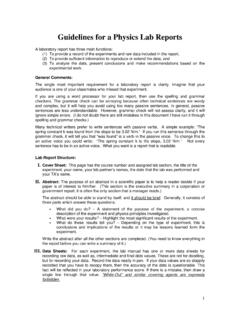
Guidelines for a Physics Lab Reports - Baylor University
www.baylor.eduOct 21, 2005 · Hooke’s Law Experiment Objective: To measure the spring constant of a spring using two different methods. Background: If a weight, W = mg, is hung from one end of an ordinary spring, causing it to stretch a distance x, then an equal and opposite force, F, is created in the spring which opposes the pull of the weight. If W is not so large as to permanently distort …

Chapter 3
www.mit.eduFor our Hooke’s law example earlier, the slope is the spring constant2. 2Since the spring constant k is de ned as F= kx (where is the force and x is the stretch), the slope in Figure3.1ais actually the inverse of the spring constant. 2. Statistics for Research Projects Chapter 3

Hooke’s law in terms of stress and strain is
www.phys.ufl.eduHooke’s law in terms of stress and strain is stress strain In terms of the definitions L L Y A F The constant of proportionality is called the elastic modulus or Young’s modulus. If has the same units as stress. Y is a property of the material used. Hooke’s law holds up to a maximum stress called the proportional limit.
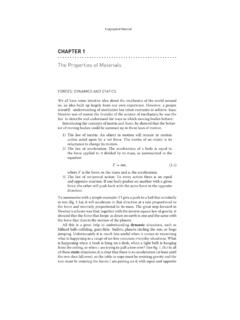
The Properties of Materials - Princeton University
assets.press.princeton.edu1) The law of inertia: An object in motion will remain in motion unless acted upon by a net force. The inertia of an object is its reluctancetochangeitsmotion. 2) The law of acceleration: The acceleration of a body is equal to the force applied to it divided by its mass, as summarized in the equation F = ma, (1.1)