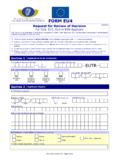
Transcription of Form EU1 Explanatory Leaflet - INIS
1 EU1 Explanatory Leaflet Page 1 of 3 DEPARTMENT OF JUSTICE AND EQUALITY irish NATURALISATION & IMMIGRATION SERVICE Explanatory Leaflet for FORM EU1 APPLICATION FOR A RESIDENCE CARD FOR A QUALIFYING FAMILY MEMBER 01/02/2016 1. Who should apply on Form EU1? Form EU1 is to be completed by each non-EEA national applying for a residence card as a qualifying family member of a European Union citizen residing in the State. A qualifying family member is: 1. the spouse or civil partner of an EU citizen; 2. a direct descendant (child, grandchild etc.)
2 Of an EU citizen or of their spouse or civil partner; or 3. a dependent direct relative in the ascending line (parent, grandparent etc.) of an EU citizen or of their spouse or civil partner. A member of the family of an EU citizen who is not a qualifying family member, including a de facto partner of an EU citizen, should apply on Form EU1A, which is available on the website at 2. Legislation Directive 2004/38/EC on the right of citizens of the Union and their family members to move and reside freely within the territory of the Member States (the "Directive") is given effect in Ireland by the European Communities (Free Movement of Persons) Regulations 2015 (the "Regulations").
3 The Directive and the Regulations apply to citizens of the European Union, citizens of EEA member states and citizens of Switzerland who move to or reside in a Member State other than that of which they are a national, and to their family members who accompany or join them. Under Regulation 7 of the Regulations, the family member of a Union citizen should apply for a residence card if they intend to reside in the State with the Union citizen for more than 3 months. 3. Making sure your application is complete Your application will not be accepted if it is incomplete.
4 No original documents should be sent with your application form, however you may be requested to submit original documents during the course of your application. Any original documents which are requested will be returned to you by Registered Post at the end of the application process. To avoid delay, please observe the following. Make your application on the correct application form, and complete all sections relevant to your application Fill out a separate application form for each non-EEA national seeking a residence card, including each minor childProvide photocopies of all required documents (see Part 10 of this Leaflet )
5 Sign and date both declarations in Section 5 of the form If you are presently unable to provide any of the information or details requested in any of the relevant sections, please explain the reasons in a letter and enclose it with the application form applications should be posted to: EU Treaty Rights Unit Residence Division irish Naturalisation and Immigration Service 13/14 Burgh Quay Dublin 2 If you need to contact the EU Treaty Rights Unit regarding your application you can do so by post at the above address or by email at Please ensure that you include your name, your date of birth, your INIS Person ID number, and your Application ID number in all correspondence.
6 4. Application times Due to the large volume of applications it can take up to 6 months for an application decision to be reached. All applications are dealt with strictly in chronological order of the date of receipt. 5. Changes in circumstances If your circumstances change (such as a change of address, a change in family status, or a change in the activities of the EU citizen) you must inform the EU Treaty Rights Unit in writing immediately. Failure to do so may result in your application being refused. Please be advised that the onus is on you to keep this office updated regarding your circumstances and to resubmit any relevant supporting documents in relation to new circumstances.
7 It should be noted that any person seeking to assert rights or entitlements under the Regulations is under an obligation to ensure that they comply with all appropriate provisions of the Regulations. Failure to comply may result in the person being guilty of an offence or offences as provided for in Regulation 30 of the Regulations, and that person may be liable to the sanctions set out therein. Department of Justice,Equality and LawReformEU1 Explanatory Leaflet Page 2 of 3 6. Immigration status during application process Subject to consideration of your initial application, you may be provided with an immigration stamp in your passport which is valid for the period of the application process only, a maximum of 6 months.
8 This would enable you to remain in the State during this period. Please note that receipt of this endorsement is not an acknowledgement of an entitlement under EU Treaty Rights. This will be determined in due course when your application is either approved or refused. 7. Data Protection notice All information provided will be treated in confidence but may be disclosed to other government departments, agencies, the Garda S och na, local authorities, foreign governments or other bodies strictly for purposes connected to the application.
9 8. Exercise of EU Treaty Rights An EU citizen residing in the State exercises their rights under the Regulations and the Directive by engaging in one of the following activities, as outlined in Regulation 6(2) of the Regulations. An EU citizen must be engaged in one or more of these activities in order for a family member to qualify for a residence card under EU Treaty Rights. A. Employment Where the EU citizen is working for an employer in the State. This may include vocational training programmes and some non-proprietary directors of a registered company.
10 B. Self-employment Where the EU citizen is a sole trader, engaged in a business partnership, or is a proprietary director of a registered company operating in the State. C. Study Where the EU citizen is engaged in a course of study with a qualifying and accredited educational institute or college in the State, while possessing comprehensive sickness/health insurance in respect of themselves, their spouse, and any dependants. D. Involuntary unemployment Where the EU citizen has been employed in the State for more than one year but has become involuntarily unemployed, and has registered as a job-seeker with a relevant office of the Department of Social Protection.