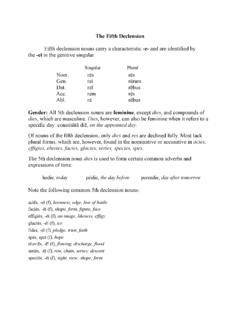
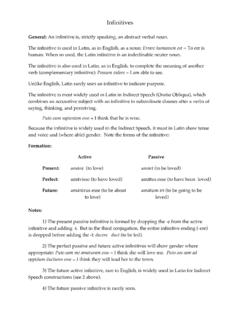
Transcription of FOURTH CONJUGATION VERBS - The Latin Library
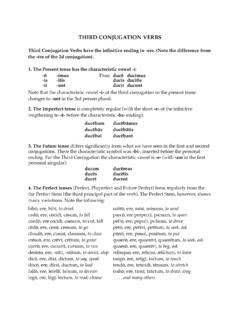
1 FOURTH CONJUGATION VERBSF ourth CONJUGATION VERBS have the infinitive ending in Present Tense:-io-is-it-imus-itis-iuntThus:venio venisvenitvenimusvenitisveniuntNote that -i is the characteristic vowel of the FOURTH CONJUGATION in the present tense,changing to -iu in the 3rd person The Imperfect Tense has regular endings, but with the characteristic -i-:veniebamveniebamusveniebasveniebatis veniebatveniebant3. The Future Tense also shows the characteristic -i-, as well as the future tensesign -e- as in the 3rd CONJUGATION (instead of the -bi- of the lst and 2dconjugations). Note, however -iam in 1st person singular:veniamveniemusveniesvenietisven ietvenient4. The Perfect tenses (Perfect, Pluperfect and Future Perfect) are regular, formingnormally from the stem of the third principal part.
2 Note the following:aperio, -ire, aperui, apertum, to openaudio, -ire, -ivi, -itum, to hearnescio, -ire, nescivi, nescitum, to be ignorant of,not to knowsentio, -ire, sensi, sensum, to feel, know, sensevenio, -ire, veni, ventum, to comeconvenio, -ire, -veni, -ventum, to meet, assemblepervenio, -ire, -veni, -ventum, to arriveThus:Perfect:venivenimusvenistiven istisvenitvenerunt Pluperfect:veneramveneramusvenerasvenera tisveneratvenerantFuture Perfect:venerovenerimusvenerisveneritisv eneritvenerint