Example: marketing
Fractions: multiplying and dividing
1. Multiplying fractions How do we multiply fractions? Let us start with an example. What is 4× 1 3? This means 4 lots of one third. Numerically, we perform the calculation like this: 4× 1 3 = 1 3 + 1 3 + 1 3 + 1 3 = 4 3 = 11 3. The concept is the same as when we multiply whole numbers, for instance 4×5 = 5+5+5+5 = 20.
Tags:
Information
Domain:
Source:
Link to this page:
Documents from same domain
Partial fractions - mathcentre.ac.uk
www.mathcentre.ac.ukPartial fractions mc-TY-partialfractions-2009-1 An algebraic fraction such as 3x+5 2x2 − 5x− 3 can often be broken down into simpler parts called partial fractions.
sigma - mathcentre.ac.uk
www.mathcentre.ac.ukSigma notation Sigma notation is a method used to write out a long sum in a concise way. In this unit we look at ways of using sigma …
Ratios
www.mathcentre.ac.uk1. Introduction A ratio is a way of comparing two or more similar quantities. Ratios can be used to compare costs, weights, sizes and other quantities.
The geometry of a circle - mathcentre.ac.uk
www.mathcentre.ac.ukThe geometry of a circle mc-TY-circles-2009-1 In this unit we find the equation of a circle, when we are told its centre and its radius. There are

evaluation of mathematics support centres - …
www.mathcentre.ac.uk3 Section 1: Executive Summary Mathematics Support Centres (MSCs) have been established at universities in the UK and in a number of other countries
Percentages
www.mathcentre.ac.ukKey Point Percentage means ‘out of 100’, which means ‘divide by 100’. To change a fraction to a percentage, divide the numerator by the denominator and multiply by
Polynomial functions - Mathematics resources
www.mathcentre.ac.uk3. Graphs of polynomial functions We have met some of the basic polynomials already. For example, f(x) = 2is a constant function and f(x) = 2x+1 is a linear function.
Solving inequalities - Mathematics resources
www.mathcentre.ac.ukSolving inequalities mc-TY-inequalities-2009-1 Inequalities are mathematical expressions involving the symbols >, <, ≥ and ≤. To ‘solve’ an
mathcentrecommunityproject - Mathematics …
www.mathcentre.ac.ukmathcentrecommunityproject encouraging academics to share maths support resources AllmccpresourcesarereleasedunderaCreativeCommonslicence community …
7.7 The exponential form - Mathematics resources
www.mathcentre.ac.uk7.7 The exponential form Introduction In addition to the cartesian and polar forms of a complex number there is a third form in which a complex number may be written - the exponential form.
Related documents
GRADE 5 SUPPLEMENT
www.mathlearningcenter.orgH Independent Worksheet 3: More Fractions & Whole Numbers A12.79 Skills & Concepts H Interpret quotients of whole numbers H Write story problems or describe problem situations to match a division expression or equation H Multiply a whole number by a fraction H Solve story problems involving multiplying a whole number or a fraction by a fraction
Rational Chapter 9
www.ncert.nic.inthe number system, from natural numbers to whole numbers and from whole numbers to integers. You were also introduced to fractions. These are numbers of the form numerator denominator, ... By multiplying the numerator and denominator of a rational
Integers, Fractions & Order of Operations
mrrenaudsclass.weebly.comMultiplying & dividing fractions ... Whole numbers that can be positive or negative are called _____. Ex. -5 + 10 Ex. 3 – (-4) MFM1P – Unit 1 – Integers, Fractions and Order of Operations 3 Operations with Integers – Addition & Subtraction When adding or …

Adding Fractions - PVAMU Home
www.pvamu.eduMultiplying Fractions Multiply the tops, multiply the bottoms. There are 3 simple steps to multiply fractions 1. Multiply the top numbers (the numerators). 2. Multiply the bottom numbers (the denominators). 3. Simplify the fraction if needed. Example 1 1 × 2 2 5 Step 1. Multiply the top numbers: 1 × 2 = 1 × 2 = 2 2 5 Step 2. Multiply the ...
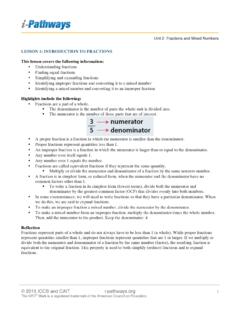
LESSON 1: INTRODUCTION TO FRACTIONS
www.i-pathways.org• The rule for multiplying fractions is if a, b, c, and d are numbers and b and d are not 0, then a b i c d = aic bid Multiply the numerators and multiply the denominators. • When numerators and denominators have common factors when multiplying fractions, cancel the common factors from the numerator and denominator before multiplying.

Finding the Least Common Multiple of Two Numbers LCD 1
www.mathantics.comAdd these ‘un-like’ fractions using the LCD method. In each problem, one bottom number is a multiple of the other. That means you won’t need a table to find the LCM because the bigger bottom number . is. the LCM. You do . not. need to simplify your answers. Fractions. 3 6. 6 5. 8 6. 3 3 + + + = ×. 2. 2 6. 6 1. 1 5. 1 5 3 + + + = ×. 3 3 ...
Fractions Packet - CNM
www.cnm.eduFractions Packet Created by MLC @ 2009 page 6 of 42 4 3 is the reduced form of 8 6. When you divide both the top and bottom numbers of a fraction by the same number, you are dividing by a form of one so the value of the fraction doesn’t

Grade 4 Mathematics
capubstore.blob.core.windows.neturrm ate igh eeve. 4 Name: Fluency and Skills Practice ©Curriculum Associates, LLC Copying is permitted for classroom use. Understanding of Place Value continued 6 Write 841,620 in three different ways. 7 Why do both of these show 27,974? 20,000 1 7,000 1 900 1 70 1 4 27 thousands 1 97 tens 1 4 ones