Transcription of Freezing Point Depression: Determining CaCl2 Van’t Hoff …
1 Freezing Point depression : Determining CaCl2 Van t Hoff Factor Minneapolis Community and Technical College C1152 I. Introduction The physical properties of solutions that depend on the number of dissolved solute particles and not their specific type are known as colligative properties. These include Freezing Point depression , osmotic pressure, and boiling Point elevation. Freezing Point depression occurs when a solute is added to a solvent producing a solution having lower Freezing Point temperature than the pure solvent. The temperature decreases by an amount T given by the following formula: T = i Kf m where Kf is the Freezing Point depression constant (a characteristic of the solvent having units of oC/molal), i is the van t Hoff factor for the dissolved solute and m is the molality of the solution in moles of solute particles per kilogram of solvent (moles/kg).
2 For water, Kf = oC/molal. One way to understand the Freezing Point depression effect is to consider the solute particles as interfering or standing between the solvent particles. With greater space between solvent particles, intermolecular forces are weaker. Consequently, lower temperatures are required to make it possible for solvent particles to approach each other and form the solid. It is also important to understand the role of the van t Hoff factor. For example, a molal solution of NaCl has a particle concentration equal to molal since each formula unit splits into two pieces (Na+ and Cl-) creating twice the number of free floating particles (ions). In this case the ideal van t Hoff factor equals two.
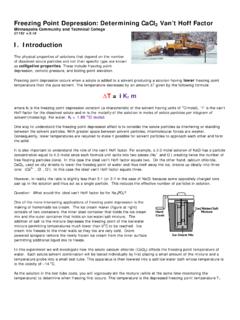
3 On the other hand, calcium chloride, CaCl2 , used on city streets to lower the Freezing Point of water and thus melt away the ice, breaks up ideally into three ions: (Ca2+ , Cl- , Cl-). In this case the ideal van t Hoff factor equals three. However, in reality the ratio is slightly less than 3:1 (or 2:1 in the case of NaCl) because some oppositely charged ions pair up in the solution and thus act as a single particle. This reduces the effective number of particles in solution. Question: What would the ideal van t Hoff factor be for Na3PO4? One of the more interesting applications of Freezing Point depression is the making of homemade ice cream. The ice cream maker (figure at right) consists of two containers: the inner steel container that holds the ice cream mix and the outer container that holds an ice/water/salt mixture.
4 The addition of salt to the mixture depresses the Freezing Point of the ice/water mixture permitting temperatures much lower than 0oC to be reached. Ice cream mix freezes to the inner walls as they too are very cold. Crank powered scrapers remove the newly frozen ice cream from the inner surface permitting additional liquid mix to freeze. In this experiment we will investigate how the solute calcium chloride ( CaCl2 ) affects the Freezing Point temperature of water. Each solute/solvent combination will be tested individually by first placing a small amount of the mixture and a temperature probe into a small test tube. This apparatus is then lowered into a salt/ice/water bath whose temperature is in the vicinity of 14 oC.
5 As the solution in the test tube cools, you will vigorously stir the mixture (while at the same time monitoring the temperature) to determine when Freezing first occurs. This temperature is the depressed Freezing Point temperature Tf. Ideally, the temperature behavior you observe would resemble the figure at right. The initial downward slope represents the cooling of the originally warm solution. The discontinuity or elbow identifies the Point where Freezing first occurs and Tf. In many cases, super cooling may produce solutions that momentarily reach lower temperatures than should be possible (figure at right). When the solution does abruptly begin to freeze, the temperature returns to a Point approximately equal to the initial Freezing Point temperature for a short time.
6 (This approximation becomes less accurate as the amount of super cooling increases.) Freezing will continue as the temperature gradually drops. In this experiment, constant stirring of the test solution minimizes but does not eliminate these super cooling effects. The lab instructor will demonstrate the stirring technique that gets the most consistent temperature measurements. In today s experiment, you will be asked to determine T values for various concentrations of CaCl2 via the following equation: T = Tsolvent T solution We could assume that the Freezing Point of the solvent in this case (tap water) should be 0oC. However, because we won t be calibrating the temperature probe, we cannot make this assumption.
7 Instead, we ll measure the Freezing Point temperature of the tap water and use that value for Tsolvent. Since we ll use the same temperature probe for all measurements (solvent and solutions), the error in each will subtract out as we calculate T. The goal of today s experiment is to experimentally determine a value of the van t Hoff factor for CaCl2 . We ll do this by recognizing that a plot of T versus the product Kf m should give us a straight line. That is: T = i Kf m y = m x + b (..the equation of a straight line) where the slope of the straight line gives us the van t Hoff factor directly. From the T vs Kf m graph, you will perform an Excel trendline analysis to determine the slope of the line and thus a value for the CaCl2 van t Hoff factor.
8 II. MSDS: Chemical Information Calcium Chloride CaCl2 WARNING! CAUSES IRRITATION TO SKIN, EYES AND RESPIRATORY TRACT. HARMFUL IF SWALLOWED OR INHALED. Health Rating: 1 - Slight Flammability Rating: 0 - None Reactivity Rating: 0 - None Contact Rating: 2 - Moderate Lab Protective Equip: GOGGLES; LAB COAT Storage Color Code: Orange (General Storage) Potential Health Effects Inhalation: Granular material does not pose a significant inhalation hazard, but inhalation of dust may cause irritation to the respiratory tract, with symptoms of coughing and shortness of breath. Ingestion: Low toxicity material but ingestion may cause serious irritation of the mucous membrane due to heat of hydrolysis.
9 Large amounts can cause gastrointestinal upset, vomiting, abdominal pain. Skin Contact: Solid may cause mild irritation on dry skin; strong solutions or solid in contact with moist skin may cause severe irritation, even burns. Eye Contact: Hazard may be either mechanical abrasion or, more serious, burns from heat of hydrolysis and chloride irritation. Chronic Exposure: No information found. Aggravation of Pre-existing Conditions: No information found. III. Procedure Today, you will be working with a lab partner. 1. Prepare the following solutions in clean, capped vial. A 5 mL pipette will be provided to measure out approximately 5 grams of water. Determine the actual weight of water dispensed by weighing the vial both before and after the water addition.
10 Weigh the vial again after the CaCl2 has been added. H2O and CaCl2 masses are determined by difference. 2. Solution Solvent Solute 0 tap water None 1 grams tap water gram CaCl2 2 grams tap water gram CaCl2 3 grams tap water gram CaCl2 4 grams tap water gram CaCl2 5 grams tap water gram CaCl2 6 grams tap water gram CaCl2 3. After the solutions above have been prepared, fill a 250 mL beaker with crushed ice. Add a small amount of tap water. Pour a inch layer of ice melting salt on top of the crushed ice and carefully stir with an alcohol thermometer. The temperature of this mixture must at or lower than 14 oC.