Transcription of Frequently Asked Questions about Transitional Care …
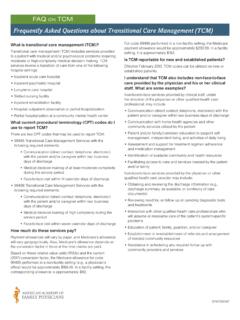
1 Q1: What is Transitional care management (TCM)?A1: TCM includes services provided to a patient whose medical and/or psychosocial problems require moderate or high-complexity medical decision making during transitions in care from an inpatient hospital setting (including acute hospital, rehabilitation hospital, long-term acute care hospital), partial hospital, observation status in a hospital, or skilled nursing facility/nursing facility, to the patient s community setting (home, domicile, rest home, or assisted living).Q2: What current procedural terminology (CPT) codes do I use to report TCM?
2 A2: There are two CPT codes that may be used to report TCM, effective January 1, 2013: 99495 Transitional care management Services with the following required elements: n Communication (direct contact, telephone, electronic) with the patient and/or caregiver within 2 business days of discharge n Medical decision making of at least moderate complexity during the service period n Face-to-face visit within 14 calendar days of discharge 99496 Transitional care management Services with the following required elements.
3 N Communication (direct contact, telephone, electronic) with the patient and/or caregiver within 2 business days of discharge n Medical decision making of high complexity during the service period n Face-to-face visit within 7 calendar days of dischargeQ3: How much are these new services worth?A3: Payment allowances will vary by payer, and Medicare s allowance will vary geographically. Also, Medicare s allowance will depend on the conversion factor in force at the time claims are paid. Based on these RVUs and the current (2012) conversion factor, the Medicare allowance for code 99495 performed in a non-facility setting ( , a physician s office) would be approximately $164; in a facility setting, the corresponding allowance would be approximately $135.
4 For code 99496 performed in a non-facility setting, the Medicare payment allowance would be approximately $ ; when performed in a facility setting, it would be approximately $ : Is TCM reportable for new and established patients?A4: Effectivie February 2013, TCM codes can be utilized on New or established patients. Q5: I understand that TCM also includes a lot of non-face-to-face care provided by the physician and his or her clinical staff. What are some examples?A5: Non-face-to-face services provided by clinical staff, under the direction of the physician or other qualified health care professional, may include.
5 Communication (direct contact, telephone, electronic) with the patient and/or caregiver within 2 business days of discharge Communication with home health agencies and other community services utilized by the patient Patient and/or family/caretaker education to support self- management , independent living, and activities of daily living Assessment and support for treatment regimen adherence and medication management Identification of available community and health resources Facilitating access to care and services needed by the patient and/or family Non-face-to-face services provided by the physician or other qualified health care provider may include.
6 Obtaining and reviewing the discharge information ( , discharge summary, as available, or continuity of care documents) Reviewing need for, or follow-up on, pending diagnostic tests and treatments Interaction with other qualified health care professionals who will assume or reassume care of the patient s system-specific problems Education of patient, family, guardian, and/or caregiver Establishment or reestablishment of referrals and arrangement of needed community resources Assistance in scheduling any required follow-up with community providers and servicesQ6: Why shouldn t I just bill an office visit ( , CPT code 99214) instead?
7 A6: The total RVUs for a 99214 in 2013 will be , which translates to $ using the current (2012) conversion factor. Thus, even 99495 in the office setting will pay almost $60 more than billing an office visit; this additional amount will help compensate the practice for the non-face-to-face physician time and significant clinical staff time that TCM services require over and above the included face-to-face visit. Q7: If the patient needs another visit during the 30 days, can I bill for this?A7: Yes, for an E/M visit you can bill additional visits other than the one bundled E/M visit in the TCM.
8 There are some restriction on what you can bill such as anticoagulation management , home health care certification and other miscellaneous forms. We ve yet to hear how these are getting paid since the earliest bill day would have been January 30, 2013. We are also waiting on CMS to release guidelines on the codes. CMS is expected to release that for us by end of February. Frequently Asked Questions : Transitional care 2013continued on the next page AAFP has posted a form created to help you document the requirements of TCM visits as well as Frequently Asked Questions that are available for your download.
9 TCM was also discussed as part of the Webinar, What s new in Medicare and Medicaid payment in 2013 hosted on Delta Exchange. Q8: May I report a discharge management code and a TCM code?A8: A physician or NPP may report both the discharge code and appropriate TCM code if he or she provided both services. However, Medicare will prohibit billing a discharge day management service on the same day that a required E/M visit is furnished under the CPT TCM codes for the same patient. That is, you cannot count an E/M service as both a discharge day service and the first E/M under the TCM codes.
10 Q9: Does the discharge visit count as the post discharge contact?A9: No, the discharge visit does not count. The initial contact must be made after the patient leaves the hospital. It is to make sure that the patient has the support necessary until they have their face-to-face visit within the 7 or 14 days as prescribed. The initial contact can be phone, e-mail, and text or direct face-to-face. It can be with the patient or their caregiver. Q10: How is a business day defined, and what happens if I can t reach the patient and/or caregiver in that timeframe?A10: For the purposes of TCM, business days are Monday through Friday, except holidays, without respect to normal practice hours or date of notification of discharge.