Transcription of Full Joint Probability Distribution Bayesian Networks
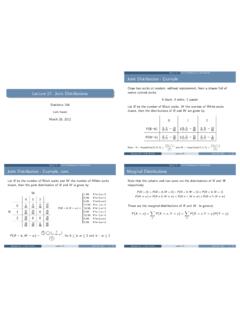
1 1 slide 1 Bayesian Networks (aka Bayes Nets, Belief Nets) (one type of Graphical Model) [based on slides by Jerry Zhu and Andrew Moore] slide 3 Full Joint Probability Distribution Making a Joint Distribution of N variables: all combinations of values (if each variable has k values, there are kN combinations) each combination a Probability should sum to 1 Weather Temperature Prob. Sunny Hot 150/365 Sunny Cold 50/365 Cloudy Hot 40/365 Cloudy Cold 60/365 Rainy Hot 5/365 Rainy Cold 60/365 slide 4 Using the Full Joint Distribution Once you have the Joint Distribution , you can do anything, marginalization: P(E) = rows matching E P(row) , P(Sunny or Hot) = (150+50+40+5)/365 Convince yourself this is the same as P(sunny) + P(hot) - P(sunny and hot) Weather Temperature Prob.
2 Sunny Hot 150/365 Sunny Cold 50/365 Cloudy Hot 40/365 Cloudy Cold 60/365 Rainy Hot 5/365 Rainy Cold 60/365 slide 5 Using the Joint Distribution You can also do inference: rows matching Q AND E P(row) P(Q | E) = rows matching E P(row) Weather Temperature Prob. Sunny Hot 150/365 Sunny Cold 50/365 Cloudy Hot 40/365 Cloudy Cold 60/365 Rainy Hot 5/365 Rainy Cold 60/365 P(Hot | Rainy) 2 slide 6 The Bad News Joint Distribution requires a lot of storage space For N variables, each taking k values, the Joint Distribution has kN numbers (and kN 1 degrees of freedom) It would be nice to use fewer numbers.
3 Bayesian Networks to the rescue! Provides a decomposed representation of the FJPD Encodes a collection of conditional independence relations slide 14 Introducing Bayesian Networks P(B) = P(E) = P(B | E) = P(B) P(A | B, E) = P(A | B, ~E) = P(A | ~B, E) = P(A | ~B, ~E) = B E A P(B) = P(E) = P(A | B, E) = P(A | B, ~E) = P(A | ~B, E) = P(A | ~B, ~E) = One node per random variable Conditional Probability table (CPT) DAG, arcs often direct causation, but don t have to be! slide 15 P(x1,..xN) = i P(xi | parents(xi)) Example: P(~B, E, ~A) = P(~B) P(E) P(~A | ~B, E) Joint Probability from Bayes Net B E A P(B) = P(E) = P(A | B, E) = P(A | B, ~E) = P(A | ~B, E) = P(A | ~B, ~E) = One node per random variable Conditional Probability table (CPT) DAG, arcs often direct causation, but don t have to be!
4 Slide 16 Join Probability with Bayes Net B E A P(B) = P(E) = P(A | B, E) = P(A | B, ~E) = P(A | ~B, E) = P(A | ~B, ~E) = One node per random variable Conditional Probability table (CPT) DAG, arcs often direct causation, but don t have to be! P(x1,..xN) = i P(xi | parents(xi)) Example: P(~B, E, ~A) = P(~B) P(E) P(~A | ~B, E) Recall the chain rule: P(~B, E, ~A) = P(~B) P(E | ~B) P(~A | ~B, E) Our has this independence assumption 3 slide 17 Directed, acylic graphs (DAGs) Nodes = random variables CPT stored at each node quantifies conditional Probability of node s given all its parents Arc from A to B means A has a direct influence on or causes B Evidence for A increases likelihood of B (deductive influence from causes to effects) Evidence for B increases likelihood of A (abductive influence from effects to causes) Encodes conditional independence assumptions Bayesian Networks slide 18 Example A: your alarm sounds J: your neighbor John calls you M.
5 Your other neighbor Mary calls you John and Mary do not communicate (they promised to call you whenever they hear the alarm) What kind of independence do we have? What does the Bayes Net look like? slide 19 Example A: your alarm sounds J: your neighbor John calls you M: your other neighbor Mary calls you John and Mary do not communicate (they promised to call you whenever they hear the alarm) What kind of independence do we have? Conditional independence: P(J,M|A)=P(J|A)P(M|A) What does the Bayes Net look like? A J M slide 20 Examples A: your alarm sounds J: your neighbor John calls you M: your other neighbor Mary calls you John and Mary do not communicate (they promised to call you whenever they hear the alarm) What kind of independence do we have?
6 Conditional independence P(J,M|A)=P(J|A)P(M|A) What does the Bayes Net look like? A J M Our BN: P(A,J,M) = P(A) P(J|A) P(M|A) Chain rule: P(A,J,M) = P(A) P(J|A) P(M|A,J) Our assumes conditional independence, so P(M|A,J) = P(M|A) 4 slide 21 A Simple Bayesian Network Cancer Smoking h ea v ylig h tnoS,, m a lig n a n tb en ig nn o n eC,, P( S=no) P( S=light) P( S=heavy) no light heavy P(C=none|S=) P(C=benign|S=) P(C=malig|S=) slide 22 A Simple Bayesian Network Cancer Smoking h ea v ylig h tnoS,, m a lig n a n tb en ig nn o n eC,, P( S=no) P( S=light) P( S=heavy) no light heavy P(C=none|S=) P(C=benign|S=) P(C=malig|S=)
7 Not needed slide 23 A Bayesian Network Allergy Sinus Headache Runny Nose Flu Evidence variables Diagnostic variables slide 24 A Bayesian Network Smoking Gender Age Cancer Lung Tumor Serum Calcium Exposure to Toxics 5 slide 25 Applications Medical diagnosis systems Manufacturing system diagnosis Computer systems diagnosis Network systems diagnosis Helpdesk troubleshooting Information retrieval Customer modeling slide 26 RICOH Fixit Diagnostics and information retrieval slide 27 FIXIT: Ricoh copy machine slide 28 Online Troubleshooters 6 slide 29 Pathfinder Pathfinder is one of the first BN systems It performs diagnosis of lymph-node diseases It deals with over 60 diseases and 100 symptoms and test results 14,000 probabilities Commercialized by Intellipath and Chapman Hall and applied to about 20 tissue types slide 30 Pathfinder Bayes Net 448 nodes, 906 arcs slide 31 slide 32 7 slide 33 Conditional Independence in Bayes Nets A node is conditionally independent of its non-descendents.
8 Given its parents A node is conditionally independent of all other nodes, given its Markov blanket ( , parents, children, and children s parents) slide 34 Conditional Independence Smoking Gender Age Cancer Cancer is conditionally independent of Age and Gender given Smoking slide 35 More Conditional Independence Cancer Lung Tumor Serum Calcium Serum Calcium is conditionally independent of Lung Tumor, given Cancer P(L | SC, C) = P(L | C) slide 36 2 nodes are unconditionally independent if there s no undirected path between them If there s an undirected path between 2 nodes, then whether or not they are independent or dependent depends on what other evidence is known Interpreting Bayesian Nets A C B A and B are independent given nothing else, but are dependent given C 8 slide 37 Example with 5 Variables B: there s burglary in your house E: there s an earthquake A: your alarm sounds J: your neighbor John calls you M.
9 Your other neighbor Mary calls you B, E are independent J is directly influenced by only A ( , J is conditionally independent of B, E, M, given A) M is directly influenced by only A ( , M is conditionally independent of B, E, J, given A) slide 38 Creating a Bayes Net Step 1: add variables. Choose the variables you want to include in the Bayes Net B: there s burglary in your house E: there s an earthquake A: your alarm sounds J: your neighbor John calls you M: your other neighbor Mary calls you B E A J M slide 39 Creating a Bayes Net Step 2: add directed edges The graph must be acyclic If node X is given parents Q1.
10 , Qm, you are promising that any variable that s not a descendent of X is conditionally independent of X given Q1, .., Qm B: there s burglary in your house E: there s an earthquake A: your alarm sounds J: your neighbor John calls you M: your other neighbor Mary calls you B E A J M slide 40 Creating a Bayes Net Step 3: add CPT s Each table must list P(X | Parent values) for all combinations of parent values B: there s burglary in your house E: there s an earthquake A: your alarm sounds J: your neighbor John calls you M: your other neighbor Mary calls you B E A J M you must specify P(J|A) AND P(J|~A). They don t have to sum to 1!