Transcription of Fun With Atoms and Molecules E - 4-H
1 Page 1 of 2 Getting startedFirst, read the through this lesson and gather necessary materials. If you need moreinformation about the topic, refer to Background Information the ActivityPart 1 Making AtomsGive children the correct number of paper signsneeded to build the following Atoms (see Background Information to understand how theatoms are built) : Atomic number = 1,Atomic Weight = There is one proton, one electron, no neutronsneeded to make this atom. To make an atom of hydrogen, one childholds a Proton sign, while one other childholds an Electron sign and walks in a circlearound the Proton. This is how a hydrogenatom is (Atomic number = 2,Atomic Weight = There are 2 protons, 2 electrons and 2neutrons needed to make this atom. They huddle together to form the atom snucleus, while another child holds anElectron sign and walks in a circle around theProton and Neutron.)
2 This is how a heliumatom is (Atomic number = 8, Atomic Weight = There are 8 protons, 8 electrons and 8 neutrons needed to make this atom. It will take 24 children to model this atom. If there aren t enough children, stand-ins (such as chairs) could be used to mark the Neutrons or Protonsbecause they don t move. To make an atom of oxygen, eight (8) children hold Proton signs, while eight (8)other children hold Neutron signs. They huddle together to form the atom snucleus. Eight other children hold Electron signs. Put them into four (4) pairs, one pair foreach orbit around the nucleus. Each pair of Electrons will be on opposite sides of a circle (so the circle isbalanced). The first pair of Electrons orbits around the nucleus, just like in the Helium andHydrogen Project:ScienceLife Skill:Acquiring and evaluatinginformationNational Education Physical ScienceProperties of Objects andMaterialsSuccess Indicator:Describe the basic structure of Atoms and Involved:20 30 minutesSuggested Group Size:2 30 childrenFu n Wi t h Atoms and MoleculesEverything is made of Atoms and Molecules but they re too small to see.)
3 Chemistryincludes understanding the complex nature of Atoms and Molecules . In thisactivity, children will easily learn the basic structure of Atoms and Molecules by acting out the parts. 24 sheets of paperlabeled and divided as follows: 8 sheets labeled Proton (+) 8 sheets labeled Neutron (Neutral) 8 sheets labeled Electron (-) 3 sheets of paper,labeled separately as follows: O, Oxygen Na, Sodium Cl, Chlorine 2 sheets of paper labeled H, Hydrogen Two hydrogens are walkingalong a street. The first onesays, Hey! I think I lost anelectron! The second onereplies, Are you sure? Thefirst one then says, Yeah, I mPOSITIVE. A neutron walks into arestaurant and orders a finishing the drink theneutron asks the waiter, Howmuch?. The waiter replies, For you, no charge. This online bonus activity is part ofthe Exploring the Treasures of 4-Hcurriculum. 2005, National 4-HCooperative Curriculum System.
4 See 2 of 2 Written by Keith G. it OverShare What You Did: How would you describe what everyone was doing?Process What s Important: How did the way an atom was organized look like theplanets in our solar system? (Electrons are like planets,which orbit around the sun, in this case the Protons andNeutrons.) Discuss: In reality, an atom is so small that it needs to bemagnified millions of times using a special electronmicroscope to see one. Planets are so big but far awaythat they need a telescope to see them well. Anotherdifference is that an atom is actually three dimensional,not two. In other words, the electrons orbit around thenucleus on many levels, not flat like a compact discspins. They form a cloud around the to Your Life: What differences are there?Apply What You Learned: What other things in the world are organized in apattern?An atom, also called an element, is the building block of is so small that it can only be seen magnified by about 15million times using an electron microscope.
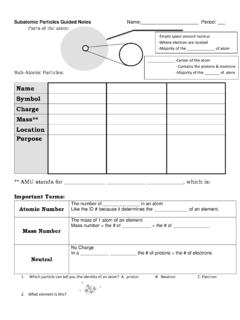
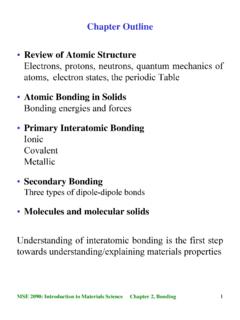
5 An atom is arrangedlike the solar system, with the nucleus like the sun, and electronsorbiting like planets. The nucleus is made up of protons(positively charged) and neutrons (no charge). Electrons(negatively charged) equal the number of protons in the atomic number is the number of protons and, therefore, alsothe number of electrons. It is possible to know the number ofneutrons by subtracting the atomic number (of protons) from theatomic weight (rounded to a whole number). Any slight extraweight is from electrons and other subatomic particles that havevery little mass. Electrons rotate around the nucleus in a shell of orbitals, whichform an electron cloud around the nucleus. Larger Atoms havemore than one electron shell. The number of protons and howfilled the atom is with electrons in its outermost shell, determinesthe properties of an element, such as metallic or non-metallic.
6 A combination of Atoms is called a molecule. Molecules are howatoms are found in nature, such as two hydrogen Atoms combiningwith one oxygen atom to form H2O, known as the types of elements in the world, theirproperties and uses. For example, consider Copper (Cu),Nitrogen (N), Iron (Fe), Uranium (U), Mercury (Hg),Neon (Ne), Calcium (Ca), Gold (Au), Sulfur (S).Science Discovery Series More ChallengesMore ChallengesActivity SummaryEverything in the universe is made up ofchemicals. All chemicals are formed fromatoms and Molecules . There are more than100 known elements. Scientists organizethem in a list called the Periodic Table ofthe Elements. If you wanted to, you could model all the elements the same way! But, Oxygen has another shell with six (6) moreelectrons, so the next pair of Electrons orbit aroundthe nucleus in a wider circle, beyond the first shell ofelectrons orbiting the nucleus.
7 The third pair of Electrons orbit in a still wider circle,beyond the first two orbits as they walk in a circlearound the nucleus. The outermost pair of Electrons orbit around all theothers. This is how an oxygen atom is organized. Oxygen is a much bigger atom than Hydrogen andHelium! But there are others that are much bigger yet!Part 2 Making a combine to form Molecules . For example, water is amolecule made up of two hydrogen Atoms and one oxygenatom. That s why it s called it can get complex to put all the Protons, Neutrons,and Electrons together (children) to act out a molecule, thisprocess can be a sign marked H, Hydrogen to two children and asign marked O, Oxygen to one child. Have the threechildren stand together, with the Oxygen atom forming thebase of a V shape. This is how a water molecule one more example, give a sign marked Na, Sodium toone child and a sign marked Cl, Chlorine to another.
8 Havethem stand together. Ask them if they know what moleculethey made. The molecule is Sodium Chloride. Do they knowwhat that is? (It s table salt!)The Atom