Transcription of FUNCTIONS OF ADJECTIVES
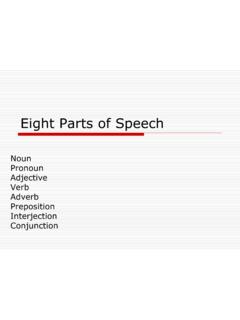
1 FUNCTIONS OF ADJECTIVES Function of ADJECTIVES ADJECTIVES can: Describe feelings or qualities: Examples He is a lonely man They are honest people Give nationality or origin: Examples Pierre is French This clock is German Our house is Victorian Tell more about a thing's characteristics: Examples A wooden table. The knife is sharp. Tell us about age: Examples He's young man My coat is very old Tell us about size and measurement: Examples This is a very long film. John tall man. Tell us about color: Examples Paul wore a red shirt. The sunset was crimson and gold. Tell us about material/what something is made of: Examples It was a wooden table She wore a cotton dress Tell us about shape: Examples A rectangular box A square envelope Express a judgment or a value: Examples A fantastic film Grammar is boring. ADVERBS - FUNCTION Adverbs modify, or tell us more about other words, usually verbs: Examples The bus moved slowly.
2 The bears ate greedily. Sometimes they tell us more about ADJECTIVES : Examples You look absolutely fabulous! They can also modify other adverbs: Examples She played the violin extremely well. You're speaking too quietly. DETERMINERS FUNCTION AND CLASSES OF DETERMINERS Function Determiners are words placed in front of a noun to make it clear what the noun refers to. The word 'people' by itself is a general reference to some group of human beings. If someone says 'these people', we know which group they are talking about, and if they say 'a lot of people' we know how big the group is. 'These' and 'a lot of' are determiners in these sentences. Classes of Determiners There are several classes of determiners: Definite and Indefinite articles the, a, an Demonstratives this, that, these, those Possessives my, your, his, her, its, our, their Quantifiers a few, a little, much, many, a lot of, most, some, any, enough, etc.
3 Numbers one, ten, thirty, etc. Distributives all, both, half, either, neither, each, every Difference words other, another Question words Which, what, whose Defining words which, whose The following words are pre-determiners. They go before determiners, such as articles: such and what, half, rather, quite The Gerund and the Present Participle: 'ING' Form The ' -ing' form of the verb may be a present participle or a gerund. The form is identical, the difference is in the function, or the job the word does in the sentence. The present participle: This is most commonly used: as part of the continuous form of a verb, he is painting; she has been waiting after verbs of movement/position in the pattern: verb + present participle, She sat looking at the sea after verbs of perception in the pattern: verb + object + present participle, We saw him swimming as an adjective, amazing, worrying, exciting, boring The gerund: This always has the same function as a noun (although it looks like a verb), so it can be used: as the subject of the sentence: Eating people is wrong.
4 After prepositions: Can you sneeze without opening your mouth? She is good at painting after certain verbs, like, hate, admit, imagine in compound nouns, a driving lesson, a swimming pool, bird-watching, train-spotting Summary of Verb Tenses in English SUMMARY OF VERB TENSES Present tenses Simple present: She wants a drink. Present continuous: They are walking home. Past tenses Simple past: Peter lived in China in 1965. Past continuous: I was reading when she arrived. Perfect tenses Present Perfect: I have lived here since 1987. Present perfect continuous: I have been living here for years. Past perfect: We had been to see her several times before she visited us. Past perfect continuous: He had been watching her for some time when she turned and smiled. Future perfect: We will have arrived in the States by the time you get this letter.
5 Future perfect continuous: By the end of your course, you will have been studying for five years. Future tenses Simple future: They will go to Italy next week. Future continuous: I will be travelling by train. Conditional tenses Present conditional: If he had the money he would go Present continuous conditional: He would be getting up now if he was in Australia. Perfect conditional: She would have visited me if she had had time. Perfect continuous conditional: I would have been playing tennis if I hadn't broken my arm. Nouns name people, places, and things. Every noun can further be classified as common or proper. A common noun names general items. Go into the kitchen. What do you see? Refrigerator, magnet, stove, window, coffee maker, wallpaper, spatula, sink, plate all of these things are common nouns. Leave the house. Where can you go? Mall, restaurant, school, post office, backyard, beach, pet store, supermarket, gas station all of these places are common nouns.
6 Go to the mall. Who do you see? Teenager, grandmother, salesclerk, police officer, toddler, manager, window dresser, janitor, shoplifter all of these people are common nouns. Common Noun coffee shop waiter jeans sandwich chair arena country fire fighter The important thing to remember is that common nouns are general names. Thus, they are not capitalized unless they begin a sentence or are part of a title. Proper nouns, those that name specific things, do require capitalization. Proper Noun Starbucks Simon Levi's Big Mac Roll-O-Rocker Amway Arena Australia Captain Richard Orsini Here are some sample sentences: Although there are five other chairs in the living room, everyone in Jim's family fights to sit in the puffy new Roll-O-Rocker. Chairs = common noun; Roll-O-Rocker = proper noun. Harriet threw the stale cucumber sandwich in the trash can and fantasized about a Big Mac dripping with special sauce.
7 Sandwich = common noun; Big Mac = proper noun. Because we like an attentive waiter, we always ask for Simon when we eat at Mama Rizzoni's Pizzeria. Waiter = common noun; Simon = proper noun.