Transcription of GAMES TO PLAY WITH ELEMENTARY AGED …
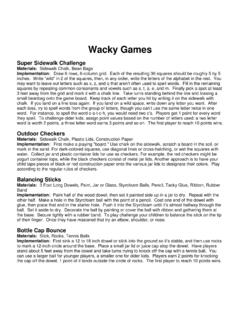
1 GAMES TO play with SCHOOL-AGE CHILDREN AND YOUTH 1. Instant Replay: A good get-acquainted game. Taking turns, each person announces his or her name and does something. Everyone repeats the name and gives back an Instant replay of the action. 2. Find Your Mates: Divide the players into Cows, Ducks and other distinctive barnyard animals. Have them close their eyes and find their fellow animals by sound alone. 3. Quack: Everyone stands with feet slightly apart, hands on knees or ankles, looking back through their legs. Then they start moving backwards. Those who make any contact with another player must say a loud Quack!
2 This game will loosen up a group! 4. Volcano: Form tow concentric circles with each of those in the outer ring standing behind someone in the inner ring, and one person is ( It ) in the center. The volcano begins to erupt when It starts clapping and the inner ring joins in with the clapping. Those in the outer ring must start running madly about shouting in panic. When It stops clapping, the inner ring also stops. Then It and the panicking villagers must each find a spot behind someone in the inner ring. The one without a spot then becomes the new It.
3 5. No Lose Hot Potato: Form a circle and start passing a ball around. Leader counts to a number between one and 12 and shouts Hot Potato! The person caught holding the ball joins the leader, chooses the next number to count to and play starts again. Younger children like counting GAMES like this. 6. Wildlife: Each person has an animal identity, , buffalo, frog, bear, snake or ape. Slap, slap, clap, clap (your animal name).. (Someone else s). Failure to do in the proper moves you to the bottom of the line. Variation: For older youth and smaller groups, each adopts hand signals for his or her animal.
4 7. Exchange Change Game: This is learning game about money combinations, played in groups of two or three. For each group you ll need 15 pennies, 10 dimes, six nickels and a die to start. The first player rolls the die and takes as many coins are rolled on the die (1-6). If they roll a six they can take six pennies, but then they have to exchange 5 pennies for a nickel. After a few times of having to exchange them, they ll learn to pick a nickel and one penny. The next player will do the same and take the allotted amount. On the players next turn they take the allotted coins, but if they end up with five pennies they exchange them for a nickel and if they have two nickels they have to exchange them for one dime.
5 When all the dimes are gone the game is over and all the players count their change. The person with the highest number wins. For the next level of learning money combinations, add 10 quarters. For the third level, add dollar bills. 8. I m Going Hunting: A good memory really helps in this game! Form a circle. One person starts the game by saying, I m going hunting and I m taking an arrow (or something else that starts with the letter A .) The next one in the circle repeats what the first person said and then adds something new starting with the next letter of the alphabet, , I m going hunting and I m taking an arrow and a bow.
6 Keep going around the circle until someone cannot remember what he or she is taking. That person is out. The next person tries to complete the phrase and the game keeps going until only one person is left. Note: You don t have to choose something that you normally take hunting. The object could be something silly or funny. 9. Circle Delight: For this game you need to two balls. Form two teams. The two teams form a single circle with teammates alternating, , every other person is on the same team. A player from Team 1 takes a ball. A player from Team 2 on the opposite side of the circle takes the other ball.
7 At the signal both starters toss balls to their next teammate in the circle, going either clock wise or counter clockwise. Both balls must be going the same direction! The goal is to move the ball from teammate to teammate as quickly as possible, to see if one team can pass its ball so fast that it overtakes the ball from the opposing team. If this happens, the team scores one point and the game begins again. The first team to score three points wins. Note: The ball must be relayed between players of one team without hindering the opposing. 10. Blanket Identification: For this game you will need a blanket that you cannot see through.
8 Two people hold up the blanket as if it were a curtain. Separate the rest of the players into two groups and place them on opposite sides of the blanket. Each team selects one player (very quietly so the other team doesn t hear), who then stands next to the blanket. Make sure the two opposing players cannot see each other. Each team selects a player who will shout out the name of the opposing player standing at the blanket when the blanket is dropped. The one who shouts the name correctly first gets a point. The first team with 10 points wins. Hint: Do not tell them the game or the rules until the blanket is up and the teams are separated.
9