Transcription of GCE Physics A - OCR
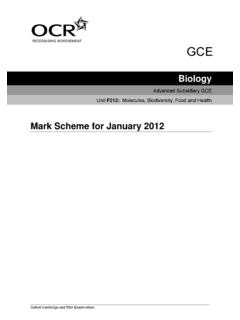
1 Oxford Cambridge and RSA Examinations GCE Physics A unit G484: The newtonian World Advanced GCE Mark Scheme for June 2016 OCR (Oxford Cambridge and RSA) is a leading UK awarding body, providing a wide range of qualifications to meet the needs of candidates of all ages and abilities. OCR qualifications include AS/A Levels, Diplomas, GCSEs, Cambridge Nationals, Cambridge Technicals, Functional Skills, Key Skills, Entry Level qualifications, NVQs and vocational qualifications in areas such as IT, business, languages, teaching/training, administration and secretarial skills. It is also responsible for developing new specifications to meet national requirements and the needs of students and teachers. OCR is a not-for-profit organisation; any surplus made is invested back into the establishment to help towards the development of qualifications and support, which keep pace with the changing needs of today s society. This mark scheme is published as an aid to teachers and students, to indicate the requirements of the examination.
2 It shows the basis on which marks were awarded by examiners. It does not indicate the details of the discussions which took place at an examiners meeting before marking commenced. All examiners are instructed that alternative correct answers and unexpected approaches in candidates scripts must be given marks that fairly reflect the relevant knowledge and skills demonstrated. Mark schemes should be read in conjunction with the published question papers and the report on the examination. OCR will not enter into any discussion or correspondence in connection with this mark scheme. OCR 2016 G484 Mark Scheme June 2016 3 Annotations Annotation Meaning Benefit of doubt given Blank Page Contradiction Incorrect Response Error carried forward Follow through Not answered question Benefit of doubt not given Power of 10 error Omission mark Rounding error Error in number of significant figures Correct Response Arithmetic error Wrong Physics or equation BP G484 Mark Scheme June 2016 4 Annotation Meaning / alternative and acceptable answers for the same marking point (1) Separates marking points reject Answers which are not worthy of credit not Answers which are not worthy of credit IGNORE Statements which are irrelevant ALLOW Answers that can be accepted ( )
3 Words which are not essential to gain credit __ Underlined words must be present in answer to score a mark ecf Error carried forward AW Alternative wording ORA Or reverse argument Subject-specific Marking Instructions All questions should be annotated with ticks where marks are allocated; One tick per mark. G484 Mark Scheme June 2016 5 CATEGORISATION OF MARKS The marking schemes categorise marks on the MACB scheme. B marks: These are awarded as independent marks, which do not depend on other marks. For a B-mark to be scored, the point to which it refers must be seen specifically in the candidate s answers. M marks: These are method marks upon which A-marks (accuracy marks) later depend. For an M-mark to be scored, the point to which it refers must be seen in the candidate s answers. If a candidate fails to score a particular M-mark, then none of the dependent A-marks can be scored. C marks: These are compensatory method marks which can be scored even if the points to which they refer are not written down by the candidate, providing subsequent working gives evidence that they must have known it.
4 For example, if an equation carries a C-mark and the candidate does not write down the actual equation but does correct working which shows the candidate knew the equation, then the C-mark is given. A marks: These are accuracy or answer marks, which either depend on an M-mark, or allow a C-mark to be scored. Note about significant figures: If the data given in a question is to 2 sf, then allow to 2 or more significant figures. If an answer is given to fewer than 2 sf, then penalise once only in the entire paper. Any exception to this rule will be mentioned in the Guidance. Penalise a rounding error in the second significant figure once only in the paper. G484 Mark Scheme June 2016 6 Question Answer Mark Guidance 1 (a) (i) Gradient /It is the acceleration which is the same (for both) (AW) B1 Note: acceleration must be spelled correctly for this mark Allow: Gradient /It is the acceleration and acceleration is free fall/ (1) (ii) Collision is inelastic / kinetic energy is lost (on impact with the ground) Idea that area is height (above ground) / Height (at E) is less (than height of A) (AW) B1 B1 Not heights are not the same Allow: displacement or distance travelled by ball for height (b) (i) )s( ) ( )1( uu B1 Not g = 10 Note answer to 3 sf is (m s-1) (ii) EITHER )(uvmtF and 3107516 tF )( ) ( vv OR a = F/m = 16 (a =123) (upwards positive) v = +123 x 75 x 10-3 = (m s-1) C1 A1 Allow ECF from b(i) Allow v = 14 x (from graph for C1 mark) 23 Note.
5 Answer to 3 sf is )(ms1 Using u = - leads to v = scores 2/2 Using u = + leads to v = 15 scores 1/2 Using equation of motion with a = (1) is WP scores 0/2 (iii) (m)..610892463222 hgvh B1 NO ECF Allow graphical method using h v Allow answer in range (m) Total 7 G484 Mark Scheme June 2016 7 Question Answer Mark Guidance 2 (a) A body will remain at rest or keep travelling at constant velocity unless acted upon by a resultant/net (external) force (AW) B1 Allow speed in straight line for velocity Allow uniform motion (b) (i) They have equal magnitude/ same size They are the same type / nature B1 B1 Allow act for the same time Allow have same line of action (ii) Act in opposite directions Act on different bodies B1 B1 Not act in different directions (c) (i) Avdtdm ( kg s-1) B1 (ii) Weight (of fireman) = 92g / W = 92 x (1) (= 903 N) Vertical component of water force = x 25 sin 55 (= 169 N)
6 Vertical component of contact force = 169 + 903 = 1100 N C1 M1 A1 Allow use of leading to 170 N Note answer to 3 sf is 1070 N Note: a bald 110055sin92 g is WP scores 0/3 Total 9 G484 Mark Scheme June 2016 8 Question Answer Marks Guidance 3 (a) (i) C and F B1 (ii) G B1 (iii) 5 /4 (= ) or (rad) B1 (b) (i) Correct shape graph (by eye) Through the points (-5,0) (0,50) and (5,0) B1 B1 Note : Max KE = 80 30 = 50 (mJ) (ii) ( )vmax = 50 x 10-3 vmax = (m s-1) A1 Allow ECF if max value on y axis from b(i) is used. If max KE = 80 mJ then vmax = = (m s-1) (iii) (s) = ) (2 = 2= 2maxTTTAv C1 A1 Allow C1 mark for correct frequency = (Hz) ECF from b(ii) Using vmax = leads to T = (s) and using vmax = leads to T = (s) Total 8 G484 Mark Scheme June 2016 9 Question Answer Marks Guidance 4 (a) (i) MMGgRM [any subject] C1 A1 If square is omitted from x 106 score is 0/2.
7 Allow 1 mark for M = x 1017 (Mars radius km not converted to m) (ii) )kg( hshghRRgg A1 Allow: h = R so gh = gs Allow use of 2hRGMgh Allow ECF from a(i) b (i) T R with T = period and R = orbital radius B1 Allow separation / distance between bodies Do not allow bald radius for R (ii) (km) DDPDPDRRTTRR [any subject] C1 A1 C1 mark is for correct substitution Allow use of 2234 GMTR with possible ECF from a(i) [Note M= x 1017 leads to x 102 km] (c) Speed will increase Because a decrease in orbital radius results in a decrease in period (by Kepler s law) / Correct reference to centripetal force = gravitational force or v2 =Gm/R M0 A1 Allow GPE decreases so KE increases Total 7 G484 Mark Scheme June 2016 10 Question Answer Marks Guidance 5 (a) (i) 22121 RRMGMF B1 Ignore sign (ii) 211214 TRMF B1 Allow 11212 RMTF (b) Centripetal forces on both star are same magnitude / F1 = F2 / answer to a(ii) equated to similar expression for S2 Correct working starting from correct a(ii)
8 Forces 1221 RRMM M1 A1 A0 Eg 222211 4 4 TRMTRM (c) (m)..(m)..121221212112211212106310844310 21108441108433 RRRRandRRRR C1 A1 A1 Allow 2 marks if R1 = x 1012 (m) And R2 = x 1012 (m) (d) vTRv C1 A1 Possible ECF Mark is for substitution Max 1 mark if T is not converted to seconds ( leads to speed = x 1012) G484 Mark Scheme June 2016 11 Question Answer Marks Guidance (e) (kg) MMRRMGMTMRRvM C1 C1 A1 Allow ECF from (c) and (d) only if method is correct Allow this C1 mark if M1 has been cancelled Special case Use of T2 R3 will lead to x 1033 (kg) this scores 1 mark. Do not allow any ECF if this method is used. Total 12 G484 Mark Scheme June 2016 12 Question Answer Marks Guidance 6 (a) (Gravitational) potential energy is converted to kinetic energy which is then converted to thermal energy/heat Statement that KE to thermal takes place on impact B1 B1 Not GPE to KE and thermal (b) GPE converted in one inversion = x x (= ) GPE converted in 50 inversions = x 50 = (J) (Use of Q =mc to give) = x c x c = 130 (J kg-1 K-1) C1 A1 C1 A1 Allow follow through from their total GPE converted Note answer to 3 sf = 131 (J kg-1 K-1) (c) No heat is absorbed by the tube/ lost (by conduction) through the tube/all heat goes to pellets All the lead falls through the same height or length of tube/ Lead does not bounce on impact B1 B1 Ignore heat lost to surroundings/air (d) Temperature change is the same (Since mass is doubled) (max)
9 GPE/KE/total energy is doubled AND Q is doubled M1 A1 Allow mgh = mc and m is same or m cancels Alternative answer Allow 2 marks for any sensible practical suggestions why T is not the same eg double mass means more lead which will not fall full length of tube. Total 10 G484 Mark Scheme June 2016 13 Question Answer Marks Guidance 7 (a) An ideal gas has zero/negligible (electrical) PE / All internal energy is (translational) KE (translational) KE absolute/ thermodynamic /kelvin temperature B1 B1 Allow internal energy absolute/ thermodynamic /kelvin temperature Note: absolute/thermodynamic/kelvin must be used and spelled correctly for second mark (b) (i) Number of moles of helium = 80 (= 2 x 10⁴) )( VpnRTV C1 C1 A1 Allow use of pV=NkT Use of T in C is WP giving max 1 out of 3 Allow follow through(FT) from an error in n (ii) 2333181041102143 ..remaining moles of numberRTpV = x 103 Number of moles escaping = 2 x 10⁴ - x 103 = x 104 C1 A1 Use of T in C is WP 0/2 Total 7 Oxford Cambridge and RSA Examinations is a Company Limited by Guarantee Registered in England Registered Office; 1 Hills Road, Cambridge, CB1 2EU Registered Company Number: 3484466 OCR is an exempt Charity OCR (Oxford Cambridge and RSA Examinations) Head office Telephone: 01223 552552 Facsimile: 01223 552553 OCR 2016 OCR (Oxford Cambridge and RSA Examinations) 1 Hills Road Cambridge CB1 2EU OCR Customer Contact Centre Education and Learning Telephone: 01223 553998 Facsimile: 01223 552627 Email: For staff training purposes and as part of our quality assurance programme your call may be recorded or monitored