Transcription of General Chemistry
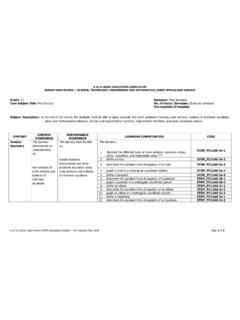
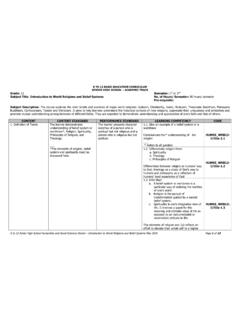
1 K to 12 BASIC EDUCATION CURRICULUM SENIOR HIGH SCHOOL SCIENCE, TECHNOLOGY, ENGINEERING AND MATHEMATICS (STEM) SPECIALIZED SUBJECT K to 12 Senior High School STEM Specialized Subject General Chemistry 1 and 2 August 2016 Page 1 of 23 Grade: 11 Semester: 1st and 2nd Subject Title: General Chemistry 1 & 2 No. of Hours/ Semester: 80 hours per semester Subject Description: Composition, structure, and properties of matter; quantitative principles, kinetics, and energetics of transformations of matter; and fundamental concepts of organic Chemistry CONTENT CONTENT STANDARD PERFORMANCE STANDARD LEARNING COMPETENCIES CODE SCIENCE EQUIPMENT Quarter 1 General Chemistry 1 Matter and its properties 1. the particulate nature of matter 2. states of matter a. the macroscopic b. microscopic view 3. Physical and chemical properties 4.
2 Extensive and intensive properties 5. Ways of classifying matter a. pure substances and mixtures b. elements and compounds c. homogeneous and heterogeneous mixtures 6. Methods of separating mixtures into their component substances The learners demonstrate an understanding of: the properties of matter and its various forms The learners: design using multimedia, demonstrations, or models, a representation or simulation of any of the following: a. atomic structure b. gas behavior c. mass relationships in d. reactions The learners: 1. recognize that substances are made up of smaller particles STEM_GC11MP-Ia-b-1 2. describe and/or make a representation of the arrangement, relative spacing, and relative motion of the particles in each of the three phases of matter STEM_GC11MP-Ia-b-2 3. distinguish between physical and chemical properties and give examples STEM_GC11MP-Ia-b-3 1.
3 Mortar and Pestle, 150 ml. capacity 2. Spatula, porcelain 3. Watch Glass, 90mm 4. distinguish between extensive and intensive properties and give examples STEM_GC11MP-Ia-b-4 1. Mortar and Pestle, 150 ml. Capacity 2. Spatula, porcelain 3. Sulfur Powder, 100 grams / bottle 4. Watch Glass, 90mm 5. use properties of matter to identify substances and to separate them STEM_GC11MP-Ia-b-5 6. differentiate between pure substances and mixtures STEM_GC11MP-Ia-b-6 K to 12 BASIC EDUCATION CURRICULUM SENIOR HIGH SCHOOL SCIENCE, TECHNOLOGY, ENGINEERING AND MATHEMATICS (STEM) SPECIALIZED SUBJECT K to 12 Senior High School STEM Specialized Subject General Chemistry 1 and 2 August 2016 Page 2 of 23 CONTENT CONTENT STANDARD PERFORMANCE STANDARD LEARNING COMPETENCIES CODE SCIENCE EQUIPMENT 7. differentiate between elements and compounds STEM_GC11MP-Ia-b-7 8.
4 Differentiate between homogenous and heterogenous mixtures STEM_GC11MP-Ia-b-8 Laser Pointer, dual-function, with dry cells 9. recognize the formulas of common chemical substances STEM_GC11MP-Ia-b-9 10. describe separation techniques for mixtures and compounds STEM_GC11MP-Ia-b-10 1. Evaporating Dish, 75 ml. capacity 2. Filter Paper, ordinary, 24" x 24" sheet 3. Glass Funnel, 50mm (Top Inside Diameter), length of stem: 75mm 11. compare consumer products on the basis of their components for use, safety, quality and cost STEM_GC11MP-Ia-b-11 12. (LAB) apply simple separation techniques such as distillation, chromatography STEM_GC11MP-Ia-b-12 1. Condenser, Liebig-type with accessories 2. Distilling Flask, 250ml Measurements 1. Accuracy and precision 2. Significant figures in calculations 3. Density measurement 1. the difference between accuracy and precision 2.
5 Different sources of errors in measurements 1. differentiate between precision and accuracy STEM_GC11MT-Ib-13 2. (LAB) Determine the density of liquids & solids STEM_GC11MT-Ib-14 1. Balance, Triple-Beam, 2610-gram capacity 2. Graduated cylinder, 10 ml capacity 3. Graduated cylinder, 100 ml. capacity K to 12 BASIC EDUCATION CURRICULUM SENIOR HIGH SCHOOL SCIENCE, TECHNOLOGY, ENGINEERING AND MATHEMATICS (STEM) SPECIALIZED SUBJECT K to 12 Senior High School STEM Specialized Subject General Chemistry 1 and 2 August 2016 Page 3 of 23 CONTENT CONTENT STANDARD PERFORMANCE STANDARD LEARNING COMPETENCIES CODE SCIENCE EQUIPMENT 4. Hydrometer for heavy liquids 5. Hydrometer for light liquids Atoms, Molecules, and Ions 1. Dalton s atomic theory 2. Basic laws of matter 3. Atomic structure 4. Subatomic particles (protons, electrons, neutrons) 5. Molecules and Ions 6.
6 Chemical Formulas 7. Naming Compounds 1. atomic structure 2. formulas and names of compounds 1. explain how the basic laws of matter (law of conservation of mass, law of constant composition, law of multiple proportion) led to the formulation of Dalton s Atomic Theory STEM_GC11AM-Ic-e-15 2. describe Dalton s Atomic Theory STEM_GC11AM-Ic-e-16 3. differentiate among atomic number, mass number, and isotopes, and which of these distinguishes one element from another STEM_GC11AM-Ic-e-17 4. write isotopic symbols STEM_GC11AM-Ic-e-18 5. recognize common isotopes and their uses. STEM_GC11AM-Ic-e-19 6. differentiate among atoms, molecules, ions and give examples STEM_GC11AM-Ic-e-20 1. Boric Acid, 100 grams / bottle 2. Calcium Chloride, 100 grams / bottle 3. Copper Sulfate, CuSO4, 100 grams / bottle 4. Potassium Chloride, 100 grams / bottle K to 12 BASIC EDUCATION CURRICULUM SENIOR HIGH SCHOOL SCIENCE, TECHNOLOGY, ENGINEERING AND MATHEMATICS (STEM) SPECIALIZED SUBJECT K to 12 Senior High School STEM Specialized Subject General Chemistry 1 and 2 August 2016 Page 4 of 23 CONTENT CONTENT STANDARD PERFORMANCE STANDARD LEARNING COMPETENCIES CODE SCIENCE EQUIPMENT 7.
7 Represent compounds using chemical formulas, structural formulas and models STEM_GC11AM-Ic-e-21 8. give the similarities and differences between the empirical formula and molecular formula of a compound STEM_GC11AM-Ic-e-22 9. name compounds given their formula and write formula given the name of the compound STEM_GC11AM-Ic-e-23 10. (LAB) Practice chemical nomenclature: writing the chemical formulas of ionic compounds; naming ionic compounds from formulas STEM_GC11AM-Ic-e-24 Stoichiometry 1. Atomic mass 2. Avogadro s number 3. The mole concept 1. the mole concept in relation to Avogadro s number and mass 1. explain relative atomic mass and average atomic mass STEM_GC11S-Ie-25 2. define a mole STEM_GC11S-Ie-26 3. illustrate Avogadro s number with examples STEM_GC11S-Ie-27 4. determine the molar mass of elements and compounds STEM_GC11S-Ie-28 5. calculate the mass of a given number of moles of an element or compound or vice versa STEM_GC11S-Ie-29 6.
8 Calculate the mass of a given number of particles of an element or compound or vice versa STEM_GC11S-Ie-30 K to 12 BASIC EDUCATION CURRICULUM SENIOR HIGH SCHOOL SCIENCE, TECHNOLOGY, ENGINEERING AND MATHEMATICS (STEM) SPECIALIZED SUBJECT K to 12 Senior High School STEM Specialized Subject General Chemistry 1 and 2 August 2016 Page 5 of 23 CONTENT CONTENT STANDARD PERFORMANCE STANDARD LEARNING COMPETENCIES CODE SCIENCE EQUIPMENT 4. Percent composition and chemical formulas 2. the relationship of percent composition and chemical formula 1. calculate the percent composition of a compound from its formula STEM_GC11PC-If-31 2. calculate the empirical formula from the percent composition of a compound STEM_GC11PC-If-32 3. calculate molecular formula given molar mass STEM_GC11PC-If-33 5. Chemical reactions and chemical equations 6. Types of chemical reactions in aqueous solutions 3.
9 The use of chemical formulas to represent chemical reactions 4. write equations for chemical reactions and balance the equations STEM_GC11CR-If-g-34 5. interpret the meaning of a balanced chemical reaction in terms of the law of conservation of mass STEM_GC11CR-If-g-35 6. describe evidences that a chemical reaction has occurred STEM_GC11CR-If-g-36 1. Alcohol Burner, glass, 150ml. capacity 2. Alcohol Thermometer, -20 C to 110 C 3. Beaker, 100 ml, borosilicate 4. Beaker, 250 ml, borosilicate 5. Beaker, 50 ml, borosilicate 6. Beaker, 500 ml, borosilicate 7. Bunsen Burner, gas-type K to 12 BASIC EDUCATION CURRICULUM SENIOR HIGH SCHOOL SCIENCE, TECHNOLOGY, ENGINEERING AND MATHEMATICS (STEM) SPECIALIZED SUBJECT K to 12 Senior High School STEM Specialized Subject General Chemistry 1 and 2 August 2016 Page 6 of 23 CONTENT CONTENT STANDARD PERFORMANCE STANDARD LEARNING COMPETENCIES CODE SCIENCE EQUIPMENT 8.
10 Ferrous Sulfate,100 grams / bottle 9. LPG tank with gas, 11 kg. capacity, regulator & hose assembly 10. Magnesium Ribbon, minimum of 1 meter/roll 11. Potassium Iodide, KI, 100 grams / bottle 12. Reagent Bottle, narrow mouth amber color (250ml. Capacity) 13. Reagent Bottle, wide mouth colorless (250ml. Cap.) 14. Stirring Rod, 6mm x 250mm long 15. Sodium sulfate, 100 grams / bottle 16. Sulfuric Acid, 500 ml / bottle 17. Test Tube, 16mm x 150mm long, borosilicate 18. Vials, screw neck vial with cover, 25mL 19. Vials, screw neck vial with K to 12 BASIC EDUCATION CURRICULUM SENIOR HIGH SCHOOL SCIENCE, TECHNOLOGY, ENGINEERING AND MATHEMATICS (STEM) SPECIALIZED SUBJECT K to 12 Senior High School STEM Specialized Subject General Chemistry 1 and 2 August 2016 Page 7 of 23 CONTENT CONTENT STANDARD PERFORMANCE STANDARD LEARNING COMPETENCIES CODE SCIENCE EQUIPMENT cover, 50mL 20.