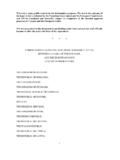
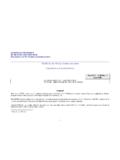
Transcription of GENERAL RULES OF INTERPRETATION
1 Harmonized Tariff Schedule of the United States (2009) Supp. 1 Annotated for Statistical Reporting PurposesGN RULES OF INTERPRETATIONC lassification of goods in the tariff schedule shall be governed by the following table of contents, alphabetical index, and titles of sections, chapters and sub-chapters are provided for ease of reference only;for legal purposes, classification shall be determined according to the terms of the headings and any relative section or chapternotes and, provided such headings or notes do not otherwise require, according to the following provisions:2.(a)Any reference in a heading to an article shall be taken to include a reference to that article incomplete or unfinished, providedthat, as entered, the incomplete or unfinished article has the essential character of the complete or finished article.
2 It shallalso include a reference to that article complete or finished (or falling to be classified as complete or finished by virtue of thisrule), entered unassembled or disassembled.(b)Any reference in a heading to a material or substance shall be taken to include a reference to mixtures or combinations ofthat material or substance with other materials or substances. Any reference to goods of a given material or substance shallbe taken to include a reference to goods consisting wholly or partly of such material or substance. The classification ofgoods consisting of more than one material or substance shall be according to the principles of rule , by application of rule 2(b) or for any other reason, goods are, prima facie, classifiable under two or more headings,classification shall be effected as follows:(a)The heading which provides the most specific description shall be preferred to headings providing a more generaldescription.
3 However, when two or more headings each refer to part only of the materials or substances contained in mixedor composite goods or to part only of the items in a set put up for retail sale, those headings are to be regarded as equallyspecific in relation to those goods, even if one of them gives a more complete or precise description of the goods.(b)Mixtures, composite goods consisting of different materials or made up of different components, and goods put up in sets forretail sale, which cannot be classified by reference to 3(a), shall be classified as if they consisted of the material orcomponent which gives them their essential character, insofar as this criterion is applicable.(c)When goods cannot be classified by reference to 3(a) or 3(b), they shall be classified under the heading which occurs last innumerical order among those which equally merit which cannot be classified in accordance with the above RULES shall be classified under the heading appropriate to thegoods to which they are most addition to the foregoing provisions, the following RULES shall apply in respect of the goods referred to therein:(a)Camera cases, musical instrument cases, gun cases, drawing instrument cases, necklace cases and similar containers,specially shaped or fitted to contain a specific article or set of articles, suitable for long-term use and entered with the articlesfor which they are intended, shall be classified with such articles when of a kind normally sold therewith.
4 This rule does not,however, apply to containers which give the whole its essential character;(b)Subject to the provisions of rule 5(a) above, packing materials and packing containers entered with the goods therein shallbe classified with the goods if they are of a kind normally used for packing such goods. However, this provision is not bindingwhen such packing materials or packing containers are clearly suitable for repetitive legal purposes, the classification of goods in the subheadings of a heading shall be determined according to the terms of thosesubheadings and any related subheading notes and, mutatis mutandis, to the above RULES , on the understanding that onlysubheadings at the same level are comparable. For the purposes of this rule, the relative section, chapter and subchapter notesalso apply, unless the context otherwise Tariff Schedule of the United States (2009) Supp.
5 1 Annotated for Statistical Reporting PurposesGN RULES OF INTERPRETATION1. In the absence of special language or context which otherwise requires--(a)a tariff classification controlled by use (other than actual use) is to be determined in accordance with the use in the United Statesat, or immediately prior to, the date of importation, of goods of that class or kind to which the imported goods belong, and thecontrolling use is the principal use;(b)a tariff classification controlled by the actual use to which the imported goods are put in the United States is satisfied only if suchuse is intended at the time of importation, the goods are so used and proof thereof is furnished within 3 years after the date thegoods are entered;(c)a provision for parts of an article covers products solely or principally used as a part of such articles but a provision for "parts" or"parts and accessories" shall not prevail over a specific provision for such part or accessory; and(d)the principles of section XI regarding mixtures of two or more textile materials shall apply to the classification of goods in anyprovision in which a textile material is named.
6 [COMPILER S NOTE: The RULES of origin provisions for some United States free trade agreements(other than those for the United States-Australia Free Trade Agreement, the United States-Singapore Free Trade Agreement and the United States-Chile Free Trade Agreement, which doreflect proclaimed rectifications) have NOT been updated to reflect changes to the tariff scheduleresulting from Presidential Proclamation 8097, which modified the HTS to reflect World CustomsOrganization changes to the Harmonized Commodity Description and Coding System and waseffective as of Feb. 3, 2007. You will therefore see tariff heading/subheading numbers in thepertinent GENERAL notes which do not correspond to numbers in chapters 1 through 97 or to otherportions of the same GENERAL notes. Contact officials of Customs and Border Protection inorder to ascertain whether affected goods qualify for FTA treatment.]
7 ]Harmonized Tariff Schedule of the United States (2009) Supp. 1 Annotated for Statistical Reporting PurposesGN NOTES1. Tariff Treatment of Imported Goods and of Vessel Equipments, Parts and Repairs. All goods provided for in this schedule and importedinto the customs territory of the United States from outside thereof, and all vessel equipments, parts, materials and repairs covered bythe provisions of subchapter XVIII to chapter 98 of this schedule, are subject to duty or exempt therefrom as prescribed in GENERAL notes3 through 29, Customs Territory of the United States. The term "customs territory of the United States", as used in the tariff schedule, includes onlythe States, the District of Columbia and Puerto Rates of Duty. The rates of duty in the "Rates of Duty" columns designated 1 (" GENERAL " and "Special") and 2 of the tariff schedule applyto goods imported into the customs territory of the United States as hereinafter provided in this note:(a) Rate of Duty Column 1.
8 (i)Except as provided in subparagraph (iv) of this paragraph, the rates of duty in column 1 are rates which are applicable to allproducts other than those of countries enumerated in paragraph (b) of this note. Column 1 is divided into two subcolumns," GENERAL " and "Special", which are applicable as provided below. (ii)The " GENERAL " subcolumn sets forth the GENERAL or normal trade relations (NTR) rates which are applicable to products ofthose countries described in subparagraph (i) above which are not entitled to special tariff treatment as set forth below. (iii)The "Special" subcolumn reflects rates of duty under one or more special tariff treatment programs described in paragraph(c) of this note and identified in parentheses immediately following the duty rate specified in such subcolumn. These ratesapply to those products which are properly classified under a provision for which a special rate is indicated and for which allof the legal requirements for eligibility for such program or programs have been met.
9 Where a product is eligible for specialtreatment under more than one program, the lowest rate of duty provided for any applicable program shall be imposed. Where no special rate of duty is provided for a provision, or where the country from which a product otherwise eligible forspecial treatment was imported is not designated as a beneficiary country under a program appearing with the appropriateprovision, the rates of duty in the " GENERAL " subcolumn of column 1 shall apply. (iv)Products of Insular Possessions.(A)Except as provided in additional note 5 of chapter 91 and except as provided in additional note 2 of chapter96, and except as provided in section 423 of the Tax Reform Act of 1986, and additional note 3(e) of chapter 71,goods imported from insular possessions of the United States which are outside the customs territory of the UnitedStates are subject to the rates of duty set forth in column 1 of the tariff schedule, except that all such goods the growthor product of any such possession, or manufactured or produced in any such possession from materials the growth,product or manufacture of any such possession or of the customs territory of the United States, or of both, which do notcontain foreign materials to the value of more than 70 percent of their total value (or more than 50 percent of their totalvalue with respect to goods described in section 213(b) of the Caribbean Basin Economic Recovery Act)
10 , coming to thecustoms territory of the United States directly from any such possession, and all goods previously imported into thecustoms territory of the United States with payment of all applicable duties and taxes imposed upon or by reason ofimportation which were shipped from the United States, without remission, refund or drawback of such duties or taxes,directly to the possession from which they are being returned by direct shipment, are exempt from duty.(B)In determining whether goods produced or manufactured in any such insular possession contain foreign materials tothe value of more than 70 percent, no material shall be considered foreign which either--(1) at the time such goods are entered, or(2) at the time such material is imported into the insular possession,may be imported into the customs territory from a foreign country, and entered free of duty; except that no goodscontaining material to which (2) of this subparagraph applies shall be exempt from duty under subparagraph (A) unlessadequate documentation is supplied to show that the material has been incorporated into such goods during the18-month period after the date on which such material is imported into the insular possession.