Transcription of Geometry Definitions - El Paso Community College
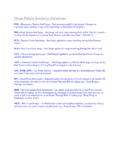
1 Geometry Definitions Line: Is determined by two distinct end points and extends Ray: A part of a line that has only one endpoint. indefinitely in both directions. End Point: Is the point at which a ray starts. Perpendicular Lines: Intersecting lines that form right angles. Angles: Two rays joined at the same end point. Vertex: Is the point at which the two rays meet. Sides: What the sides of the ray are called. Parallel Lines: Lines that never intersect or cross each other. Right Angles: an angle that is exactly 90 degrees Straight Angle: One angle that equals 180 Basically, a straight angle is a straight line. Vertical Angles: Adjacent Angles: Vertical angles are opposite angles.
2 They will form two acute angles and Adjacent Angles are two angles that share a common two obtuse angles. side. They are also supplementary angles, which means, the measure of the sums of their angles must d and b are vertical obtuse angle. They have the same measure equal 180 degrees. a and c are vertical acute angles. They have the same measure Adjacent Angles a and d a and b b and c d and c Acute Angles: Complementary Angles: one angle between 0 and 90 degrees. Two angles whose measures add up to 90o. Obtuse Angles: Supplementary Angles: Two angles whose One angle between 90 and 180 degrees. measures add up to 180 . Transversal Alternate Interior Angles Two parallel lines intersected by a transversal form corresponding For any pair of parallel lines intersected by a third pairs of angles that are congruent.
3 Several types of angles are line, the transversal, alternate interior angles are formed: alternate interior, alternate exterior , corresponding and formed. Alternate interior angles have the same vertical angles. degree. o r p q Triangles: The sum of the interior angles of a triangle equal 180 Saved: Geometry Definitions Lines & Angles-1. 1. Similar Two polygons are similar if their corresponding sides are proportional. Similar Figures have the same shape, but not necessarily the same size. For Example: The triangles below are similar. Therefore, the measures of their corresponding angles are equal, and the corresponding sides are in proportion.
4 Side AB corresponds to side DE. Side AC corresponds to side DF. Side BC corresponds to side EF. AB AC 6 10.. DE DF n 5. 6 x 5 10n 3 n {the length of side DE is 3cm}. Alternate Exterior Angles For any pair of parallel lines 1 and 2, that are both intersected by a third line, such as line 3 in the diagram below, angle A and angle D are called alternate exterior angles. Alternate exterior angles have the same degree measurement. Angle B and angle C are also alternate exterior angles. n o m t Corresponding Angles Corresponding angles are two angles that are on the same side of the transversal. Both are acute angles or both are obtuse angles.
5 They have the same measure. Corresponding Angles Study Tip: To help you remember this rule, think of corresponding angles as top-top and bottom-bottom Top Angles m q Bottom Angles o s Top Angles n r Bottom Angles p t Corresponding Interior Angles Angles on the same side of the transversal, and inside the parallel lines are supplementary angles, and therefore the sum of their measures equals 180 degrees. o q are corresponding interior angles p r are corresponding interior angles Saved: Geometry Definitions Lines & Angles-1. 2.