Transcription of Geometry Notes - ASU
1 Geometry Notes Perimeter and Area Page 1 of 57 PERIMETER AND AREA Objectives: After completing this section, you should be able to do the following: Calculate the area of given geometric figures. Calculate the perimeter of given geometric figures. Use the Pythagorean Theorem to find the lengths of a side of a right triangle. Solve word problems involving perimeter, area, and/or right triangles. Vocabulary: As you read, you should be looking for the following vocabulary words and their definitions: polygon perimeter area trapezoid parallelogram triangle rectangle circle circumference radius diameter legs (of a right triangle) hypotenuse Formulas: You should be looking for the following formulas as you read: area of a rectangle area of a parallelogram area of a trapezoid area of a triangle Heron s Formula (for area of a triangle) circumference of a circle area of a circle Pythagorean Theorem Geometry Notes Perimeter and Area Page 2 of 57 We are going to start our study of Geometry with two-dimensional figures.
2 We will look at the one-dimensional distance around the figure and the two-dimensional space covered by the figure. The perimeter of a shape is defined as the distance around the shape. Since we usually discuss the perimeter of polygons (closed plane figures whose sides are straight line segment), we are able to calculate perimeter by just adding up the lengths of each of the sides. When we talk about the perimeter of a circle, we call it by the special name of circumference. Since we don t have straight sides to add up for the circumference (perimeter) of a circle, we have a formula for calculating this. Example 1: Find the perimeter of the figure below 8 11 14 4 Solution: It is tempting to just start adding of the numbers given together, but that will not give us the perimeter. The reason that it will not is that this figure has SIX sides and we are only given four numbers. We must first determine the lengths of the two sides that are not labeled before we can find the perimeter.
3 Let s look at the figure again to find the lengths of the other sides. Circumference (Perimeter) of a Circle rC 2= r = radius of the circle = the number that is approximated by perimeter circumference Geometry Notes Perimeter and Area Page 3 of 57 Since our figure has all right angles, we are able to determine the length of the sides whose length is not currently printed. Let s start with the vertical sides. Looking at the image below, we can see that the length indicated by the red bracket is the same as the length of the vertical side whose length is 4 units. This means that we can calculate the length of the green segment by subtracting 4 from 11. This means that the green segment is 7 units. 8 11 14 4 4 11 4 = 7 In a similar manner, we can calculate the length of the other missing side using 6814= . This gives us the lengths of all the sides as shown in the figure below. 8 11 14 4 7 6 Now that we have all the lengths of the sides, we can simply calculate the perimeter by adding the lengths together to get.
4 5067811144=+++++ Since perimeters are just the lengths of lines, the perimeter would be 50 units. area Geometry Notes Perimeter and Area Page 4 of 57 The area of a shape is defined as the number of square units that cover a closed figure. For most of the shape that we will be dealing with there is a formula for calculating the area. In some cases, our shapes will be made up of more than a single shape. In calculating the area of such shapes, we can just add the area of each of the single shapes together. We will start with the formula for the area of a rectangle. Recall that a rectangle is a quadrilateral with opposite sides parallel and right interior angles. Example 2: Find the area of the figure below 8 11 14 4 Solution: This figure is not a single rectangle. It can, however, be broken up into two rectangles. We then will need to find the area of each of the rectangles and add them together to calculate the area of the whole figure.
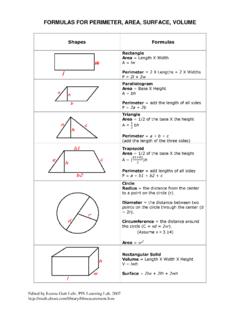
5 There is more than one way to break this figure into rectangles. We will only illustrate one below. Area of a Rectangle bhA= b = the base of the rectangle h = the height of the rectangle rectangle Geometry Notes Perimeter and Area Page 5 of 57 8 11 14 4 8 11 14 4 8 11 14 4 We have shown above that we can break the shape up into a red rectangle (figure on left) and a green rectangle (figure on right). We have the lengths of both sides of the red rectangle. It does not matter which one we call the base and which we call the height. The area of the red rectangle is 56144= ==bhA We have to do a little more work to find the area of the green rectangle. We know that the length of one of the sides is 8 units. We had to find the length of the other side of the green rectangle when we calculated the perimeter in Example 1 above. Its length was 7 units. 8 11 14 4 4 11 4 = 7 Thus the area of the green rectangle is 5678= ==bhA.
6 Thus the area of the whole figure is 1125656rectanglegreenofarearectangleredo farea=+=+. In Geometry Notes Perimeter and Area Page 6 of 57 the process of calculating the area, we multiplied units times units. This will produce a final reading of square units (or units squared). Thus the area of the figure is 112 square units. This fits well with the definition of area which is the number of square units that will cover a closed figure. Our next formula will be for the area of a parallelogram. A parallelogram is a quadrilateral with opposite sides parallel. You will notice that this is the same as the formula for the area of a rectangle. A rectangle is just a special type of parallelogram. The height of a parallelogram is a segment that connects the top of the parallelogram and the base of the parallelogram and is perpendicular to both the top and the base. In the case of a rectangle, this is the same as one of the sides of the rectangle that is perpendicular to the base.
7 Example 3: Find the area of the figure below 15 6 15 Solution: In this figure, the base of the parallelogram is 15 units and the height is 6 units. This mean that we only need to multiply to find the area of 90615= ==bhA square units. You should notice that we cannot find the perimeter of this figure since we do not have the lengths of all of the sides, and we have no Area of a Parallelogram bhA= b = the base of the parallelogram h = the height of the parallelogram parallelogram Geometry Notes Perimeter and Area Page 7 of 57 way to figure out the lengths of the other two sides that are not given. Our next formula will be for the area of a trapezoid. A trapezoid is a quadrilateral that has one pair of sides which are parallel. These two sides are called the bases of the trapezoid. The height of a trapezoid is a segment that connects the one base of the trapezoid and the other base of the trapezoid and is perpendicular to both of the bases.
8 Example 4: Find the area of the figure 121 45 20 Solution: For this trapezoid, the bases are shown as the top and the bottom of the figure. The lengths of these sides are 45 and 121 units. It does not matter which of these we say is b1 and which is b2. The height of the trapezoid is 20 units. When we plug all this into the formula, we get ()()16602045121212121=+=+=hbbA square units. Area of a Trapezoid ()hbbA2121+= b1 = the one base of the trapezoid b2 = the other base of the trapezoid h = the height of the trapezoid trapezoid Geometry Notes Perimeter and Area Page 8 of 57 Our next formulas will be for finding the area of a triangle (a three-sided polygon). We will have more than one formula for this since there are different situations that can come up which will require different formulas The height of a triangle is the perpendicular distance from any vertex of a triangle to the side opposite that vertex.
9 In other words the height of triangle is a segment that goes from the vertex of the triangle opposite the base to the base (or an extension of the base) that is perpendicular to the base (or an extension of the base). Notice that in this description of the height of a triangle, we had to include the words or an extension of the base . This is required because the height of a triangle does not always fall within the sides of the triangle. Another thing to note is that any side of the triangle can be a base. You want to pick the base so that you will have the length of the base and also the length of the height to that base. The base does not need to be the bottom of the triangle. You will notice that we can still find the area of a triangle if we don t have its height. This can be done in the case where we have the lengths of all the sides of the triangle. In this case, we would use Heron s formula. Area of a Triangle For a triangle with a base and height bhA21= b = the base of the triangle h = the height of the triangle Heron s Formula for a triangle with only sides ))()((csbsassA = a = one side of the triangle b = another side of the triangle c = the third side of the triangle s = (a + b + c) triangle Geometry Notes Perimeter and Area Page 9 of 57 Example 5: Find the area of the figure.
10 6 Solution: Notice that in this figure has a dashed line that is shown to be perpendicular to the side that is units in length. This is how we indicate the height of the triangle (the dashed line) and the base of the triangle (the side that the dashed line is perpendicular to). That means we have both the height and the base of this triangle, so we can just plug these numbers into the formula to get ) )( (2121===bhA square units. Notice that the number 6 is given as the length of one of the sides of the triangle. This side is not a height of the triangle since it is not perpendicular to another side of the triangle. It is also not a base of the triangle, since there is no indication of the perpendicular distance between that side and the opposite vertex. This means that it is not used in the calculation of the area of the triangle. Example 6: Find the area of the figure. Geometry Notes Perimeter and Area Page 10 of 57 Solution: In this figure there are two dashed lines.